
US Private Credit Default Rate Hits Historic High, Pressure Mounts in Industrial and Healthcare Sectors, While Software Industry Remains Relatively Resilient

A report released by Fitch Ratings on Thursday shows that in the second quarter of this year, the default rate in the US private credit market continued to rise, reaching a historic high. This reflects that the high-interest-rate environment continues to put pressure on highly leveraged borrowers.
Zhitong Finance APP reports that Fitch Ratings released a report on Thursday showing that in the second quarter of this year, the US private credit market default rate continued to climb, reaching a record high and reflecting the ongoing pressure that a high interest rate environment places on highly leveraged borrowers.
According to data tracked by Fitch on approximately 1,300 US private credit borrowers, the private credit default rate over the past 12 months rose to 6% by the end of the second quarter, above the previous record high of 5.7% in the first quarter. In the second quarter, Fitch recorded a total of 32 private credit default events involving 20 new defaulting companies, bringing the cumulative number of defaulting firms to 84.
The report noted that among the default events in the second quarter, loan maturity extensions have replaced payment-in-kind interest and interest payment deferrals as the main form of default. Of the 32 default events recorded in the second quarter, more than half involved various forms of debt extension, indicating that an increasing number of borrowers are relieving short-term debt repayment pressure by prolonging their debt maturities.
Lyle Margolis, Head of North American Private Credit at Fitch, said that earlier in the year, the market had expected the Federal Reserve to start a rate-cutting cycle, and with a revival in M&A activity, the private credit default rate was expected to gradually fall. However, as the market is now once again pricing in rate hike expectations and the M&A market remains sluggish, the private credit default rate is expected to remain elevated for the remainder of this year.
By industry, industrials and manufacturing have become the sectors with the highest default risk. By the end of the second quarter, the private credit default rate in this sector had risen sharply to 10.4%, up from 5.9% in the first quarter; in the healthcare industry, the default rate also rose from 6.9% to 9.4%, indicating ongoing intensifying financing pressures.
By contrast, even though artificial intelligence (AI) is rapidly reshaping the competitive landscape of the tech sector, the overall credit profile of the software sector remains relatively stable. Fitch noted that the software sector's default rate stands at just 1.2%—not only the lowest among major sectors but also a further decrease from 2.3% in the first quarter, indicating that the credit pressure on related companies is currently relatively limited.
Fitch stated that its overall outlook for the global private credit market remains "neutral." However, the report also pointed out that the situation in the Middle East, especially the inflation risks brought on by the Iran conflict, has weakened market expectations for short-term interest rate cuts, which means highly leveraged borrowers will continue to face high financing costs and debt repayment pressure for some time.
Disclaimer: The content of this article solely reflects the author's opinion and does not represent the platform in any capacity. This article is not intended to serve as a reference for making investment decisions.
You may also like
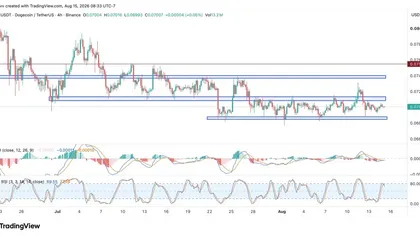
Foreign media: DOGE holds the $0.068 support level
TAESA announces extraordinary shareholder meeting
Crypto prices
More


