
The US Q2 GDP nowcast shows strong performance but hides risks of economic downturn for the whole year

FX168 Finance, July 28—— In summary, while the soon-to-be-released Q2 GDP data is likely to paint a moderate and resilient picture, investors and policymakers should look beyond the surface data. The second half of 2026 faces markedly different risks, largely shaped by forces outside traditional cyclical drivers.
The ongoing Iran conflict continues to disrupt the U.S. economic outlook, but the impact of the Middle East crisis may be difficult to reflect in this week's Q2 GDP report. While geopolitical tensions have already driven up global energy prices and brought new volatility to financial markets, Q2 data mainly reflect economic activity from April to June, a period in which many of the most intense shocks were still unfolding and not fully realized.
The Bureau of Economic Analysis (BEA) will release official Q2 GDP data on July 30. According to the median forecast, the number is expected to roughly match the 2.1% real annualized growth rate in Q1. The Capital Spectator's median estimate has been revised up from 1.8% on July 18 to 2.1%, while the Econoday consensus is slightly higher at 2.3%. These moderate upward revisions reflect stronger-than-expected retail sales and resilient industrial production data in recent weeks, helping to offset some of the earlier drag from rising input costs.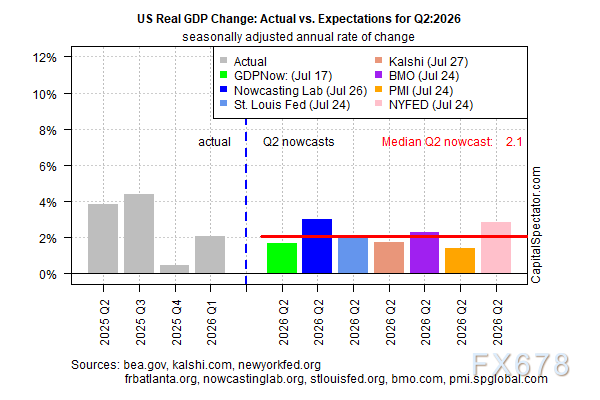
(Forecasts for U.S. Q2 GDP growth in late July 2026 by different institutions)
Overall, Q2 is again expected to demonstrate the resilience of the economy, despite a series of macro shocks. From stubborn inflation data to persistent supply chain frictions and ever-changing monetary policy expectations, the U.S. economy has shown underlying strength, mainly driven by domestic demand rather than external trade. The Iran conflict remains a significant risk by keeping energy prices elevated, feeding through supply chains to raise costs, and amplifying pressure on the Federal Reserve to tighten policy.
Crude oil prices hovering around or above $100 per barrel have already begun pushing up gasoline prices at the pump, raising transportation and logistics costs, and generating wider producer price pressures. These effects tend to lag, so Q2 GDP may still appear relatively unaffected, while the real economic costs will accumulate in Q3 and Q4.
The ongoing threat of escalation continues to cast a shadow over markets, and persistent geopolitical uncertainty amounts to a “tax” on growth—pushing up energy costs, disrupting trade flows, and skewing inflation risks to the upside. Companies face higher hedging costs and delayed investment decisions, while consumers see reduced purchasing power for non-essentials due to increased energy and food budgets. Beyond energy, the conflict also has indirect effects on global trade routes and investor sentiment. Shipping and insurance costs rise in affected regions, putting mild upward pressure on import prices and reinforcing the Federal Reserve’s cautious stance toward rate cuts.
Even so, consumer spending remains steady, thanks to income growth and the labor market’s continued moderate pace of job additions. Real disposable personal income continues to rise modestly, supported by wage gains in the service sector and housing costs that, while still high, are starting to cool. Households have also tapped into savings accumulated in earlier years, helping to maintain spending on durable goods and services.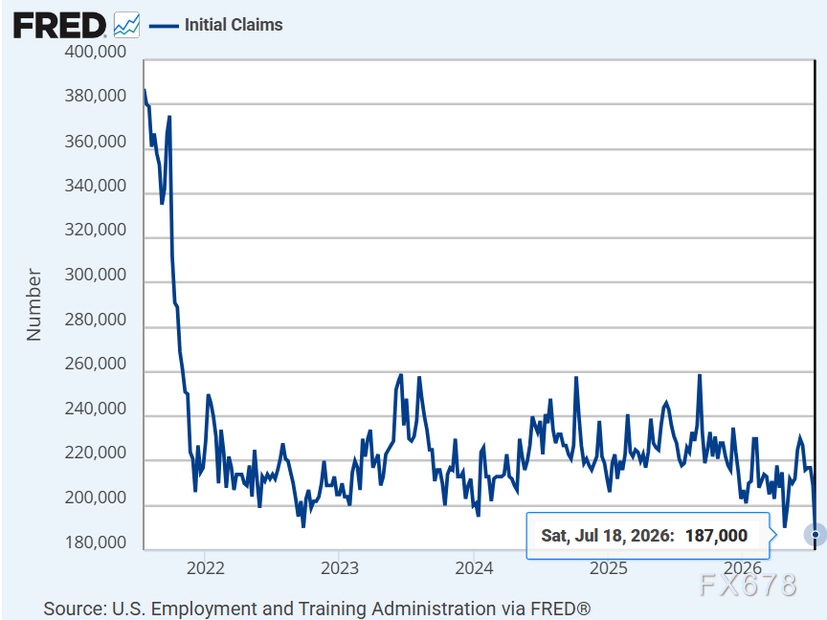
(According to the Federal Reserve Bank of St. Louis economic database, U.S. initial jobless claims have remained in a healthy range of 200,000-240,000 after falling from a peak, dropping further to an extremely low 187,000 in July 2026, which bodes well for the future job market.)
Layoffs remain rare, with new initial unemployment claims last week falling to 187,000, the lowest level since 1969. This remarkable strength in initial jobless claims underscores the labor market’s resilience, far exceeding the expectations of many analysts, even after multiple shocks.
The half-century low in jobless claims, combined with $100 oil prices, indicates virtually no slack in the labor market—a combination that could become problematic if the conflict persists. A tight labor market typically translates into stronger wage bargaining power, which, while briefly benefiting workers, embeds higher labor costs that companies eventually pass on to consumers, further complicating the inflation picture.
There has been a brief lull in U.S.-Iran hostilities, hinting at improvement, but after five months of intermittent conflict, the outlook remains highly uncertain. Diplomatic efforts and ceasefire talks appear fragile, and markets are pricing in the possibility of another interruption of oil supplies from the Strait of Hormuz or related shipping lanes.
As a result, it is becoming increasingly difficult for the Federal Reserve to ignore the warning signs of rising inflation. Core PCE inflation readings remain stubbornly above the Fed's 2% target, and any sustained energy price shocks could reaccelerate overall inflation, forcing policymakers to maintain a restrictive stance longer than previously anticipated.
As everything now hinges on energy price trends, geopolitical stability, and labor market tightness, the first half of the year may offer little reliable guidance for the second half. Analysts increasingly forecast a “high uncertainty” environment for the second half of 2026. If oil prices remain high or businesses cut capital spending due to increased risk aversion, baseline growth may slow.
Downside risks include a sharper hit to consumer confidence or renewed supply chain bottlenecks, while upside surprises could come from a faster resolution to the conflict or stronger productivity gains.
In summary, while the soon-to-be-released Q2 GDP data is likely to paint a moderate and resilient picture, investors and policymakers should look beyond the surface data. The second half of 2026 faces markedly different risks, largely shaped by forces outside traditional cyclical drivers.
Disclaimer: The content of this article solely reflects the author's opinion and does not represent the platform in any capacity. This article is not intended to serve as a reference for making investment decisions.
You may also like
Spot DEXs on Solana see $5.8B in trading volume for tokenized stocks
Turmoil Intensifies Within OpenAI: Ongoing Restructuring, Employee Exhaustion, Continued Management Resignations, IPO Plans Quietly Delayed
OpenAI has undergone nearly five restructurings this year, with a continued wave of executive departures. Chief Revenue Officer Denise Dresser became the latest to leave this week. The company also disbanded its safety team responsible for assessing the "catastrophic risks" of AI models, raising internal concerns. Although revenue has increased to about $40 billion, OpenAI has been surpassed by Anthropic. Employees generally feel exhausted, and the IPO plans have quietly been postponed until next year.
Bitcoin and Ethereum ETF Flows Shifted Last Week: Here’s What You Missed

Crypto prices
More


