
SpaceX has already "dropped by the equivalent of one Tesla"

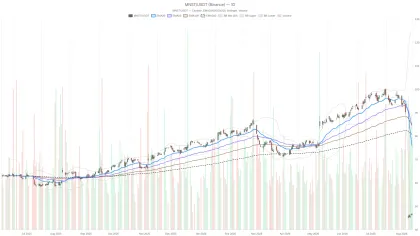
SpaceX's stock price has fallen from its June high of $225 to about $113, wiping out more than $1.2 trillion in market value. Starting August 6, nearly 900 million shares will be unlocked, and the number of tradable shares will surge from 639 million to 5.33 billion by the end of the year, creating significant supply pressure. $100 has become the critical line for the battle between bulls and bears; institutions are building downside protection, while retail investors continue to bet on a reversal. Starship malfunctions and the shift in AI valuation logic have heightened concerns about the fundamentals, and the first quarterly report will be a key point for repricing.
SpaceX just lost an entire Tesla's worth of market cap.
At the close on July 27, SpaceX was priced at $113.50, a near 50% pullback from its June 16 high of $225.64, erasing over $1.2 trillion in market cap—almost exactly equivalent to Tesla's total company value now.

Tesla itself also fell to its lowest level in almost a year during this period.

Even more dramatic is the timing. On August 4, SpaceX will release its first earnings report since going public, and two days later, on August 6, over 900 million insider shares will be unlocked, involving a market cap of about $116 billion.
By the end of the year, the total number of tradable shares will surge from about 639 million to 5.33 billion, a more than seven-fold increase. With such a massive flood of new supply, whether there will be enough demand to absorb it becomes the most pressing issue facing the bulls.
$100 Is the Bull-Bear Vote on AI
$100 is not just some arbitrary number. It's the market's dividing line to decide: "Is SpaceX worth being an AI company?"
$97, often cited as a floor price, was actually the reference price used for SpaceX's internal tender offer earlier this year, when the company's overall valuation was less than $200 billion.
However, in terms of anchors, the $100 option strike is a firmer level than the historical $97.
According to Cboe LiveVol data, one of Monday's most-watched block trades was a transaction collecting about $1.8 million in premiums: selling 5,200 put options with a $100 strike price expiring October 16, while buying 7,000 puts with an $85 strike expiring the same day for hedging purposes.
The logic: as long as SpaceX doesn’t fall below $100, the seller keeps the whole premium. In effect, this forms a "soft support" guarded by institutional capital.
Overall options flows show that on Monday, call volume was about 106,000 contracts, puts about 77,000; but by premiums, puts dominate. Out of the day’s total $442 million in premium, most relate to puts.
Charles Moon, Prosper Trading Academy (Chicago) expert in technology and momentum strategies, says:
For investors, it’s still early to enter; for traders, Wall Street is punishing AI stocks over capital expenditure concerns.
Interestingly, some retail investors are still chasing deep out-of-the-money call options. For example, Monday's largest contract by volume was a $330 strike call expiring this Friday, priced at just 10 cents per contract. According to ThinkOrSwim, the probability of profit by expiration is about 0.3%.
This reflects the market's split psychology: institutions building downside protection while retail bets on a miracle reversal.
Unlocking Flood, Unprecedented Supply Shock
Even excluding the price move, the structure of SpaceX’s share unlocking this time is already rare for the market.
Unlike the standard "180-day lockup" in typical IPOs, SpaceX has designed a staggered, phased release mechanism.
On August 6—two trading days after the first quarterly report—about 911.5 million shares will be unlocked first; over the following months, more will be released, reaching a total of 5.33 billion tradable shares by early December.
This means, in the coming months, the market must absorb new supplies equivalent to 5-7% of total share capital almost every month. For a newly public company with an immature price discovery mechanism, this supply pace is not to be underestimated.
The prospectus also includes a trigger clause: If SpaceX trades at or above $175.50 for at least five of the ten trading days before earnings, up to another 455.8 million shares will become unlocked immediately after earnings.
Based on Monday's close of $119.85, this trigger would require a further rise of over 46%, so the market generally views this outcome as low-probability in the short term.
The largest potential seller is not the main concern. Musk holds about 7.8 billion shares, about 60% of the total, which are locked for one year post-IPO, so they pose no near-term direct selling pressure.
The real focus is the early private investors. SpaceX’s private fundraising a year ago valued it at about $400 billion. Even after recent price drops, this still represents a considerable paper profit for those investors, so their exit incentive cannot be underestimated.
According to S3 Partners, about 30% of tradable shares are currently being shorted, with $7 billion of paper profit for the shorts. Charles Moon says:
I don't think the unlocking will be as bad as feared, but it's definitely not going to help the stock price either.
Progress Toward Fundamental Promises and Valuation Restructuring
Aside from the unlocking overhang, SpaceX’s headline growth story pitched at the IPO has faced challenges in recent weeks.
The Starship rocket launch was canceled due to engine failure, casting doubt on SpaceX’s space commercialization road map.
The market had placed high hopes on Starship: from lowering satellite deployment costs, supporting Starlink network expansion, to eventually providing transport for "space compute" infrastructure, the launch cadence of Starship is a key pillar of the valuation logic.
"Space compute" was repeatedly touted as a long-term narrative at the SpaceX IPO; however, the monetization cycle for this storyline is long, and it's unlikely to deliver tangible financial contributions in the short term.
As the macro environment shifts from embracing high AI valuations to scrutinizing capital expenditure, SpaceX faces a similar valuation adjustment to that of the broader AI infrastructure sector.
Volatility in SpaceX has already spilled over to the broader new listings market.
According to Bloomberg, the weighted average return for this year’s new listings has dropped to negative 4.4%. Even excluding SpaceX and SK Hynix, gains are only 5.3%—far below the S&P 500’s 9.4% rise over the same period.
The upcoming first quarterly earnings report will be a crucial moment for the market to recalibrate SpaceX’s fundamentals.
However, the earnings release almost coincides with the initial unlock window, meaning the results will directly impact bulls’ and bears’ bargaining chips as they absorb the unlocking wave.
How to balance liquidity release and price stabilization will be the central challenge facing SpaceX and its underwriters in the coming months.
Disclaimer: The content of this article solely reflects the author's opinion and does not represent the platform in any capacity. This article is not intended to serve as a reference for making investment decisions.
You may also like
Monster Beverage Corporation stock oversold as sales hit record $2.5B
Nvidia’s SpaceX investment falls from $21 billion to $17 billion after IPO
$111M of tokenized stocks now deposited across 15 DeFi applications
Polkadot recovers 2.5%, traders focus on $0.79198 resistance
Crypto prices
More


