
In-depth Update on Japanese Electronic Components: AI Orders Shift to Profit Realization, Ibiden Expands Production, MLCC Pricing and Power Semiconductor Recovery

TL;DR
1.The industry outlook has moved from 'demand confirmation' to 'profit realization'. Goldman Sachs expects the total operating profit of covered companies for FY3/27 to reach 27.031 trillion yen, a 36% year-on-year increase, which is 9% higher than the Bloomberg consensus estimate. For FY3/28, 33.604 trillion yen is projected, up 24% year-on-year and 13% above consensus. Q2 (April–June) results are likely to be solid, but what will truly determine share price direction is whether management can present evidence—order backlog, production capacity, pricing—to support profitability in the second half of 2026, FY3/28, and beyond.
2.Ibiden remains the company with the steepest profit slope and the highest verification requirements. The ramp-up utilization of the Ohno new line, mass production of Rubin substrates, and CPU/switch chip demand may drive FY3/27 operating profit to 102.5 billion yen; however, the market still needs confirmation as to whether further capacity expansion will occur on top of the already planned 500 billion yen capex, and whether the FY3/31 operating profit target of 300 billion yen has upside potential.
3.The key for MLCCs is who can translate tightening supply and demand into high gross margins; there is still no evidence for across-the-board price rises. Murata and Taiyo Yuden both need to address order-to-shipment ratios, lead times, long-term contracts through 2027, and AI data center sales growth. Non-Japanese suppliers have already started raising prices, but both companies had no prior plans to do so. Thus, this cycle focuses more on product mix, yield, and utilization rates, rather than assuming a universal price hike.
4.The recovery of analog and power semiconductors has started to show up in profits. Renesas Electronics needs to prove if test equipment, foundry, and in-house capacity bottlenecks can be resolved on time, while Rohm must show improvement in analog/power product pricing, reduced SiC losses, and that the integration of Toshiba-related businesses is not diluted by transaction costs or goodwill amortization.
5.Valuations already require companies to deliver forward-looking evidence. Based on July 23, 2026 share prices, Goldman Sachs gives target upside of 74% (Taiyo Yuden), 48% (Murata), 41% (Ibiden), 34% (Rohm), and 29% (Renesas Electronics). These numbers should be viewed as a checklist for validation, not a margin of safety: if order quality, yield, capacity ramp, or pricing power falter at all, forward valuations may drop ahead of current earnings.
ContentsJoin Knowledge Planet to view the full original report and reference research
- I. What’s New in This Outlook
- II. Strong Profit Forecasts, but Not All Companies Are in Sync
- III. Ibiden: Strongest Demand, Highest Execution Threshold
- IV. MLCC: Murata Relies on Product Mix, Taiyo Yuden on Yield
- V. Renesas Electronics and Rohm: Semiconductor Recovery Must Get Through Capacity and Integration
- VI. Remaining Sections
The core validation for this earnings season is whether orders can pass through capacity, yield, pricing, and cost, ultimately turning into sustainable profit.
I. What’s New in This Outlook
The previous round of Japanese electronics component earnings previews has already confirmed that AI servers are driving MLCCs, ABF substrates, hard disk heads, and high-end connectors into a profit expansion phase.The main topic in the last round was whether April–June profits could exceed initial company guidance; this July 24, 2026 Goldman Sachs report advances things a step further:Short-term profit strength is increasingly expected by consensus; the new debate is whether these profits can be sustained beyond 2027.
Goldman Sachs focuses on three supply chains for incremental insights.The first is ABF substrates: track capacity utilization and new capex; second is MLCCs: monitor order quality, long-term agreements, and pricing; third is analog/power semiconductors: look for bottleneck removal, price improvements, and business integration. They all highlight the same issue: AI demand is visible, but how much profit companies retain depends on internal execution.
This also explains why this time, it’s not enough to look at 'beats'.If orders are only coming in early because clients want to lock in capacity, shipments may surge but could later drop off; if revenue growth is from low-margin products, higher utilization may not yield equivalent profit; if price hikes only offset higher raw materials, energy, or outsourced costs, profit margins won't expand noticeably. On the other hand, if order-to-shipment ratios stay above 1, lead times lengthen but cancel rates remain stable, the share of premium products rises, yields improve, and new capacity ramps up as scheduled, profits have a chance to break beyond a short-term boom and result in a longer earnings cycle.
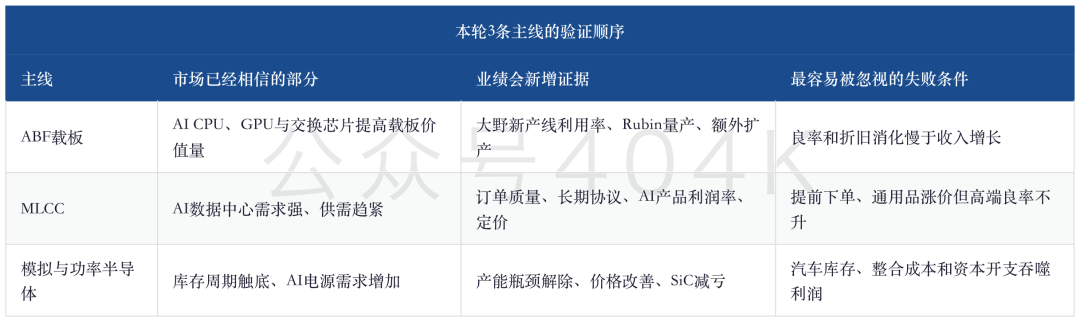
II. Strong Profit Forecasts, but Not All Companies Are in Sync
Goldman Sachs projects the aggregate operating profit of covered companies at 2.7031 trillion yen for FY3/27, up 36% year-on-year and 9% above Bloomberg’s consensus; for FY3/28, it’s 3.3604 trillion yen, up 24% and 13% higher than consensus.This shows that sell-side models are no longer treating the industry as a quarterly rebound, but are increasingly factoring in a longer AI data center upcycle, tighter supply-demand, and product mix upgrades.
But breaking down the totals, profit elasticity differs greatly by company.Murata’s edge is high-end MLCC scale and mix, Taiyo Yuden’s edge is cyclical elasticity, Ibiden’s value comes from AI substrate content, Renesas’ key is removing capacity bottlenecks, and Rohm blends sector recovery with business restructuring.
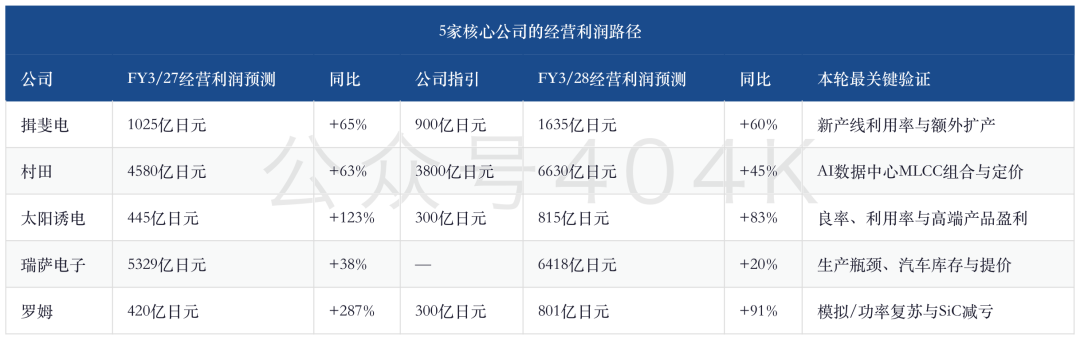
Renesas Electronics uses a December year-end; the table above shows FY12/26 and FY12/27. Goldman Sachs uses non-GAAP operating profit, while Bloomberg consensus usually uses GAAP; differences in accounting methods mean you can’t just directly compare % beats as 'surprise'.This accounting nuance is crucial: seemingly large model discrepancies may be due to definitions, not operating changes.
Quarterly cadence is also notable.Goldman Sachs expects Ibiden’s April–June operating profit to be 20.7 billion yen, rising quarterly to 24.3, 26.8, and 30.7 billion yen; Murata is projected at 99.5, 117.5, 126, and 115 billion yen; Taiyo Yuden is seen at 6.6, 12.4, 13.4, and 12.1 billion yen. The market is trading on July–December profit acceleration, not just April–June numbers. If a company posts only a single strong quarter but fails to explain follow-on orders and capacity, the share price reaction could be weaker than headline profit implies.
III. Ibiden: Strongest Demand, Highest Execution Threshold
Ibiden is the clearest example in this report of 'capacity determines profit'.Goldman Sachs believes Ohno’s new line utilization in the second half of FY3/27 may exceed conservative company forecasts, with AI CPU, Rubin platform, switch chips, and new ASIC customers all supporting ABF substrate demand. If utilization ramps ahead of plan, the high fixed-cost business can see major profit upside, which is why Goldman expects operating profit to surge 65% in FY3/27, and another 60% in FY3/28.
Incremental information is found not just in orders, but also in capital expenditure.The company has already committed to invest 500 billion yen; the next question is whether this will cover the customer roadmap, or whether further expansion is needed. If they expand further, extra depreciation and yield ramp may bring revenue before profit. The market will also ask if the FY3/31 300 billion yen operating profit target remains a ceiling, or if there is upside.
There are four key product-level watchpoints.First, can Rubin substrates enter full-scale mass production as scheduled? Second, will Agentic AI drive greater CPU demand? Third, do advanced packaging routes such as EMIB-T increase Ibiden’s value per machine? Fourth, can network clients and two ASIC customers reduce reliance on any single platform? None of these alone are sufficient; the ideal combination is more customers, higher per-unit value, rising utilization, and yield improvement all at once.
Based on the July 23 share price of 18,075 yen, Goldman’s target is 25,500 yen, a 41% upside; but the target valuation is around 40.2x FY3/29 earnings, vs about 28.5x at current prices.This is not cheap, and requires FY3/29 operating profit to hit 230 billion yen, still up 41% y/y. The main downside risks to Ibiden are customer roadmap changes, slow ramp on new lines, poor yield, or higher than expected depreciation. You might not need for AI demand to disappear—if profit growth can’t keep up with valuation digestion, the share could lag.
IV. MLCC: Murata Relies on Product Mix, Taiyo Yuden on Yield
Both Murata and Taiyo Yuden are in an MLCC upcycle, but they face different validation challenges.Murata must prove its high-end product edge continues, while Taiyo Yuden has to show it can both benefit from the upturn and also convert AI data center orders into higher margins.
Murata faces four core questions.First, do order-to-shipment ratios, lead times, and cancellation rates prove demand is real (not just double-ordering)? Second, are customers demanding long-term agreements covering 2027, which would directly reflect scarcity? Third, can sales and margins for AI data center MLCCs keep improving in Q2, Q3, and the second half? Fourth, non-Japanese suppliers have already raised prices on standard MLCCs; Murata had not planned price hikes, but if high-end capacity remains tight, will they adjust prices or manage orders differently?
Murata’s upside is not just about MLCCs.Products like intermediate bus converters (IBC) and backup battery units (BBU) for AI server power supplies could also add value per system. But the real constraint is internal allocation: does high-end equipment, materials, engineers, and line space get prioritized for automotive, consumer electronics, or AI data centers? Strong demand doesn’t mean all orders are worth taking—the ability to prioritize scarce resources for high-margin products determines profit ceiling.
Taiyo Yuden’s demand angle is similar, but the validation challenge is more manufacturing-focused.Goldman Sachs forecasts FY3/27 operating profit at 44.5 billion yen, 14.5 billion above company guidance; the market needs confirmation that this gap is from AI data center portfolio and yield improvement, not just higher utilization. The company plans to increase capacity by about 10% annually, but if high-end MLCC yield and unit earnings don’t improve accordingly, greater output will just lead to more depreciation—not equivalent profit.
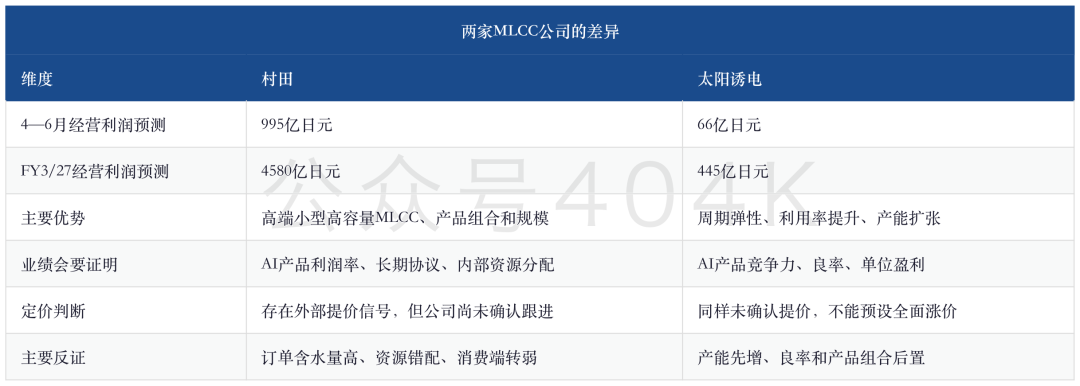
Valuation has already assigned considerable elasticity to Taiyo Yuden.Goldman’s target is 21,200 yen, 74% above the July 23 share price of 12,155 yen; the target P/E for FY3/29 is about 30.8x, vs. about 17.7x now. Murata’s target is 12,600 yen, 48% over the current price of 8,538 yen, with a similar P/E. Both have similar forward multiples, but since Taiyo Yuden starts from a lower profit base and steeper ramp, any variance in yield or demand will drive a larger revision.
V. Renesas Electronics and Rohm: Semiconductor Recovery Must Get Through Capacity and Integration
Renesas Electronics’ opportunity comes as AI data center and automotive demand improves just as supply bottlenecks are easing.The company plans to add more test equipment in Q3, boost foundry outsourcing thereafter, and add in-house capacity in January 2027. If all three steps occur on time, power management IC (PMIC), memory interface, and automotive product revenue and margins could keep rising.
But Renesas Electronics is most at risk of “revenue up, profit unclear.”The timing business was sold on July 1, 2026, so one must separate disposal gains from ongoing operating profit; the auto business also requires regional inventory checks; and the July—December price hikes Goldman notes are only potential, not set. Real validation comes if, after output increases, lead times are normal, margins trend up, auto inventory doesn’t worsen, and price hikes cover outsourcing and materials costs.
Rohm is betting on both sector recovery and corporate restructuring.Analog and power semiconductor orders have improved since the start of the year; if tightening supply and demand lead to price hikes, the path to 42 billion yen operating profit for FY3/27 and 80.1 billion for FY3/28 is credible. AI data center demand could help the SiC business break even in FY3/28—sooner than the market previously expected.
The catch is, Rohm’s P&L still faces M&A variables.The company is conducting due diligence on Toshiba’s analog and power semiconductor businesses: costs, goodwill amortization, integration setup, and synergy realization all impact final profits for common shareholders. Power semiconductor collaboration negotiations with Mitsubishi Electric also need clearer boundaries. Goldman’s target is 6,500 yen—a 34% premium to the July 23 price of 4,863 yen—mapping to 24.6x FY3/29 P/E. If SiC losses narrow and legacy analog rebounds, valuation can be absorbed; if integration costs hit before synergies, operating profit gains may not even reach net profit in proportion.
The remaining 30% of the sections are available on Knowledge Planet, where you can access the full text and reference report. Join now for more details.
Disclaimer: The content of this article solely reflects the author's opinion and does not represent the platform in any capacity. This article is not intended to serve as a reference for making investment decisions.
You may also like
Spot DEXs on Solana see $5.8B in trading volume for tokenized stocks
Turmoil Intensifies Within OpenAI: Ongoing Restructuring, Employee Exhaustion, Continued Management Resignations, IPO Plans Quietly Delayed
OpenAI has undergone nearly five restructurings this year, with a continued wave of executive departures. Chief Revenue Officer Denise Dresser became the latest to leave this week. The company also disbanded its safety team responsible for assessing the "catastrophic risks" of AI models, raising internal concerns. Although revenue has increased to about $40 billion, OpenAI has been surpassed by Anthropic. Employees generally feel exhausted, and the IPO plans have quietly been postponed until next year.
Bitcoin and Ethereum ETF Flows Shifted Last Week: Here’s What You Missed

Crypto prices
More


