
Will gold replicate the super bull market of 1978?

Huitong Network July 24 News—— On Friday (July 24), the international spot gold price remained near $4,055/oz, with a slight intraday increase of 0.14%. However, from a comprehensive mid-to-long-term market perspective, institutions remain optimistic about the future trend of gold. The short-term price correction is merely a normal consolidation within the upward cycle, rather than a signal of the end of the bull market. Industry analysts have given clear medium-to-long-term price forecasts: international gold prices are expected to rise to around $5,000/oz by the end of 2026, and the bullish momentum is projected to continue, with a further surge to $5,600/oz by the end of 2027.
On Friday (July 24), the international spot gold price remained near $4,055/oz, with a slight intraday increase of 0.14%. However, from a comprehensive mid-to-long-term market perspective, institutions remain optimistic about the future trend of gold. The short-term price correction is merely a normal consolidation within the upward cycle, rather than a signal of the end of the bull market. Industry analysts have provided clear medium-to-long-term forecasts: international gold prices are expected to rise to the $5,000/oz level by the end of 2026, and with the uptrend continuing, are projected to further rise to $5,600/oz by the end of 2027.
From a historical cycle perspective, the current rhythm of the gold market is highly similar to that in 1978. That year, gold went through a prolonged period of range-bound consolidation to fully absorb floating capital and accumulate upside momentum, before launching into the strongest and fastest super bull run in modern financial history. The core drivers of that market were concentrated in three areas: rampant high inflation, elevated global geopolitical risks, and the overall bull run of commodities. The current market is synchronously repeating this set of core bullish drivers, with gold's investment cost-effectiveness and risk-reward ratio continuing to rise, attracting mid-to-long-term capital inflows.
The market deeply compares the 2026 gold market with that of 1978, based on the highly similar structure of these two bull cycles: both the current and 1978 gold markets experienced staged corrections and consolidation in the mid-to-late phase of a long-term bull market, and after a brief period of volatility, the most explosive and largest upside phase of the super bull market begins.
The 1978-1980 gold bull market was one of the most representative classic events in the global commodity development history. At that time, the global economy fell into stagflation, with weak growth and rapidly surging prices, compounded by geopolitical turmoil from the Iranian Revolution and the full outbreak of the second oil crisis. These multiple bearish factors for the economy and bullish factors for safe-haven assets resonated together. In just a year and a half, the gold price soared from around $200/oz in 1978 to a historic high of $850/oz in January 1980—a cumulative gain over 320%, setting a decades-long record for short-term gold rallies and becoming one of the most spectacular commodity bull markets in modern financial history.
1979 became the key turning point for the full-scale explosion of gold prices. Multiple fundamental bullish drivers overlapped, triggering a global commodity bull run that covered crude oil, precious metals, industrial metals, and agricultural products. Gold, with its superior safe-haven and anti-inflation attributes, led the rise. The specific core drivers are as follows:
1. The second oil crisis triggered global inflation. After the outbreak of the Iranian Revolution, Iran's crude oil production and export system was completely paralyzed, leading to a sharp contraction in global oil supply. The international oil price nearly doubled. As a key cost in global industry, soaring oil prices were quickly transmitted through the supply chain, sparking global imported inflation, universally higher prices, and completely shattering what was a stable price system. This laid a solid core foundation for gold’s anti-inflation rally.
2. Global high inflation spiraled out of control. Impacted by both the oil crisis and excessive monetary supply, inflation rates in the US and most developed economies in Europe quickly broke into double digits. Prolonged inflation continually eroded the value of market assets, significantly shrinking the purchasing power of fiat currency and depreciating traditional assets like cash, savings, and bonds. The market urgently needed high-quality store-of-value assets to hedge inflation risk, leading to a surge in demand for gold allocation.
3. Persistent dollar weakness forced funds into safe havens. Economic stagflation, high inflation, and widening trade deficits placed persistent downward pressure on the dollar and its credibility in the market came under widespread doubt. Investors abandoned single-currency dollar assets, massively increasing holdings of gold, silver, and other non-sovereign hard currency stores of value, further boosting gold’s valuation.
4. Concentrated outbreak of geopolitical risk boosted safe-haven demand. The Iranian Revolution, the Tehran hostage crisis, and the Afghan war, among a string of geopolitical conflicts, played out one after another, causing violent upheavals in the global political landscape. Market uncertainty soared, risk-asset volatility intensified with subdued returns, and safe-haven sentiment surged, with funds flowing en masse into safe-haven assets like gold.
5. Global commodity bull market created a ripple effect. This rally was not limited to gold, but was a systemic bull market across all major commodity categories. Crude oil, industrial metals, agricultural products, and other commodities surged together, forming a strong sectoral linkage for coordinated rallying. The prevailing bullish sentiment in commodities spread throughout the market, driving gold’s price doubling.
Current market status: Short-term volatility as consolidation, fundamentals continue the bull market logic
Based on current real-time market data, gold’s short-term performance is characterized by repeated fluctuations and relatively fierce long-short battles. The current spot gold intraday volatility range holds at $3,390–$3,405/oz, with neither the bulls nor the bears establishing a clear trend—this is a typical high-level consolidation, fully consistent with the choppy shake-out seen before the 1978 bull market started. The recent volatility is mainly due to a short-term cooling of market risk sentiment and a temporary dip in geopolitical safe-haven demand, leading to a minor correction in gold, but the mid-to-long-term core bullish logic remains intact.
Upcoming key market events such as US July inflation data and Federal Reserve officials’ speeches will dominate short-term gold fluctuations, with the market waiting for inflation data and monetary policy signals for direction. Currently, the Fed’s benchmark interest rate remains stable at 4.5% with no substantial move up or down, and overall monetary policy remains moderately accommodative, providing a benign monetary environment for gold's mid-to-long-term upside. At the same time, with US wholesale inventory growth in June coming in below expectations and labor productivity rebounding sharply in Q2, the US economy shows signs of weak recovery, with early hints of stagflation—further matching the macro background of the 1970s bull market.
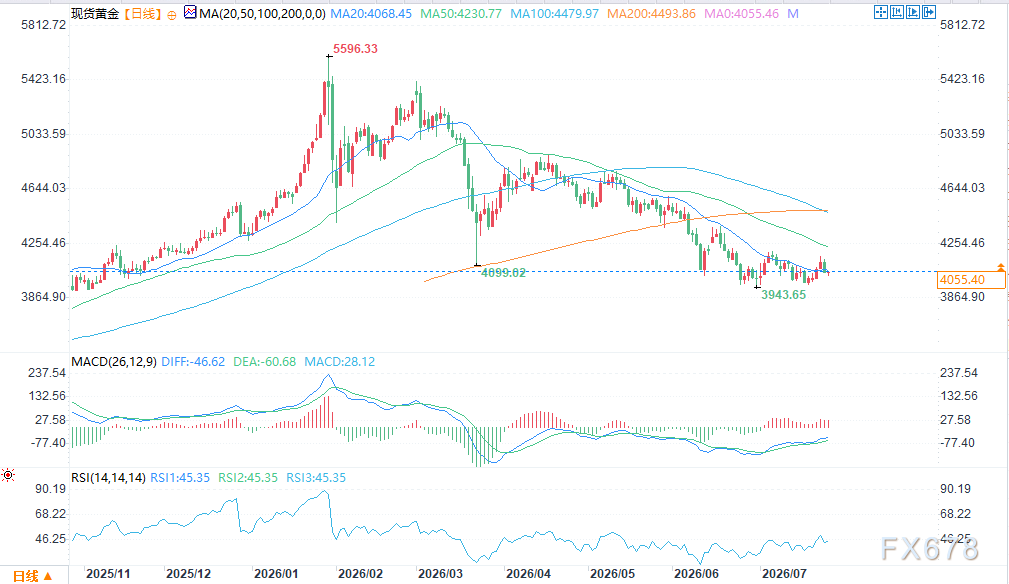
(Spot gold daily chart Source: EasyHuitong)
The current macro environment shares multiple core characteristics with the late 1970s: persistent global geopolitical uncertainties, swelling levels of sovereign debt, widening fiscal deficits, continued large-scale gold reserve purchases by global central banks, and a gradual weakening of market confidence in fiat currency credit. The synchronized resonance of stagflation risk, weakening monetary credibility, and rising safe-haven demand highly matches the market environment prior to the 1978 bull market.
However, investors should perceive historical comparisons rationally, and not blindly replicate historical events. There are essential differences today in the global monetary system, the degree of economic globalization, market trading mechanisms, and capital flow efficiency, compared with the 1970s. Although rampant inflation broke out in the 1970s, today inflation remains overall controlled and more moderate, and monetary policy is more mature and flexible. Therefore, the rhythm, amplitude, and duration of this gold bull market will differ from historical episodes. Investors should rely on current market data and macro events, and rationally position themselves for the mid-to-long-term trend.
Disclaimer: The content of this article solely reflects the author's opinion and does not represent the platform in any capacity. This article is not intended to serve as a reference for making investment decisions.
You may also like
SEC said to be slow-walking assistance requested for US crypto market bill
Bank objections over state provision could complicate stablecoin bill
Landmark crypto market overhaul bill advances past first committee
LINK Breakout Pushes Toward $10 Resistance
Crypto prices
More


