
Tesla Q2 2026 Earnings Highlights: Revenue Surged 26% YoY to Three-Year High and Beat Expectations, but Adjusted EPS Dropped 18% Far Below Consensus; Free Cash Flow Turned Negative Amid Peak Investment Phase
 2026/07/23 04:54
Core Viewpoint
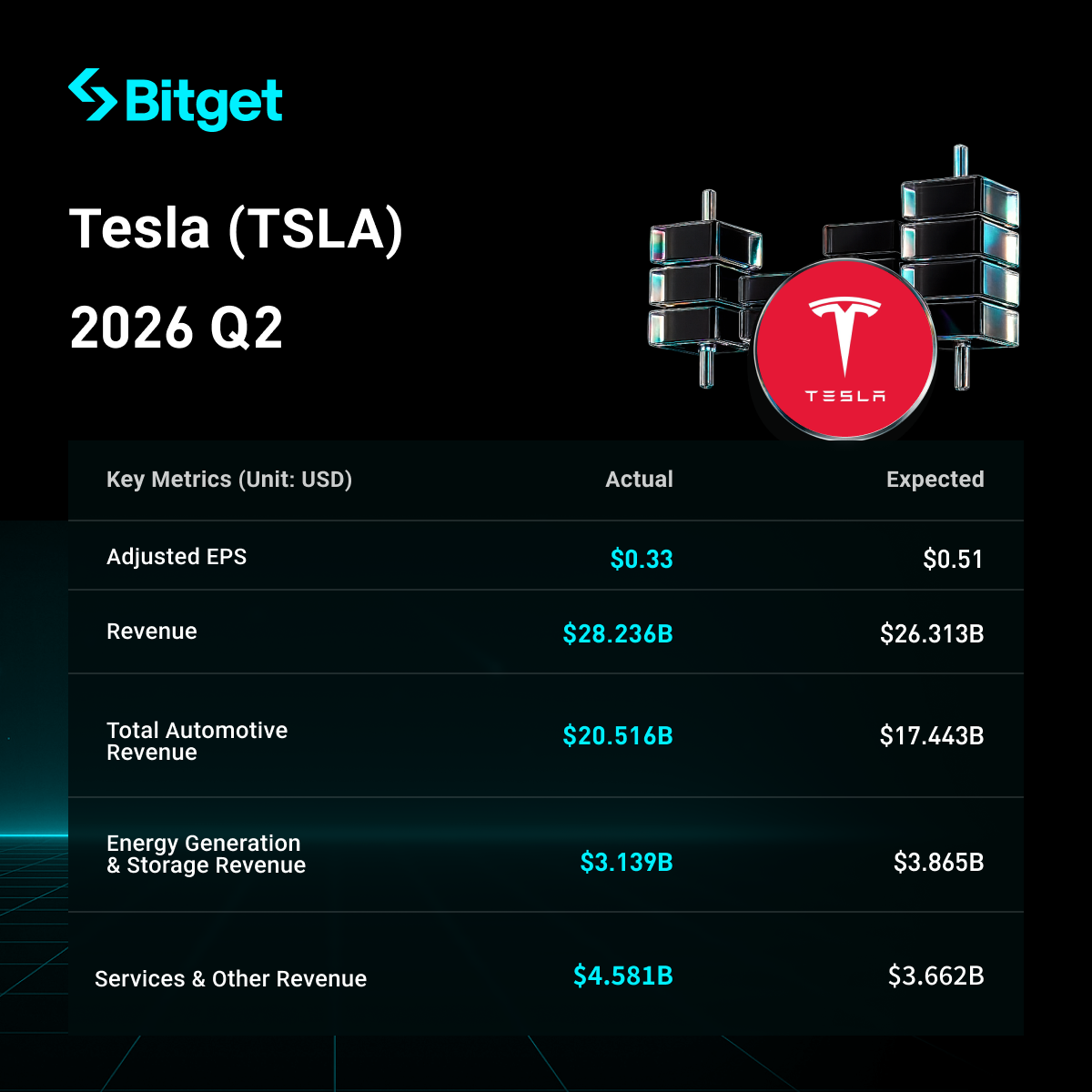
Tesla reported Q2 2026 revenue of $28.236 billion, up 26% year-over-year (the highest growth rate since Q2 2023), with trailing twelve-month revenue surpassing $100 billion for the first time and exceeding market expectations by more than 7%. Automotive deliveries reached a Q2 record of 480,126 vehicles (+25%), while Services and Other showed strong growth. However, profitability came under clear pressure: adjusted EPS was $0.33, down 18% YoY and more than 35% below the roughly $0.51 consensus; gross margin stood at 16.8% (versus 19.4% expected), and operating income was only $398 million (down 57% YoY, less than one-third of the expected ~$1.39 billion). Free cash flow turned negative for the first time in two years (approximately –$1.09 billion), driven primarily by a sharp rise in capital expenditures. Management emphasized that the company is in its “largest and most exciting investment phase.” Shares fell further after hours (at times down more than 3–5%), reflecting investor concerns over the pace of margin recovery and sustained negative free cash flow.
Detailed Breakdown
- Overall Revenue and Profit Performance
- Total revenue: $28.236 billion, up 26% YoY, approximately $1.923 billion (about 7.3%) above consensus; trailing twelve-month revenue exceeded $100 billion for the first time.
- Adjusted EPS: $0.33, down 18% YoY and more than 35% below the analyst consensus of roughly $0.51.
- Gross margin: 16.8%, below the 19.4% expectation (2.6 percentage points short), down 41 basis points YoY and significantly lower than the 21.1% recorded in Q1. Implied gross profit was approximately $4.74 billion.
- Operating income: $398 million, down 57% YoY and only about 30% of the expected ~$1.39 billion; operating margin was approximately 1.4%.
- Free cash flow: approximately –$1.09 to –$1.1 billion (first negative reading in two years), though better than some market expectations; operating cash flow was about $4.7 billion (up roughly 85% YoY).
- GAAP net income: approximately $1.11 billion, down about 5% YoY. Operating expenses rose 47% YoY to about $4.35 billion; R&D expenses increased about 49% YoY to approximately $2.37 billion.
- Automotive Business Performance
- Automotive revenue: $20.516 billion, up 23% YoY (accelerating from 16% in Q1) and nearly 10% above the $17.443 billion consensus, accounting for roughly 73% of total revenue and the primary driver of the top-line beat.
- Deliveries: 480,126 vehicles, up 25% YoY — a company record for any second quarter. Production was 451,758 vehicles, up 10% YoY. Deliveries grew faster than production, indicating some inventory drawdown.
- Approximate automotive revenue per vehicle: ~$42,700 (including leasing and regulatory credits), showing resilience on the revenue side despite volume growth.
- Key drivers: Demand remained solid with no clear signs of a sharp slowdown; growth in Europe and other regions offset weakness in certain markets. However, ongoing price competition, shifts in product and regional mix, and lower regulatory credit revenue weighed on margins. Scale expansion has not yet fully translated into operating leverage.
- Other Business Segment Performance
- Services and Other: Revenue of $4.581 billion, up 50% YoY (versus 42% in Q1) and roughly 40% above the ~$3.662 billion consensus, delivering record profitability and margins. Active FSD subscribers reached 1.48 million, up 56% YoY and above the 1.4 million expectation, underscoring continued expansion of the software subscription business (more than 55% of new North American deliveries included an FSD subscription).
- Energy Generation and Storage: Revenue of $3.139 billion, up 13% YoY (reversing the 12% decline in Q1) but below the ~$3.865 billion expectation. Energy storage deployments reached 13.5 GWh, up 41% YoY — strong volume growth, though revenue recognition timing or pricing dynamics left the top line short of expectations.
- Capital Expenditure and Investment Plans
- Quarterly CapEx: approximately $5.8 billion, up 142% YoY (more than doubled sequentially), primarily directed toward AI compute infrastructure, robotics, and manufacturing capacity expansion.
- Full-year guidance: Management reiterated that 2026 CapEx will exceed $25 billion and expects CapEx to continue growing over the next two to three years. The company stated it is in its “largest and most exciting investment phase,” with business scale expansion expected to be non-linear and a continued focus on long-term value creation.
- AI and robotics progress: AI compute more than doubled in the first half; Cortex 2 capacity exceeded 115 MW. Installation of the first-generation Optimus production line is underway, with production expected to begin soon (initial units will be used for training data collection and feature development, not customer deliveries). Elon Musk described Optimus on the earnings call as the company’s hardest product to scale into mass production.
- Other updates: Cybercab production has begun; Semi remains on track for volume production. Cash and short-term investments stood at approximately $43.5 billion (down sequentially).
- Next-Quarter and Full-Year Related Guidance
- No specific numerical guidance was provided for Q3 revenue or operating income. Management did, however, make clear that CapEx is expected to keep rising over the next two to three years and that free cash flow may remain under pressure.
- Overall tone: While core business performance remains strong, the company continues to invest heavily in AI, autonomy, energy, and robotics for the long term, emphasizing the use of AI to transform transportation, energy, and productivity.
- Market Context and Investor Concerns
- Core tension: Revenue and deliveries were robust (demand and scale advantages remain intact), yet profit conversion efficiency fell well short of expectations. Gross margin and operating income came in substantially below consensus, reflecting persistent pricing pressure, elevated investment-phase costs, and limited near-term contribution from newer businesses.
- Market reaction: Shares extended losses after the release (down more than 3% at times after hours and more than 5% during the conference call). Investors focused less on the growth itself and more on the durability of automotive pricing pressure, the timeline for margin recovery, the prospect of multi-quarter negative free cash flow due to elevated CapEx, and limited profit leverage relative to the current valuation.
- Analyst perspective: Growth itself is not being questioned, but the market’s emphasis has shifted from “can Tesla grow?” to “can growth generate meaningful profits?” The company is in a peak investment phase, which is amplifying near-term profitability pressure.
Disclaimer This content is for reference purposes only and does not constitute any form of investment advice.
Disclaimer: The content of this article solely reflects the author's opinion and does not represent the platform in any capacity. This article is not intended to serve as a reference for making investment decisions.
You may also like
US national debt nears $40 trillion, Bank of America’s Hartnett: Going long on gold is currently the optimal solution
U.S. Treasury debt is approaching the $40 trillion mark. Bank of America’s Hartnett believes that "going long on gold" is currently the optimal solution—gold is the best hedge against dollar depreciation, bond collapse, and political risk. Meanwhile, the AI financing frenzy has driven a 61% year-over-year surge in corporate bond supply, structurally crowding out Treasury buyers, and debt interest payments have reached $1.4 trillion. Hartnett warns that the outcome of the November elections will be the biggest variable determining market direction at the end of the year.
Gold gains momentum to near $4,400 as Fed hike expectations drop despite Us-Iran tensions
Goldman Sachs Breaks Down U.S. Stock Q2 Earnings: AI Infrastructure Profits Soar, Application-Side Profits Still Just "Pie in the Sky"
Goldman Sachs strategist Ben Snider pointed out that companies are investing in artificial intelligence (AI) at an unprecedented pace. However, for most companies, this technology has yet to translate into significant profitability improvements.

Euro strengthens above 1.1550 as Fed rate hike bets fade
Crypto prices
More


