
Strategist: Silver's Deep Correction Is Not the End of the Bull Market, May Challenge $70 by Q2 Next Year

Huitong Finance Network, July 23—— WisdomTree investment strategist Nitesh Shah believes that the sharp correction in silver since its January high does not mark the end of the bull market; the rationalization of prices is actually beneficial to prevent persistent crowding out of industrial demand. Silver has high beta characteristics and closely tracks gold's moves. Institutions predict that the future upward trend in gold prices will drive silver higher, with expectations that silver could rebound to $70/oz by the second quarter of next year. The silver market is smaller and has greater retail participation, making it naturally more volatile; future rallies will depend more on fundamentals, making it difficult to repeat the speculative surge earlier this year.
Silver has seen a sharp pullback from its historic high in January, shaking investor confidence. Nitesh Shah, WisdomTree’s head of commodity investments, points out that this correction actually strengthens the long-term outlook; falling silver prices help curb the loss of industrial demand and pave the way for a sustainable bull market. Silver has always followed gold's volatility but with greater elasticity. Institutions expect a stronger gold price to lift silver, and forecast a rebound in silver to $70/oz by Q2 2027. This rebound is driven by fundamentals, making a repeat of the early-year speculative rally unlikely. The small market size and concentration of retail investors mean silver’s volatile nature will remain.
The end of speculative frenzy at the top, correction as market self-repair
In January 2026, speculative capital briefly pushed silver prices above $120, with market sentiment peaking before quickly cooling down and entering a sustained correction. Despite ongoing volatility, spot silver held above the key support of $50, with the latest price hovering around $59. Shah reminds investors that several months of declines should not be interpreted as a destruction of the long-term logic for precious metals. Silver’s high beta means it tracks gold closely in both bull and bear cycles; this correction is simply a normal adjustment after a rally.
For those holding positions, the drop may bring book losses, but more reasonable price levels cater to the needs of the industrial sector. Silver’s extreme price surge at the start of the year seriously squeezed downstream manufacturers’ profits. If prices stayed above $120 for a prolonged period, companies would accelerate the search for alternative materials, permanently reducing silver's industrial demand. Even the current level around $59 is prompting manufacturers to optimize silver usage. Slowing demand from major Asian solar nations, easing inventory pressures, and steady mining output are jointly absorbing excess speculative froth from earlier this year.
Industrial cost pressures remain, reasonable silver prices protect long-term demand
Although silver prices are down around 18% this year, they are still up 60% from the same period last year, meaning downstream manufacturing companies still face significantly higher raw material costs, felt most acutely by the solar industry. Silver is a core raw material for photovoltaic modules and accounts for a high proportion of costs. Persistently high prices will force manufacturers to accelerate R&D of alternative technologies.
In Shah’s view, returning silver prices to a balanced level is strategically significant. Should industrial demand continue to shrink, the upward momentum for silver would be fundamentally undermined. A moderate adjustment helps ease downstream pressures, avoiding lasting damage to industrial demand, and protects silver’s unique advantage over gold—its ever-expanding industrial applications.
Gold price as the core driver, silver’s high volatility difficult to change
Institutions remain optimistic about the macro environment for precious metals, predicting that over the next 12 months gold prices could rise above $4,560, serving as the core catalyst for a rebound in silver. Silver and gold share similar positive macro drivers; geopolitical risks and changes in monetary policy will boost both assets.
The key difference is in the market structure: silver’s overall trading volume is much smaller than gold, with higher retail investor participation, making short-term speculative rallies more likely. The sharp surge earlier this year is a classic example, which means that even if prices rally again in the future, the pace will likely be steadier and more fundamentally driven, making it hard to repeat previous one-sided extremes.
Summary
All in all, the current deep correction in silver is essentially a process of deflating a bubble, so there is no need for excessive pessimism. In the short term, the price pullback eases cost pressures on industrial companies and prevents a persistent loss of industrial demand, solidifying a foundation for long-term gains. As gold prices trend higher, silver has room to recover, with a target of $70 cited.
Investors should recognize silver's highly volatile nature, distinguish between fundamental-driven trends and short-term speculation driven by retail capital, and take a rational view of subsequent back-and-forth volatility.
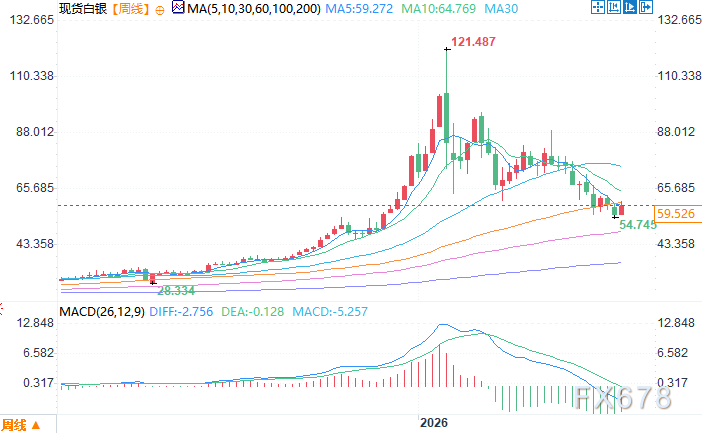
Spot silver weekly chart Source: Yihuicomm
UTC+8 July 23 10:25 Spot Silver quoted at $59.46/oz
Disclaimer: The content of this article solely reflects the author's opinion and does not represent the platform in any capacity. This article is not intended to serve as a reference for making investment decisions.
You may also like
Shiba Inu burn rate jumps 2,842% in 24 hours as Shibarium activity grows
Zcash trades near $490 as traders eye $500 resistance and $425 support
Dogecoin’s rare setup mirrors 2022 – Can DOGE repeat its 140% rally?
Bitcoin falls 47%, Strategy’s STRC preferred stock returns 9% in one year
Crypto prices
More


