
Institution: Gold Remains a Safe Haven Against Global Financial Risks, Strategic Value Continues to Rise

Forex Network, July 23 — Steve Forbes from Forbes Media believes that the recent pullback in gold prices is only a superficial effect brought on by a stronger US dollar, while the true intrinsic value of gold remains stable. The Trump administration's shift in currency stance, along with the Federal Reserve's policy orientation, have fueled a rebound in the dollar. Iran conflicts and high national debts have raised global monetary risks, positioning gold as a safe haven against financial turmoil. The continued aggressive gold purchases by multiple central banks, coupled with market skepticism toward fiat currencies, are expected to further enhance gold’s strategic value in the global financial system.
Steve Forbes, Chairman and Editor-in-Chief of Forbes Media, put forth a central argument that the recent correction in gold prices is essentially a surface phenomenon caused by a strong US dollar, while gold’s inherent and real value has not changed. The Trump administration’s shift in rhetoric on currency policy, combined with the new Federal Reserve Chairman’s policy orientation, have jointly propelled the rebound of the dollar, thereby pressuring gold prices. However, geopolitical conflicts, soaring global debt, and looming risks in the currencies of major economies all persist, leaving gold’s role as a "hedge asset" against financial risk unchanged. In the long run, the ongoing purchasing of gold by various national central banks indicates that gold’s importance in the international monetary system may continue to rise.
The Decline in Gold Prices Is Only Superficial, Gold’s Value Holds Enduring Attributes
Since late January, spot gold soared close to $5,600 per ounce before experiencing a sharp decline. While the market is largely bearish on gold, Forbes has a distinctly different view. He believes that gold has preserved real purchasing power for millennia, acting as a natural benchmark for measuring currency value,
The dollar’s strength stems from two key factors. After gold prices broke $5,000 per ounce in January, the Trump administration ceased to advocate deliberate dollar devaluation to narrow the trade deficit. At the same time, Federal Reserve Chairman Kevin Walsh supports fighting inflation through currency stability rather than stifling the economy, thus providing further support to the dollar. Yields on US Treasury bonds have continued to climb, driven by supply and demand, as massive US debt issuances cover fiscal deficits and refinance maturing debts, pushing up rates across maturities.
Multiple Risks Loom, Hidden Dangers of a Global Monetary Crisis Cannot Be Ignored
Forbes cautions against being overly optimistic about the current dollar rally. Compared with 2022, the dollar’s purchasing power has still declined significantly, and gold prices are up about 20% from last summer, indicating this dollar strength leans more towards a bear market rally. The Iran conflict could once again spike energy prices at any time, forcing hawkish calls for rate hikes inside the Federal Reserve, while policy uncertainty would shock the bond market.
Moreover, the international monetary system harbors vulnerabilities. Japan is burdened by massive government bonds, with financial institutions holding large amounts of low-yield JGBs, putting assets under depreciation pressure; aggressive policy implementation by the UK’s new Prime Minister could put the pound under pressure, weakening the British government’s ability to finance through new bonds. Historically, the strong US dollar in the mid-1980s prompted the US to guide exchange rates lower, indirectly triggering the 1987 stock market crash, a chain of risks worth close attention.
Firm Support for Gold’s Long-Term Logic, Several Signals Point to a Gold Standard Return
In Forbes’ view, gold is not a speculative investment asset but rather protection against financial turmoil, and he advises maintaining allocations. He remains optimistic about gold’s rising status in the global financial system and forecasts that the world is moving towards a new form of the gold standard. During America’s 180 years on the gold standard, inflation was manageable and economic prosperity was achieved; after abandoning the gold standard, growth slowed significantly, even as academic circles continued to question the gold standard concept.
There are already multiple strong supporting signals in reality. Major Asian countries, India, Russia, Poland, and several other central banks continue to set records with gold purchases, fundamentally driven by concerns about the long-term credibility of the US dollar. Against a backdrop of ever-expanding global public and private debt, a debt bubble will inevitably create an intractable financial crisis, highlighting gold’s value as a hedge.
Summary
To summarize, in the short term, a stronger US dollar puts direct pressure on gold prices, but this is a cyclical monetary effect and does not shake gold’s long-term value foundation. Middle East geopolitical tensions, a surge in US Treasury supply, and the potential volatility of the yen and pound together constitute sources of global financial market risk. Central banks continue to accumulate gold, and the market is searching for alternatives to fiat currencies, further boosting gold’s strategic position.
There is no need for undue pessimism over short-term market fluctuations. In an environment of continued global debt expansion and an uncertain monetary system, gold remains the risk hedge within an asset portfolio, and there is long-term validity to maintaining allocations.
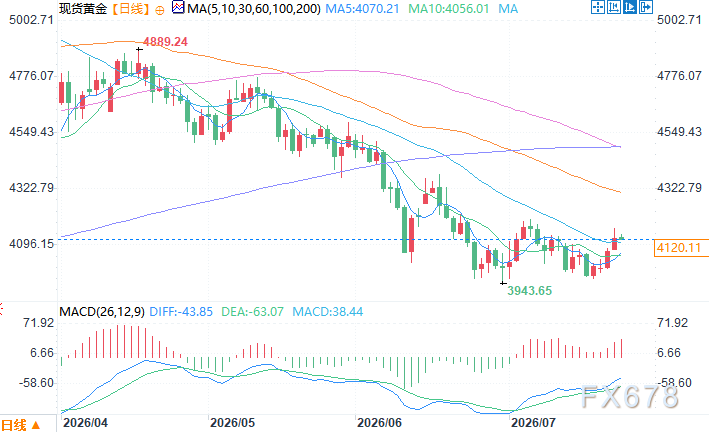
Spot gold daily chart Source: Easy Forex Network
Beijing time, July 23, 10:22 (UTC+8), spot gold quoted at $4,115.75 per ounce
Disclaimer: The content of this article solely reflects the author's opinion and does not represent the platform in any capacity. This article is not intended to serve as a reference for making investment decisions.
You may also like
Shiba Inu rallies to $0.00001004 after exchange debut and Dubai expansion
Nvidia plans to invest $3 billion in SoftBank’s SB Energy, betting on OpenAI's Ohio data center project
Nvidia is reportedly in talks to invest up to $3 billion in SB Energy, a SoftBank subsidiary, as part of a supporting arrangement for providing around $100 billion in credit support to OpenAI's Ohio data center project. The investment is planned to be completed in two phases: $1.5 billion upon signing, and another $1.5 billion when SB Energy goes public—an IPO that could launch as soon as next month, aiming to raise at least $5 billion.
World Liberty Financial Nears Bank Charter After OCC Approval
Cardano Bulls Target $0.25 as Key Warning Signs Emerge

Crypto prices
More


