
Conversation: With a 34.4% hedging ratio, why are exchange losses still increasing?

Morning FX
1. Why are foreign exchange losses increasing?
The article points out: The hedging ratio has increased from 30% to 34.4%, which is indeed an improvement, but it is still far from "fully covered." This is also one of the core reasons why, despite the hedging ratio reaching a new high, foreign exchange losses continue to expand.
This explanation is unscientific.
In practice, companies have a low application rate of hedge accounting, causing the gains and losses of the hedged items and corresponding hedging derivatives to be unable to offset each other. This should be one of the core reasons.
There are actually three accounts related to hedging and foreign exchange: exchange gains and losses corresponding to foreign currency assets and liabilities; changes in fair value corresponding to derivative valuations; and investment gains corresponding to derivative settlement and delivery. If hedge accounting is not used, the gains and losses of the hedged items are reflected in exchange gains and losses; unrealized gains and losses of the derivatives before maturity are reflected in fair value change gains and losses, and after maturity, they are reflected in investment gains.
Take the example of an export company using forwards to hedge foreign currency exposure: A company holds USD 100 million in 3-month accounts receivable, with a contract exchange rate of 7.0 USD/CNY. At the balance sheet date, the rate falls to 6.8, resulting in a CNY 20 million exchange loss. If at the time of signing the trade contract the company also signs a 3-month forward contract locking in an exchange rate of 6.96, then at the balance sheet date, the forward contract has an unrealized gain of CNY 16 million, which is recorded under “fair value change gains and losses” (and transferred to “investment income” at maturity). The financial statement shows an exchange loss of CNY 20 million and a fair value gain of CNY 16 million, so the company’s actual net impact is a loss of only CNY 4 million. However, the separate disclosure will visually exaggerate profit volatility by account.
For example, a certain listed company in the electronics industry recorded CNY 252 million in exchange losses in 2025, but earned a total profit of CNY 1.098 billion from FX derivative transactions, resulting in a net FX profit of CNY 846 million. Examining only the exchange gains and losses account is clearly misleading.

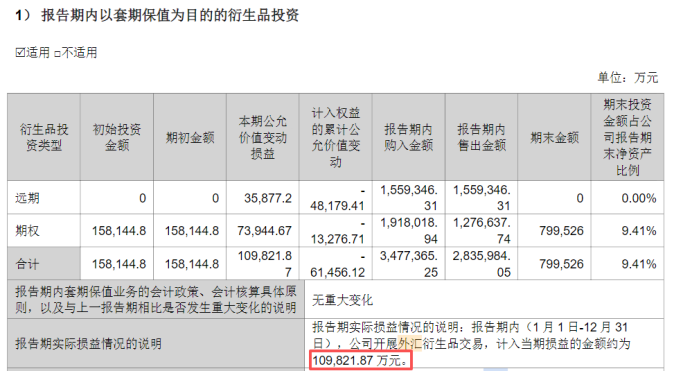
However, what is described in the article, that discount points are becoming a new source of losses, is correct. Export companies do incur losses due to swap point discounts, directly reducing overall settlement gains and amplifying volatility in foreign exchange gains and losses. Deep discounts also significantly dampen the hedging enthusiasm of export companies.
2. What level of hedging ratio is reasonable?
Personally, I believe the core issue is the credit period.
The credit period here refers to the time from contract signing to payment received. The longer the credit period, the more necessary hedging becomes, and the credit period varies greatly across industries. Why do some small e-commerce operators not need to hedge? It’s not just because of their small size, but also because they have almost no credit period. They receive orders, buy goods from the market, ship, and are paid within days.
The credit period can be further broken down into three components: production of goods, transportation of goods, and the payment cycle:
In the production stage, some companies start production only after receiving an order, so the production cycle should be included in the total credit period; other companies continuously produce standardized products and not per order, so their total credit period is naturally shorter.
The length of the transport and payment cycle mainly depends on the settlement method. The most common methods are TT (Telegraphic Transfer), D/A (Documents against Acceptance), and L/C (Letter of Credit). From practical experience, TT seems to be the main method, accounting for 70-80%. TT is further divided into advance TT and post-shipment TT. For exporters, advance TT means the client pays first and then the goods are shipped; post-shipment TT means the company ships first and, after delivery, the client pays. However, regardless of the type, the TT credit period is shorter than that of L/C and collection.
Therefore, to reduce risk, you first need to try to shorten the credit period.
How to shorten the credit period:
1. Strive to use favorable settlement methods.
2. For long-term contracts, try to split payments and receipts into batches at different times, thus averaging out exchange rates through diversification. For example, if a client is scheduled to pay USD 5 million a year later, splitting the payment into 12 batches of USD 416,700 each month reduces risk compared to a lump-sum payment.
3. Utilize trade financing and foreign currency loans to adjust the credit period. For example, if an export company signs a 180-day L/C order, it can use a 180-day export bill advance to receive USD from the bank for immediate settlement, and pay off the advance when the payment is received. This way, the 180-day credit period becomes zero.
Disclaimer: The content of this article solely reflects the author's opinion and does not represent the platform in any capacity. This article is not intended to serve as a reference for making investment decisions.
You may also like
Don’t Blink Now: 4 Altcoins That Could Lead the Wildest Altseason Rally of 2026

Nillion rises 22% following integration of Chainlink’s CCIP
Monster Beverage Corporation stock oversold as sales hit record $2.5B
Nvidia’s SpaceX investment falls from $21 billion to $17 billion after IPO
Crypto prices
More


