
July 23 Financial Morning Brief: Dollar Weakens and Technical Buying Pushes Gold to Two-Week High; U.S. and Iran Exchange Harsh Words; U.S. Oil Targets the $90 Mark

Huitong Network, July 23—— In the early Asian trading session on July 23, spot gold hovered around $4,126/oz. On Wednesday, gold hit a two-week high at $4,165.92/oz, mainly supported by a weaker U.S. dollar and technical buying. Hostilities between the U.S. and Iran continue to escalate, increasing supply risks in the Strait of Hormuz. Oil prices surged more than 2% on Wednesday, with U.S. crude trading near $88.17/barrel and potentially testing the $90/barrel mark during the day.
On Thursday morning (July 23, GMT+8), spot gold traded near $4,126/oz. On Wednesday, gold prices reached a two-week high of $4,165.92/oz, mainly driven by the weakening dollar and technical buying. Hostile actions between the U.S. and Iran continue to escalate, heightening supply risks in the Strait of Hormuz. Oil prices surged over 2% on Wednesday, with U.S. crude currently trading around $88.17/barrel and possibly testing the $90/barrel level intraday.
Key Areas to Watch Today
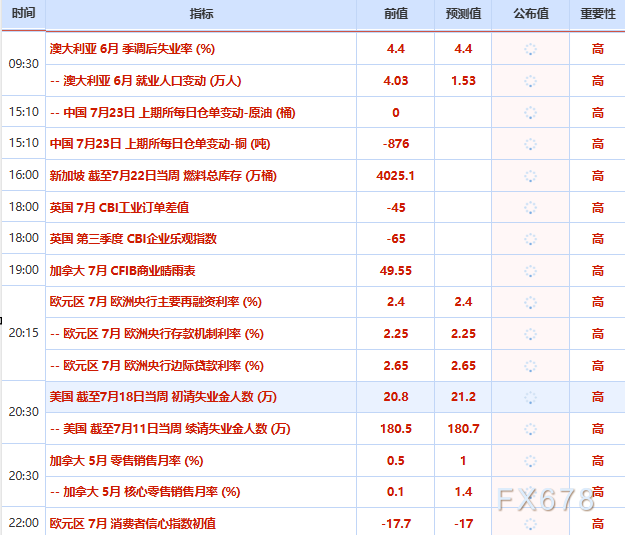
Stock Market
U.S. stocks fell on Wednesday, led by the Nasdaq, which declined 0.57% to 25,690.90 points. The S&P 500 edged down 0.14% to 7,498.96, and the Dow Jones Industrial Average was nearly flat, down just 0.01% to close at 52,218.58. Investors exercised caution ahead of Q2 earnings reports from tech giants such as Alphabet and Tesla, assessing whether the AI-driven rally is sustainable.
The Philadelphia Semiconductor Index closed up 0.4%, rising for a third consecutive trading day, rebounding after confirming a bear market, yet momentum was shaken by weak software stocks and mixed chip performance. Post-earnings, Alphabet closed down 1.5% (as concerns rose over delays to its core AI model), Tesla fell 1.3% during the regular session and dropped another 3% after hours due to negative free cash flow for the first time in over two years. Texas Instruments rose 1% in regular trading but fell after hours, despite its quarterly revenue guidance exceeding expectations.
Meanwhile, intensifying Middle East conflict pushed crude oil futures to a six-week high, as Iran-backed Houthi forces in Yemen threatened Red Sea shipping and U.S. President Trump vowed severe retaliation for any Iranian attacks on ships in the Strait of Hormuz. Higher oil prices have heightened inflation concerns, prompting investors to rotate into defensives such as utilities, while gains in energy and materials stocks reflected the inflationary environment.
With regard to Federal Reserve rates, surveys predict no change for the remainder of 2026, but the risk of hikes remains high. The FedWatch tool shows a roughly 66% probability that rates will remain unchanged next week. Among individual stocks, Super Micro Computer surged 19.8% after announcing over $60 billion in Q4 new orders, leading the S&P 500 and driving Dell Technologies up 9.3%.
Gold Market
Gold prices hit a two-week high on Wednesday, with spot gold rising 1.28% to $4,129.79/oz, at one point reaching $4,165.92, the highest since July 7, mainly on a weaker dollar and technical buying momentum.
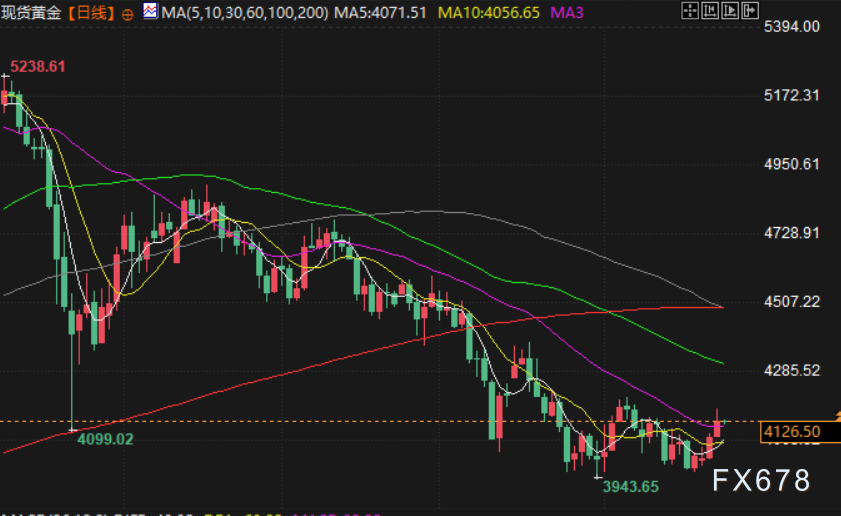
FXTM Senior Research Analyst pointed out that a weak dollar and dip buying injected new momentum but also warned that rising oil prices could limit the upside. Geopolitically, U.S. Secretary of State Rubio stated willingness to negotiate with Iran but said Tehran was not serious, while Iran-backed Houthi militants threatened shipping—causing four Saudi oil tankers to turn back in the Red Sea—pushing oil to a near six-week high and intensifying safe-haven sentiment.
Meanwhile, investors closely monitored the Federal Reserve’s policy outlook. Surveys suggest the Fed may keep rates unchanged for the rest of 2026, though markets expect two hikes by the end of March next year. The CME FedWatch tool indicates about a 76% probability of a rate hike in September. Next week’s Federal Open Market Committee meeting will shed more light on the stance of monetary policy.
Regarding other precious metals, spot silver rose 1.56% to $59.68, platinum was up 0.7% to $1,640.63, and palladium increased 1.4% to $1,299.47.
Oil Market
Oil prices closed Wednesday at the highest since June 11. Brent crude climbed 2.72% to $93.84/barrel (intraday high of $95.44), while U.S. crude rose 2.29% to $86.48/barrel, mainly due to escalating U.S.-Iran hostilities and increased supply risks in the Strait of Hormuz. Iran-backed Houthi militants threatened attacks on Saudi oil tankers via Bab el-Mandeb, announcing a sea blockade and opening a new front—prompting five tankers in the Red Sea to alter course.
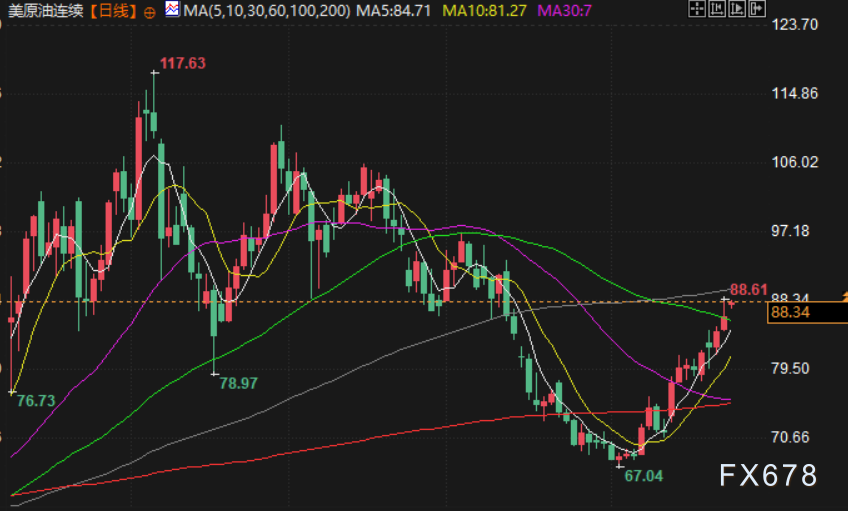
The Brent three-month spread widened to $9.26/barrel (the widest since May 22), reflecting tighter near-term supply. The U.S. military carried out a strike on Iran for the 11th straight night, with Kuwait's military intercepting Iranian drones. Trump threatened to bomb infrastructure if Iran attacked shipping, while Iran's Revolutionary Guard warned that mines had been placed on the southern route of the Strait of Hormuz. The EU naval command advised vessels linked to Israel, the U.S., or Saudi Arabia to avoid the Red Sea and Gulf of Aden. Asian refiners sought to ship Saudi crude via the Suez Canal or around Africa.
Meanwhile, EIA data showed U.S. crude inventories rose 2 million barrels to 411.7 million for the week ending July 17 (expected to drop by 1.1 million), due to lower refinery runs, reduced exports, and increased imports. The market is mainly focused on the impact of geopolitical risks on supply.
Forex Market
The U.S. Dollar Index fell 0.09% on Wednesday to 101.12, weighed by weak inflation data diminishing the urgency for further Fed policy tightening. Meanwhile, escalating Middle East tensions pushed Brent crude to a six-week high and unsettled forex market sentiment due to increased geopolitical risk.
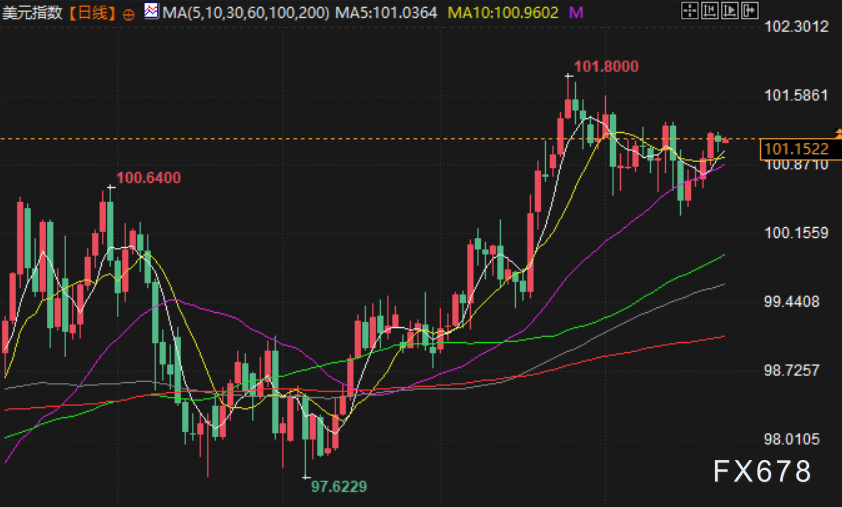
The U.S. dollar rebounded Wednesday from near a 40-year low against the Japanese yen, after media reports suggested BOJ officials are open to raising rates faster than generally anticipated and traders assessed the potential for Tokyo’s intervention. USD/JPY closed down 0.1% to 163.13. Japan’s Finance Minister Katayama Satuki reiterated that authorities would act decisively if necessary to curb excessive yen weakness. However, analysts note that intervention can only buy time, not reverse the trend, unless BOJ policy shifts, and concerns over political intervention in monetary policy have grown following the government’s retention of language urging the BOJ to cooperate with its economic plan in the final version of the blueprint.
In the UK, June inflation fell more than expected (due to lower gasoline prices), dampening the case for further hikes by the Bank of England. GBP/USD edged up 0.07% to 1.3384. The currency markets are now fully pricing in a 25 bp hike this year and about a 60% chance of a second.
International News
On July 22, President Trump stated that from now on, if the Islamic Republic of Iran opens fire on ships in the Strait of Hormuz—whether by missile, rocket, drone or any device or weapon—the United States will bomb and destroy a bridge or power plant, including facilities near or inside the Iranian capital Tehran.
According to CME "FedWatch": The probability that the Fed holds rates unchanged in July is 65.3%, the probability of a cumulative 25bp hike is 34.7%. By September, the probability of rates remaining unchanged is 22%, 25bp hike is 54.9%, and a 50bp cumulative hike is 23%. By December, there is a 9.5% chance of rates being unchanged, a 33.7% chance of a 25bp hike and at least a 56.8% chance of a 50bp hike.
On July 22, an Iranian military source, responding to the latest U.S. threat, said Iran is resolute in exercising sovereignty over the Strait of Hormuz and will never allow it to be used as a tool of threat against Iran. The source said as long as vessels coordinate with Iran and follow its arrangements, passage through the Strait of Hormuz is safe, otherwise, Iran will not yield control to ensure the long-term security of the strait. The military source stressed that if the U.S. attacks Iranian bridges or power plants, Iran will strike regional infrastructure and bridges in kind, including energy facilities with U.S. interests. Earlier in the day, President Trump posted on social media that any Iranian opening of fire in the Strait of Hormuz, by missile, rocket, drone, or other device or weapon, would lead the U.S. to bomb and destroy a bridge or power plant. (CCTV News)
According to Politico, the U.S. House passed a bill on Wednesday aimed at restricting trading of stocks by members of Congress and their families. However, divisions within the Democratic Party emerged as some lawmakers felt the bill lacked strength. The "Stop Trading on Congressional Knowledge Act" was the first stock trading ban for Congress to be voted on by the whole House and passed 232-198, with 13 Democrats voting in favor. Of the bill’s 93 co-sponsors, just two were Democrats. Another, stricter bill—which would have required lawmakers and their families to sell their current individual holdings—had broader bipartisan support but failed to make it to the floor. Most Democrats believe the passed measure is too weak as it doesn't require divestment of existing stocks. The bill moves to the Senate for further review.
The Iranian Islamic Revolutionary Guard Corps Navy stated on July 22 that the route in and out of the Strait of Hormuz is clear and fully under Iranian control. Any alternative routes are unsafe and highly dangerous. They warned all parties not to use these routes or risk severe and irreparable consequences.
On July 22, EU member state diplomats met but failed again to reach a consensus on the 21st round of sanctions against Russia. The new sanctions are reportedly aimed at Russian banking. However, Greece hopes the EU will ease restrictions on Russian LNG supplies. Last week, Greece said a coming ban on LNG transfers from Russia would only shift market share outside Europe and would not affect Russian revenues. (CCTV News)
Iranian Parliament Speaker Qalibaf wrote on social media: "The logic of this war is very clear: either everyone sells oil, or no one does. If we are unable to sell oil in the region, other countries will not be able to either.” He stated that if Iran's security cannot be guaranteed, no infrastructure will be safe. Qalibaf emphasized that security in the Strait of Hormuz depends on the absence of U.S. troops in the region and reiterated that the strait's status will not return to pre-war conditions.
Domestic News
On July 22, Politburo member and Foreign Minister Wang Yi met U.S. Secretary of State Rubio in Manila. Wang noted that this year is a "big year" for China-U.S. relations. The two presidents held a historic summit in Beijing, setting the tone for a constructive, stable strategic relationship and pointing out the direction for joint efforts. This is a significant step toward peaceful coexistence between the two major powers, serves the fundamental interests of both peoples, and meets the expectations of the international community. Our responsibility now is to stay on course set by the leaders, eliminate interference, overcome obstacles, and turn their consensus into whole-of-government, multi-sector consensus and action, thus promoting global peace and stability through China-U.S. strategic stability and providing momentum for international cooperation through constructive interaction. Wang also stated China's stern position on a series of recent U.S. negative actions, called on the U.S. to respect China's core interests, adhere to the one-China principle, properly manage differences, address China's legitimate concerns, and turn the year of opportunity for bilateral relations into reality. Both sides exchanged views on key international and regional issues, agreeing that the meeting was pragmatic, positive, and constructive, and to work towards implementing the important consensus reached by the leaders, using political and diplomatic channels effectively, preparing for the next round of high-level engagements, and making tangible progress towards a constructive and stable China-U.S. strategic relationship. (Xinhua News Agency)
Disclaimer: The content of this article solely reflects the author's opinion and does not represent the platform in any capacity. This article is not intended to serve as a reference for making investment decisions.
You may also like
Capital B buys 5 more Bitcoin, pushing total treasury to 3,145 BTC
Cards Before the Storm: On the Eve of the "AI Stock King" Liquidation, SA Bets Big on Memory Chips, Citadel Fully Hedged, and Jane Street Faces Massive Losses Despite Hundreds of Billions in Hedges
SA, Citadel Investment, and Jane Street have recently released their Q2 holdings reports (13F) for the period ending June 30, 2026.

14 consecutive quarters of net selling ends! Berkshire Q2 “spends big on stocks”: Google (GOOGL.US) rises to third largest holding, Delta Air Lines (DAL.US) and real estate stocks receive major investment
Berkshire Hathaway has submitted its Q2 holdings report (13F) for the period ending June 30, 2026.

Altcoin LINK Flashes Most Brutal Bull Pattern of the Year, Could the Asset Pull a 200% Pump Again?

Crypto prices
More


