
The Best Summer Got Liquidated

On July 20, Reuters reported the story of a Korean university student.
Lee Seungho, 24 years old, saved 20 million Korean won during his military service, then invested in the stock market with 5x leverage, growing his account to almost 300 million won at one point. Within a few weeks, however, sharp market fluctuations triggered a forced liquidation by his broker, wiping out all profits and even eating into his principal
He said he felt unable to breathe, but he didn't leave the market because of this. Instead, he plans to come back with leverage once again after accumulating enough capital. For him, the average price of an apartment in Seoul is about 14 years of his salary, while 5x leverage, at least on the surface, could potentially shorten those 14 years.
This young man's account almost encapsulates the dramatic transition in the Korean stock market—from "the best summer in adulthood" to "one out of every 30 Korean adults receiving a margin call".
In the first half of 2026, the KOSPI once more than doubled, making it the best-performing major index in the world. Samsung Electronics and SK Hynix reaped massive profits from the AI storage cycle, enticing Koreans to bet their savings and loans on the market. In late May, to keep more speculative capital at home, major Korean asset management companies quickly launched domestic 2x leveraged ETFs focused on Samsung and SK Hynix for local investors caught in FOMO. Why are storage chips becoming more expensive?
However, after reaching a record high on June 19, the KOSPI entered a volatile "monkey market."
As of July 21, in just 22 trading days, the Korean stock market triggered 13 intraday trading halts and four circuit breakers. In a month, after several rounds of forced liquidations and attempted bottom-fishing, the KOSPI fell 25%, with volatility reaching levels rarely seen since the Asian financial crisis.
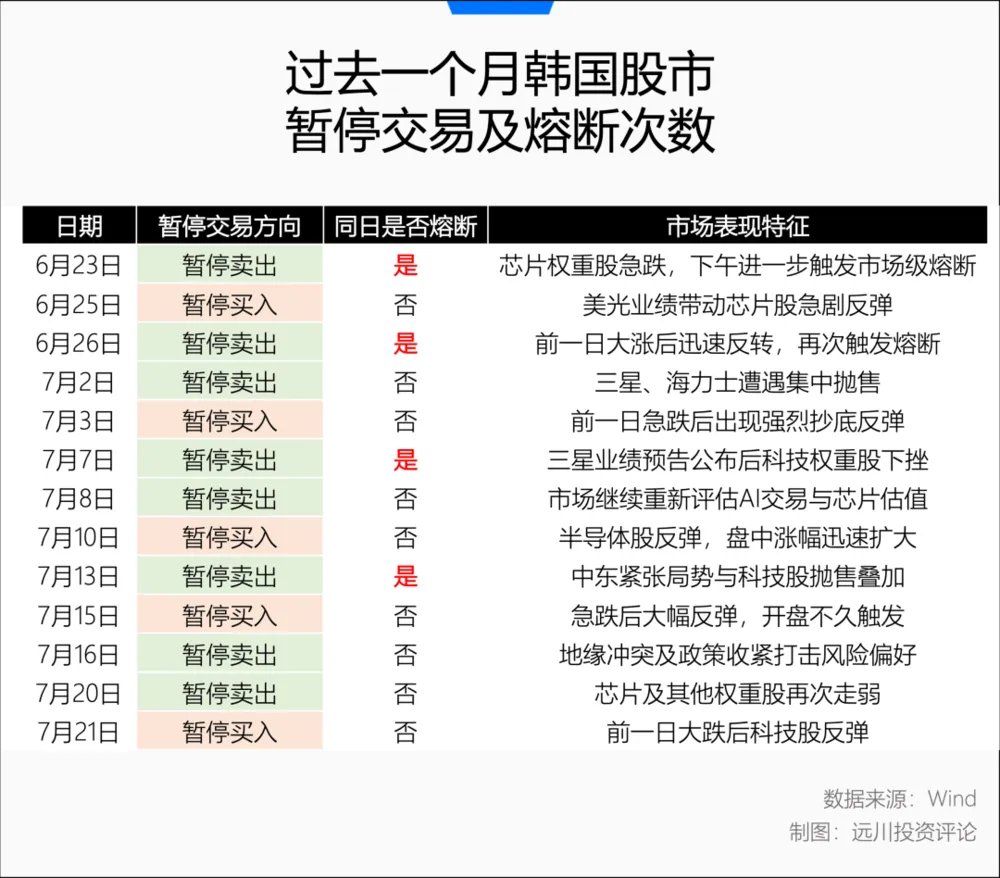
Goldman Sachs estimates that as of July 13, more than 1.2 million retail leverage accounts in the Korean market had triggered margin calls, with approximately 320,000 to 360,000 accounts forcibly liquidated by brokers.
While the industrial fundamentals have not changed, some investors had already left the market for half a month only to return with zeroed-out accounts. Leverage seems to be the keyword to understanding everything—the more intense the passion during the leverage buildup, the greater the panic when forced to deleverage.
On July 16, as the Bank of Korea raised the base rate from 2.5% to 2.75% on inflation worries, regulators on the same day urgently suspended new single-stock leveraged ETFs and raised the minimum retail investment threshold for such products from 10 million to 30 million won.
Under this cooling-off combination, regulators may not like to burst speculative bubbles as directly as Japan did in the 1990s, but they believe it's their responsibility to decide what type of prosperity is worth sustaining.
I. How to Keep the Money Home
Before "AI deleveraging" became the market's keyword since July, leverage first had to be built up.
No financial regulator in any country is ever careless about leverage. But in late May, the Korean market faced a more pressing contradiction—during the ongoing memory supercycle, two Korean giants generated profits that even Trump would envy. Without domestic leverage products, nothing would stop Koreans from taking leverage overseas.
The US and Hong Kong markets already had various single-stock leveraged ETFs. Korean investors could easily use local brokerage apps to buy 2x long Tesla or NVIDIA products, or buy 2x Samsung or SK Hynix products listed in Hong Kong.
For Korean investors, this only meant a difference in trading venue and fees. Compared to absolute returns, such inconveniences are negligible. But for the Korean government, it implied an outflow of capital, trading volume, and management fees, and exerted depreciation pressure on the Korean won.
On April 28, Korea hastily revised the rules for leveraged products. Previously, Korean ETFs had to invest in at least ten assets, with no single asset exceeding 30%, thus prohibiting funds tracking just one company. The new rule removed this barrier, allowing blue-chip single-stock ETFs on the domestic market, and permitting maximum exposure up to 2x of the underlying stock.
A month later, 16 new 2x leveraged ETFs on Samsung or SK Hynix were listed in Korea's local market.
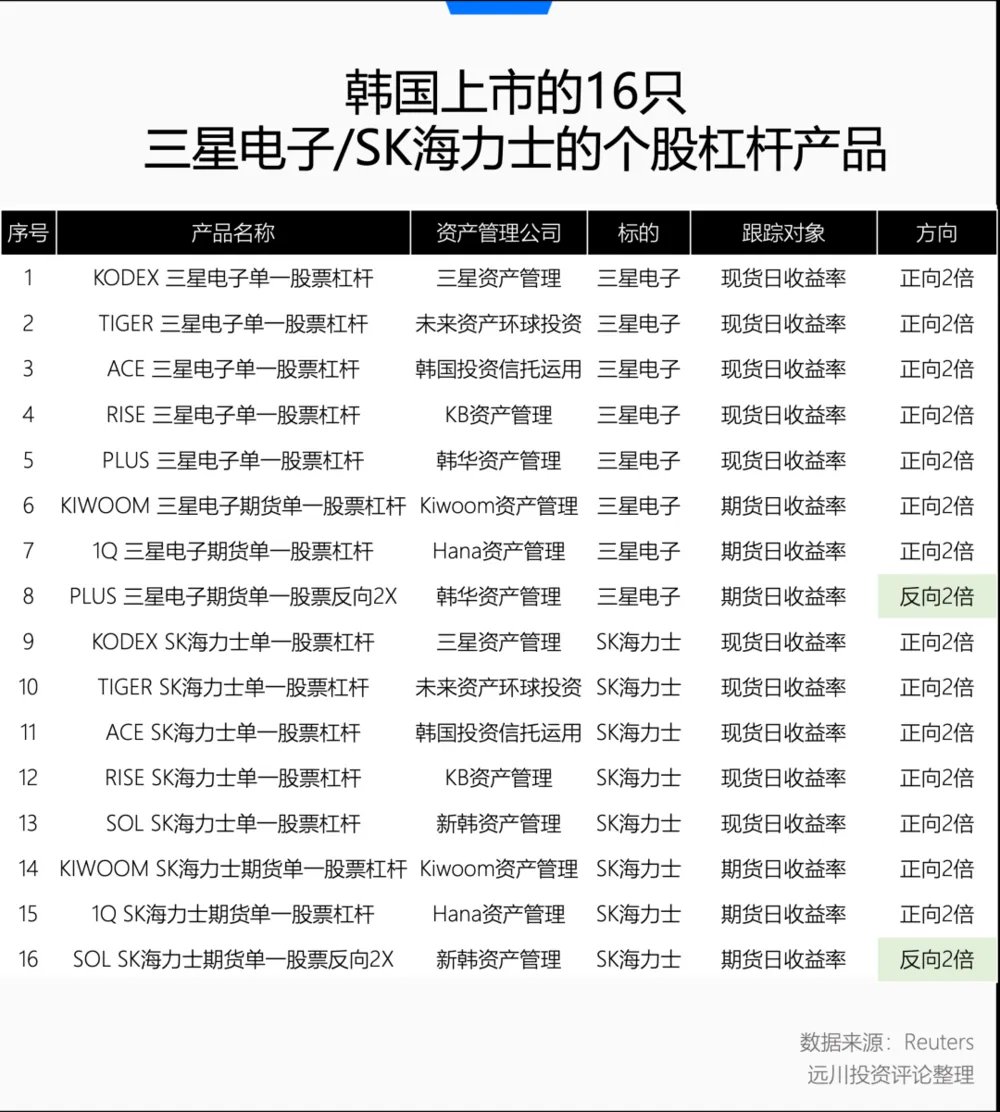
Balancing risks around leverage and the currency, Korean regulators set an East Asian "exam culture"-style qualifying threshold for these products.
To buy single-stock leveraged ETFs, not only did investors need at least 10 million won in their accounts, but they also had to complete a two-hour intensive course on negative compounding, premiums and discounts, and the risks of leverage.
But exam requirements can't stop the investors of the "castle in the sky." As a large number of retail traders crowded onto the Korea Financial Investment Association website for the training, the site briefly crashed. Within a few days, 350,000 Korean investors completed the course.
Within three days of listing, the 16 funds saw a combined trading volume of 28 trillion won, 5.5 times their combined net asset value. After three weeks, the size of just the long products exceeded 14 trillion won.
According to Goldman Sachs, by June 22, the total asset size of domestic and overseas leveraged ETFs tracking Samsung and SK Hynix reached a peak of $53 billion.
At a press conference held the same day, Financial Supervisory Service Chairman Lee Chan-joon candidly stated: "We hurried to launch single-stock leveraged ETFs to address the surging exchange rate and to bring back speculative funds that were focusing on Hong Kong-listed leveraged ETFs. But in hindsight, the results were minimal and even brought side effects
However, by July 16, the total size of these leveraged ETFs had nearly halved in less than a month, dropping to about $28 billion
A popular term once circulated in Korea—"bolt-from-the-blue poverty"—which refers to how, when house and stock prices soar rapidly, people without assets suddenly realize the gap between themselves and asset owners has overnight widened, even if their income hasn't dropped.
As Samsung and SK Hynix became the brightest stars in the eastern hemisphere's night sky amid the super storage cycle, this sentiment reoccurred. They offered an almost irrefutable industrial story. What happened in the Korean market is not that people believed in a false narrative but that a genuine uptrend made more and more people believe they shouldn't miss out.
But for those who arrive only after stocks have doubled or tripled, being late itself creates demand for leverage.
The later you join, the more you need to borrow to make up for missed gains; the more afraid you are of being left behind by the times, the more you want to use leverage to compress your road to financial freedom into a single sprint.
II. Is Wall Street to Blame Again?
Every leveraged trade has the same premise: the music must continue for the dancing to go on—an overcrowded ballroom can't withstand a rush for the exits.
The first to leave were foreign investors.
As the memory rally went up, Samsung and SK Hynix’s market capitalization not only dominated half the KOSPI index but also passively raised their weighting in global fund portfolios. Many foreign allocators did not need a strong reason to question the AI industry's outlook. They simply had to rebalance so that a single country, a single sector, and two stocks wouldn’t become too concentrated in their portfolios.
In the first half of 2026, foreign capital saw a net outflow of approximately $70.8 billion from the Korean stock market, including $12.63 billion in June alone. By mid-July, the cumulative divestment was close to $110 billion[4].
Judging by SK Hynix's ADR issuance in the US, foreign investors leaving Korea doesn't mean global capital has abandoned the memory supercycle.
In July, SK Hynix issued ADRs on Nasdaq, raising $26.5 billion—a record for foreign companies on the US market—and was oversubscribed seven times. Global funds are still keen on HBM's scarcity value, opting increasingly to buy the same company's shares in the US dollar system, New York time zone, and with higher liquidity.
Overseas sales motivation might just be profit taking, portfolio management, or switching to dollars for their own settlements; trading systems don't record motives. Whether fund managers are still bullish on HBM or not, all the Korean market sees are cold sell orders.
The danger in market deleveraging is that once the chain reaction starts, there’s no need for new bad news—downtrends become self-perpetuating: foreign investors sell Korean stocks → KOSPI falls → leveraged ETFs are forced to reduce exposure → margin accounts are called → forced liquidation by brokers → further declines in Korean stocks.
As long as the selling speed of foreign investors exceeds the entry of new leveraged money, bottom-fishing can't end the pain of deleveraging and only moves the next wave of forced liquidation to other accounts.
This also explains an anomaly in this selloff.
On July 7, Samsung Electronics announced its Q2 earnings outlook: revenue of about 171 trillion won, operating profit about 89.4 trillion won, an increase of about 129% and 19 times, respectively, over the previous year, and profits surpassing market expectations.
Yet Samsung’s stock still dropped 6.9% on the day these prospects were released. Clearly, even the best earnings report doesn’t directly inject liquidity into the market, can’t substitute for margin replenishment, and can’t change the rule of leveraged ETFs having to reduce positions passively.
In July’s dramatic AI deleveraging, the market’s core issue was not whether "AI will keep developing," but rather "who else is left to buy." Fundamentals can explain why a company may ultimately realize its value; trading structure determines how far a price can fall before that value is realized.
Fundamentals only affect voluntary trading. Investors may buy because profits are growing or hold because valuations are cheap. But deleveraging is forced trading; brokers, risk models, and ETF rebalancing mechanisms don’t need to judge industries at all.
In a market that’s extremely crowded, leverage highly concentrated, and new money drying up, fundamentals don’t need to actually worsen to temporarily lose their pricing power.
III. Epilogue
Korean sociologist Chang Kyung-sup describes Korea’s development experience as “compressed modernity.”
In his definition, Korea rapidly achieved industrialization, urbanization, democratization, and globalization. Social and institutional changes that took generations in other countries were compressed into decades; traditional familial obligations, modern market competition, and global capitalism coexist and constantly exert pressure on individuals.
From postwar poverty to industrial power, from steel giant to memory chip giant, Korean companies covered a century's worth of industrial evolution in just decades. Even SK Hynix’s own corporate story is a tale of intense compression—its global yield and market share in HBM was won in a high-risk gamble when the company was on the brink of bankruptcy.
The same compression appeared in the capital markets.
An AI industry cycle that should have taken years to play out was compressed into a few months of stock gains; what normally required occupation, savings, and generational accumulation for a wealth leap was compressed into a few months of leveraged trading in a securities account.
The most brutal and chaotic part of this round is that Koreans didn’t borrow money to buy a bunch of unprofitable junk companies. On the contrary, they bet on the two most profitable, most important, and most representative companies of Korea’s AI era.
The only remaining problem, it seems, is too little principal and too late an entry.
Borrowing money can certainly speed up the wait, but it also compresses the margin for error. Investors without leverage can keep waiting after being wrong; those with leverage, even if they eventually turn out right, might be wiped out before the answer comes due.
Korea’s best summer didn’t cool off because the AI industry entered a winter.
Samsung is still making money, SK Hynix still wants to hike HBM prices, and the memory cycle hasn’t ended because of this correction. What really blew up was an imagination about time: that as long as the direction is right, you can borrow a little more money and bring tomorrow’s wealth forward to today.
Good companies can survive cycles, but they can never carry the burden of a bad balance sheet for investors.
Disclaimer: The content of this article solely reflects the author's opinion and does not represent the platform in any capacity. This article is not intended to serve as a reference for making investment decisions.
You may also like
Ethereum (ETH) Breaks Above $1.9K: How Close Is the Push Toward $2K? post-165832 post-165832 post-165832
Capital B buys 5 more Bitcoin, pushing total treasury to 3,145 BTC
Cards Before the Storm: On the Eve of the "AI Stock King" Liquidation, SA Bets Big on Memory Chips, Citadel Fully Hedged, and Jane Street Faces Massive Losses Despite Hundreds of Billions in Hedges
SA, Citadel Investment, and Jane Street have recently released their Q2 holdings reports (13F) for the period ending June 30, 2026.

14 consecutive quarters of net selling ends! Berkshire Q2 “spends big on stocks”: Google (GOOGL.US) rises to third largest holding, Delta Air Lines (DAL.US) and real estate stocks receive major investment
Berkshire Hathaway has submitted its Q2 holdings report (13F) for the period ending June 30, 2026.

Crypto prices
More


