
Institutional Report: Significant East-West Divergence, Central Banks’ Long-term Continued Accumulation Supports Gold's Long Bull Market

FX Markets, July 22 - Schroders' research report points out that the gold price sharply dropped nearly 12% in June, with a clear divergence of capital flows: Western investors continue to reduce holdings, while Asian funds and emerging market central banks buy gold on dips. The massive US debt restricts the Fed's room for further rate hikes, and the gold price may bottom out in the next three to six months. Central banks, represented by major Asian economies and Poland, are advancing reserve diversification. With a lengthy gold purchase cycle, sustained central bank accumulation will become the core force supporting a prolonged bullish trend in gold.
Schroders' precious metals analysts released a monthly outlook, pointing out that gold prices pulled back by close to 12% in June, with a marked East-West capital divide. Asian investors continue to buy gold on dips, while Western investors persistently reduce exposure. Eastern emerging market central banks are using the declining gold prices as a strategic opportunity to increase holdings for long-term reserve diversification. Constrained by the massive scale of debt, the Fed’s room for continued rate hikes is limited, and the gold price is expected to find a bottom over the next three to six months. The wave of gold buying by emerging market central banks, represented by major Asian economies and Poland, is far from over. Sustained central bank accumulation will be the core pillar supporting a long-term bull market in gold.
Diverging Capital Patterns, Divergent Bull/Bear Logic
During the current gold price correction, there has been a pronounced contrast in trading behavior between East and West. Emerging market central banks in the East regard the gold price correction as a window of opportunity, making significant purchases to diversify reserves in the long term. In contrast, Western investors are continuously closing positions and leaving the market, betting mainly on the Fed maintaining a hawkish monetary stance. Some market participants speculate that the Fed's policy framework could change after Kevin Warsh assumes office.
There is internal disagreement among institutions about the Fed’s future policy direction. David Rees, Head of Economic Research at Schroders, worries about broadening inflation and an overheating economy, which may trigger rate hikes. However, the precious metals team believes that tail risks of inflation fueled by energy are cooling, long-term inflation expectations are significantly falling, and labor market data is mixed, with no sustained wage inflation. The continuous decline in labor participation has suppressed the rise in the unemployment rate; once the unemployment rate breaks through 5%, market expectations for monetary policy may quickly reverse.
Fiscal Constraints Emerge, Fed Faces Rate-Hike Ceiling
Currently, the world has entered a fiscally dominated phase, greatly limiting the Fed’s ability to raise rates. In the coming year, the amount of maturing and reissued US Treasury bonds could reach $8 to $10 trillion. Coupled with high deficit financing needs, the pressure of issuing bonds is unprecedented, with interest expenses on Treasuries already surpassing the defense budget. The market is beginning to discuss a key question: Will high debt weaken the transmission effect of monetary policy? Though rate hikes increase borrowing costs, they also raise fixed income asset interest receipts. The actual effect of tightening policy is diminished, further restricting the space for aggressive Fed tightening.
The mainstream market expectation is that, as hawkish expectations are gradually absorbed, gold prices will find a cyclical bottom within three to six months.
The Wave of Gold Purchases by Emerging Market Central Banks is Sustainable
Major Asian central banks are the world’s most important sovereign buyers. Ongoing gold buying not only creates direct physical demand but also sends strong signals, spurring domestic demand and leading other central banks to follow suit. Data show that with gold prices above $5,000, the central bank’s monthly purchases are only 2 tons; as gold fell to around $4,250 in June, the average monthly accumulation reached 15 tons—a scale increase of more than seven fold. Schroders judges that the actual purchase scale may be higher than disclosed. Historically, central banks have often revealed large, previously undisclosed accumulations in centralized disclosures. Amid global geopolitical realignments, selective disclosure of reserve changes is a rational strategy.
Long-term Gold Purchase Potential, Solid Support for Gold’s Bull Market
Calculations show that at a gold price of $4,200, gold accounts for only 8.3% of major Asian economies’ FX reserves. To boost it to a reference target of 30%—maintaining an average monthly purchase of 15 tons—would require continued buying for 33 years. This means major Asian central banks’ gold purchase cycle is extremely lengthy.
Globally, referencing this allocation target, other national central banks also have significant room to increase holdings. Against the backdrop of continuous central bank allocation to gold, the fundamental logic for gold’s long-term upward trend is hard to shake.
Summary
Overall, short-term capital outflows from the West have put pressure on the gold price, but Asian investment and central bank buying on dips provide a counterbalance. High federal debt restricts the Fed’s rate-hike room, and bearish expectations will eventually be absorbed. More importantly, the long-term trend of reserve diversification by global central banks remains unchanged. Continued gold accumulation, represented by major Asian countries and Poland, establishes solid long-term support for gold. Short-term market volatility cannot reverse the big cycle pattern, and over the mid-to-long term, gold remains highly valuable as an asset allocation.
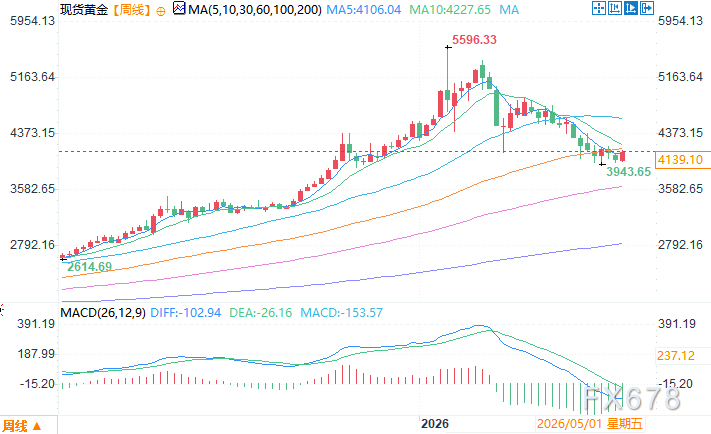
Spot gold weekly chart source: EasyFX
East 8th District July 22, 12:00 (UTC+8) spot gold quoted at $4,130.10 per ounce
Disclaimer: The content of this article solely reflects the author's opinion and does not represent the platform in any capacity. This article is not intended to serve as a reference for making investment decisions.
You may also like
Institutional XRP Exposure Gains Ground

Crypto Investment Fundamentals Split Market: Tokens Fall 36% as Stocks Jump 23%
Bloomberg’s Mike McGlone warns Bitcoin could fall to $10,000 as tech stocks rally
3 Altcoins Set to Shine in 2026: Top Picks, Catalysts, and Market Trends

Crypto prices
More


