
The AI bull market reaches a crossroads! Wall Street stages a rare and fierce bull-bear debate


Hard·AI
Author | Zhao Ying
Editor | Hard AI
As artificial intelligence trading enters its third year, Wall Street is experiencing an unusual public split in judgment regarding the nature of this trend.
Recently, top macroeconomists at BCA Research have launched an internal bull-bear debate on the AI trade, with both sides expressing sharply opposing views.The bears argue that U.S. stocks are currently in a profit bubble, with valuations reflecting the most optimistic scenarios, leaving almost no room for positive surprises;
The bulls, however, insist that the computing power market remains undersupplied, the returns on capital expenditures are seriously underestimated by the market, and the breadth of profit growth far exceeds external perceptions.The core of this debate is not whether AI is real, but how long the party will last, and what price the market will pay when it ends.
On Monday, major U.S. stock indexes closed lower: the S&P 500 fell by 0.2%, the Dow Jones Industrial Average slid 0.6%, while the Nasdaq Composite was little changed.
01
Bears: Profit bubble has formed, valuations exceed the 2000 dot-com peak
BCA Research's Chief Economist Peter Berezin and Chief Macro & Emerging Markets Strategist Arthur Budaghyan clearly expressed a bearish stance during last week’s bull-bear debate webcast. They argue that U.S. stocks are currently experiencing a profit bubble–the numbers appear robust but profit margins are far less sustainable than they look, and valuations have already priced in the most optimistic outcomes.
From a valuation perspective, nearly all metrics indicate that stocks are expensive. If the S&P 500’s profit margin is rolled back to 2019 levels, its current forward P/E ratio is about 27x, higher than the 26.5x historic peak in March 2000.Even excluding tech and financial stocks, the rest of the market isn’t cheap either: according to BCA Research and FactSet data, these parts are trading at 26x rolling P/E, while profits over the past two to three years have grown only about 3%.
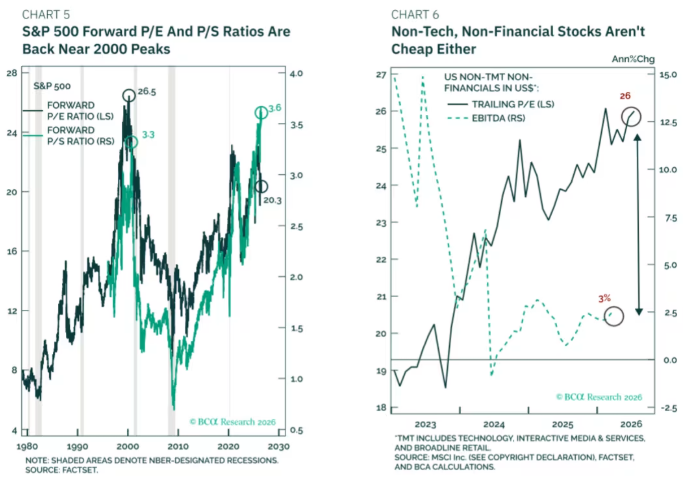
On the issue of AI capital expenditures, Berezin and Budaghyan point out that large tech hyperscalers are collectively pouring hundreds of billions of dollars into data centers, specialized chips, power grids, and energy upgrades. Although these massive capital expenditures boost reported profits, they are eroding real cash flows. "Each chip sold is reported as revenue and profit by the vendor, while the hyperscaler buying the chip classifies it as capex not operating expense, so reported profit rises but cash flow does not increase in tandem," they said.
Berezin further noted, "AI may eventually follow the path of the development of electricity—it improves corporate efficiency, but if everyone gets it, it might not actually make companies more profitable."
02
Bulls: Shortage of computing power, hyperscaler valuations at ten-year lows
On the other hand, BCA Research’s Head of Portfolio Construction Juan Correa and Director of Equity Research Noah Weisberger take a diametrically opposite position. They believe the computing power market remains undersupplied, the market is underestimating (not overestimating) returns on capex, and profit growth extends far beyond the few companies normally associated with AI.
On the demand side, BCA Research data shows hyperscaler cloud backlogs—orders received but not yet fulfilled—have risen by about $750 billion over the past two quarters, indicating industry demand still exceeds supply.
On valuations, Correa and Weisberger argue that while concerns about high valuations are common, hyperscalers are actually trading at their lowest multiples in nearly a decade, even as their returns continue to improve.
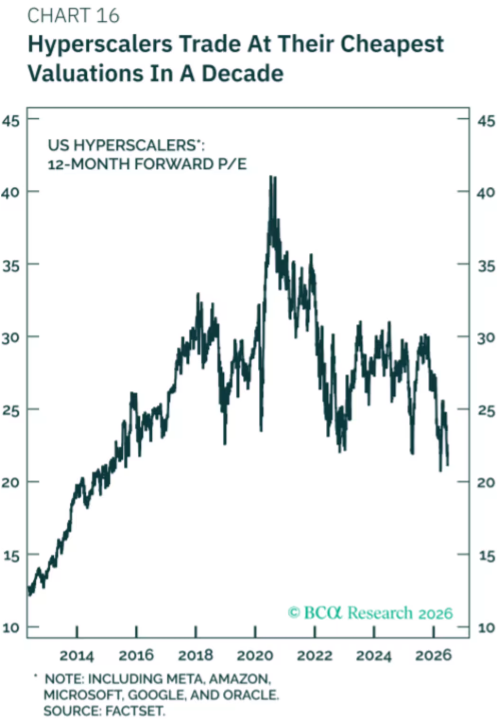
From a broader earnings perspective, this year's rental price for next-generation GPUs has continued to climb, contract values for cloud services have nearly doubled per megawatt year-on-year, and the ratio of EBIT to headcount has surged; beyond core cloud profits, earnings are growing fast including AI-driven ad revenue growth at Meta and a strong rebound in Google’s search business. “The market will be wowed by the actual earnings generated by these capital outlays in the next two quarters,” they predict.
01
Key Point of Dispute: Not "if", but "when" and "how it will end"
It's worth noting that the bull-bear debate is not about the authenticity of AI technology itself—both sides agree that AI is fundamentally reshaping productivity, capital allocation, and the workforce. There is no dispute on this premise.
The real disagreement is about timing:how much longer AI spending mania can outrun skepticism, and how severe the fallout will be when the market finally reckons with reality.
Interestingly, even the bulls admit the trade will eventually end badly. “The capital expenditure trade will eventually end, and likely disruptively,” Correa and Weisberger state. “But for now, economic and fundamental tailwinds will dominate. For the bulls, the biggest worry is valuation compression rather than recession or profit collapse.”
This means that whether investors realize it or not, they are already caught up in this debate—the answer will be provided by the market over the coming quarters.
Hard·AI

Disclaimer: The content of this article solely reflects the author's opinion and does not represent the platform in any capacity. This article is not intended to serve as a reference for making investment decisions.
You may also like
Why Prediction-Market Signals Rarely Override Crypto Investors’ Existing Bets
Indian Rupee holds ground despite RBI ending FCNR forex swap window early
The AI bull market has entered the "realization era"! Morgan Stanley and JPMorgan both target S&P 8000, with semiconductors and the South Korean stock market mounting a strong comeback, confirming the "main wave of profit growth."
Wall Street's two major financial giants—Morgan Stanley and JPMorgan—recently released research reports in sync, stating that the primary driver pushing the S&P 500 higher is shifting from valuation expansion to upward earnings revisions and the realization of AI commercialization.

Senate’s August recess casts doubt on CLARITY Act’s path to passage this year
Crypto prices
More


