
IBM Q2 Earnings Preview: Delayed Deal Closures Take Center Stage — Can Red Hat Sustain the Software Narrative?
 2026/07/21 03:58
1. Investment Highlights Snapshot
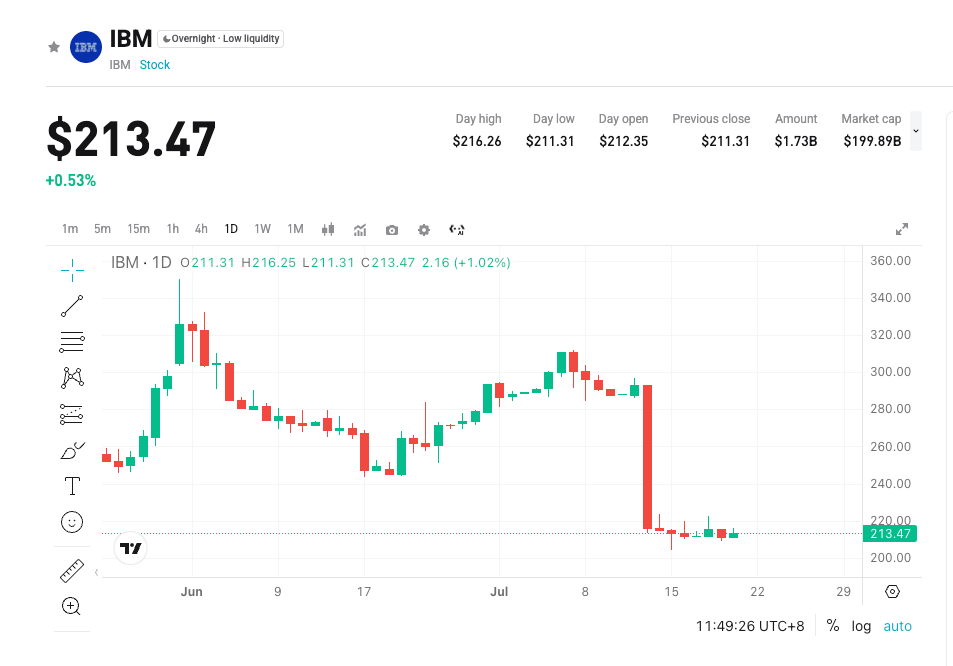
IBM will release its official Q2 results and hold a conference call on July 22 at 5:00 p.m. ET. The company already pre-announced preliminary figures on July 14: revenue of $17.2 billion (+1% YoY), below Wall Street expectations of approximately $17.86 billion; operating (non-GAAP) EPS of $2.93 (+5% YoY), also short of the consensus estimate of around $3.01. The market’s focus is no longer on confirming the single-quarter numbers, but on whether delayed large deals can be recovered in the second half, the quality of Red Hat’s growth, and whether full-year guidance needs to be revised lower.
2. Four Key Focus Areas
Focus 1: The True Nature of Delayed Large Deals
CEO Arvind Krishna explicitly acknowledged that the company did not adapt quickly enough to clients’ budget re-prioritization, and numerous large deals failed to close on the expected timelines — the primary driver of the revenue shortfall. In the final weeks of June, clients shifted quarterly capex toward servers, storage, and memory to secure supply-constrained infrastructure ahead of potential price increases, while also being distracted by rapidly evolving industry-wide cybersecurity concerns. The formal results must quantify whether these delayed deals represent pure timing shifts, reductions, or cancellations, as this will directly determine second-half revenue visibility.
Focus 2: Red Hat Growth Quality vs. Overall Software Slowdown
Red Hat revenue growth accelerated sequentially to 11%, one of the few bright spots in software. However, total software revenue rose only 5%, well below the 11% growth recorded in Q1. The gap was mainly driven by weakness in high-margin Transaction Processing and related mainframe software. Investors should assess whether Red Hat’s growth is underpinned by renewals, OpenShift workloads, and new subscriptions rather than currency or pricing effects, and whether Transaction Processing expectations for the full year will be adjusted.
Focus 3: Sharp Divergence Within Infrastructure
Infrastructure revenue declined 7% overall, but the internal picture was highly polarized. Distributed Infrastructure delivered a record 37% increase (strong Power and Storage performance) and exited the quarter with a backlog of approximately $500 million. Meanwhile, the z17 program remains at nearly 130% program-to-program (well ahead of z16), yet quarterly deal closures fell significantly short of expectations. Formal disclosures should break out the respective contributions of z17 and Distributed Infrastructure to prevent the market from incorrectly concluding that mainframe demand is structurally weakening.
Focus 4: Margin Resilience and Free Cash Flow Strength
First-half free cash flow reached $4.8 billion. Although GAAP gross and pre-tax margins came under pressure, operating (non-GAAP) pre-tax income margin still expanded by 30 basis points. The market will test whether IBM can maintain its defensive characteristics through cost discipline and its high-margin software mix while revenue is temporarily constrained, and whether the full-year free cash flow target remains intact.
3. Risks and Opportunities
Upside Catalysts:
- Concentrated conversion of delayed deals in the second half, driving sequential improvement in both software and infrastructure.
- Sustained double-digit Red Hat growth, combined with cross-selling from HashiCorp and Confluent, lifting organic software momentum.
- Management provides a verifiable conversion roadmap and maintains or slightly raises full-year guidance.
Downside Risks:
- Delayed deals are reduced or cancelled, forcing a downward revision to full-year revenue growth guidance.
- Continued weakness in Transaction Processing drags on the high-margin software mix and overall profitability.
- Clients permanently re-prioritize capital spending toward general-purpose servers and storage, leading to structural softness in mainframe-related software demand.
4. Trading Strategy Considerations
Bull Case: Clear evidence of delayed-deal conversion, quantified positive signals from Red Hat and Distributed Infrastructure, and no meaningful reduction in full-year guidance could allow the stock to recover from the post-pre-announcement sell-off.
Bear Case: Management fails to provide a credible recovery timeline or explicitly lowers full-year revenue and free cash flow targets, potentially triggering a second round of valuation compression.
Key Metrics to Watch:
- Software sub-segment breakdown (especially Transaction Processing and Red Hat ARR/bookings)
- Specific contributions from z17 versus Distributed Infrastructure and changes in backlog
- Magnitude of any full-year revenue and free cash flow guidance adjustments
- Consulting signings and GenAI-related contribution
Tactical Notes: Volatility around the release is likely to be elevated. Focus on the marginal language around deal conversion and client budget trends during the conference call rather than the already-known headline numbers. Position sizing should reflect an event-driven approach and avoid heavy directional bets while guidance uncertainty remains high.
Stock Limited-time Offer:July new user gift: Buy U.S. stocks and get free NVIDIA stock.Trade Now for Better Deals
Have a view but unsure about position sizing? Click how to use options to cap your downside while keeping upside potential during earnings season. Happy trading! 📈"
Disclaimer: The above content is for reference only and does not constitute investment advice.
Disclaimer: The content of this article solely reflects the author's opinion and does not represent the platform in any capacity. This article is not intended to serve as a reference for making investment decisions.
You may also like
Robinhood Chain sees nasty retrace with only 5 tokens above $10M market cap
XRP holds key trendline as SBI Shinsei Bank launches retail rewards program
Tether Gold leads market cap growth in tokenized gold assets, adding $237M
Aave becomes the dominant DeFi venue for tokenized gold deposits
Crypto prices
More


