
Analyst: Interest rate trends are the core pricing logic; gold and silver still face short-term downside risks

FX168 July 21,—— StoneX analyst Rhona O’Connell pointed out that the US-Iran conflict is unlikely to boost gold and silver; interest rates remain the core pricing logic, and precious metals face considerable downside risks. Physical demand from India provides only limited support, while rising US Treasury yields continue to pressure gold and silver prices. Federal Reserve officials are divided, and there remains a possibility of a rate hike at the July policy meeting. Net long positions in gold and silver futures are far below their multi-year averages, and global precious metals ETFs continue net outflows, with only a small amount of short-term bottom-fishing; overall, market liquidity is weak.
Rhona O’Connell, Head of Market Analysis for EMEA and Asia at StoneX, highlighted in her weekly precious metals analysis report that even if US-Iran tensions continue to escalate, the trend of interest rates remains the dominant factor for gold and silver prices, leaving these two major precious metals under downward pressure.
From multiple perspectives—physical demand, inflation data, crude oil trends, Federal Reserve policy, derivative and ETF positions—the consistently rising 10-year US Treasury yield forms a long-lasting suppression. Capital is flowing out of precious metals from both the long and short sides, with only weak support coming from India’s physical demand; the Federal Reserve will hold its policy meeting from July 28 to 29, and the rate decision will be announced at 2:00 am Beijing time on July 30. With officials divided, the ongoing expectation of tightening policy continues to suppress precious metals valuations.
Diverging Physical Demand, Limited Power to Reverse Weak Gold and Silver Prices
O’Connell noted that previous market uncertainties kept retail investors on the sidelines, with small-scale buying in some Far Eastern regions, but this was offset by synchronized selling in other regional markets, resulting in overall demand largely cancelling out. Trading in gold has been quiet in the Middle East, with gold prices long trading at a discount. As the world’s largest market for silver jewelry consumption, India accounts for 90% of global demand for silver jewelry; there, interest in buying gold and silver has only slightly warmed, providing limited support and not enough to drive a price rebound.
Professional institutions only engage in short-term trades when interest rates are released or when there are sudden geopolitical headlines; they remain on the sidelines during regular periods, causing a lack of sustained buying power. Gold and silver are likely to remain in a narrow range with the probability of further decline higher than a sustained upward move.
Inflation Lags Behind Oil Price Changes, Creating a Dilemma for Federal Reserve Policy
The breakdown of June’s CPI figures shows energy as a prominent driver of inflation that month, accounting for 80% of consumer spending. The transmission of higher energy prices to transport and manufacturing sectors has further pushed up overall prices. The complete easing of inflation in June was entirely due to the short-term drop in energy prices, and institutions expect inflation data for July to rebound. While West Texas Intermediate crude oil has retreated from April highs, it remains up strongly year-on-year; Middle East geopolitical risks keep oil prices elevated. Even if geopolitical premiums fade and oil prices drop, the supply chain restoration process is lengthy, making it difficult to alleviate inflationary pressures quickly.
Persistently high inflation leaves Federal Reserve Chair Jerome Powell facing complex choices. Opinions are split within the Federal Open Market Committee; half the members support further rate hikes if inflation persists, while the rest advocate holding rates steady. Former policy dove Chris Waller has turned more hawkish, stating that stronger inflation could prompt a rate hike, but also expressing concern that excessive tightening may hurt the economy. A sustained series of cooler inflation reports are needed to confirm it’s under control.
US Treasury Yields Continue to Rise, Obvious Pressure on Precious Metals Valuations
The 10-year US Treasury yield has climbed from below 4% at the end of February to 4.6%, becoming the core bearish factor depressing gold and silver. Gold offers no yield, and high-yield assets are attracting capital away from the precious metals market; silver, with its dual industrial attributes, is also weakened in a rising-rate environment.
According to derivative positioning data, gold net longs have seen a modest increase but overall remain 23% below the 12-year average. Silver net longs have dropped sharply, shrinking more than 40% from the average, with a slight increase in short positions as well, pointing to stronger bearish sentiment in the market.
Global gold ETFs have seen only minimal net inflows this year, with North America registering continued net outflows and only a slight net increase in Asia. Silver ETFs have witnessed large net outflows year-to-date, with only a small amount of bargain hunting over the past weekend; overall, the outflow trend has not been reversed.
Conclusion
Looking across all dimensions—supply and demand, macro policy, and capital positioning—safe haven buying generated by geopolitical risks is weak, while the interest rate hike cycle is the key bearish force for gold and silver.
Diverging physical demand, shrinking long positions in derivatives, and sustained ETF outflows all constitute multiple headwinds. The Federal Reserve’s rate decision at 2:00 am Beijing time on July 30 will become a short-term key variable; a hawkish statement could push gold and silver even lower. Only if inflation continues to cool and US Treasury yields fall can precious metals expect a period of recovery.
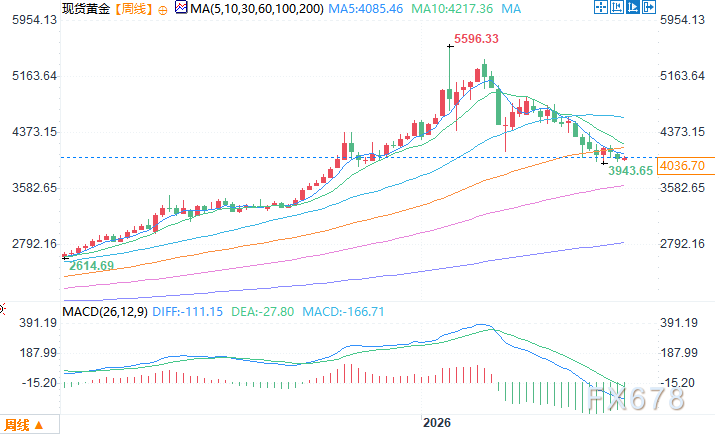
Weekly Spot Gold Chart Source: Yihuitong
10:57, July 21 (UTC+8) Spot Gold quoted at $4,036.70/oz
Disclaimer: The content of this article solely reflects the author's opinion and does not represent the platform in any capacity. This article is not intended to serve as a reference for making investment decisions.
You may also like
Hackers exploited macOS Screen Sharing flaw to install Monero miners, Dutch cyber agency says
3 Altcoins With Major Catalysts and Risks to Watch in 2026
Pump.fun ranks third in 7-day revenue among all protocols, trailing only Tether and Circle
Walmart Inc. stock stalls at $116 resistance ahead of Aug. 20 earnings
Crypto prices
More


