
Strategist: Before September is an excellent window to allocate to gold; bond market pressure forcing currency devaluation will drive its long-term rise

Huitong Network, July 21 — Sprott strategist Paul Wong stated that multiple indicators show gold is deeply oversold, with selling momentum exhausted. It is highly likely to bottom out before September, and policies or geopolitical events in August may trigger a rebound. Outflows from European and American ETFs are being absorbed by major Asian nations, and positions have already weakened significantly. Globally, high debt and deglobalization are pushing up inflation, continuing to pressure the bond market. Ultimately, central banks will have no choice but to devalue currencies to dilute debt, with currency depreciation set to become the long-term fundamental driver for gold prices reaching new highs.
Paul Wong, Managing Partner and Market Strategist at Sprott, pointed out that all major quantitative indicators for gold are now in deeply oversold territory, with market selling momentum nearly exhausted, indicating that gold prices are likely to complete a cyclical bottom before September. Continued currency devaluation is the core long-term logic driving gold to new historical highs.
In the short term, August will usher in a window for market reversal, with the Jackson Hole Global Central Bank Annual Meeting, Middle East geopolitical tensions, and sharp bond market volatility all possible catalysts for a gold price rebound. Meanwhile, massive global debt, ongoing deglobalization, and fiscal expansion continue to drive up inflation, forcing central banks to dilute debt via currency, providing long-term support for rising gold prices.
Comprehensive Technical and Position Signals Turning Bullish: Summer Is the Window to Position in Gold
According to Wong, gold prices typically find support at around 90% of the 200-day moving average. This recent drop has already surpassed that threshold, and in-house quantitative models (five to six sets) consistently show that gold is in a -2 to -3 standard deviation oversold zone. From a probability perspective, the drive to further suppress gold prices has greatly diminished.
From a position perspective, quantitative trend fund holdings have normalized, with US CFTC gold long positions falling to 2018 lows. Global gold ETFs have seen only slight redemptions, with outflows from Europe and America being fully absorbed by increased purchases in Asian gold ETFs.
Multiple oversold indicators resonating does not mean an immediate bottom, but rather that the concentrated selling phase has ended. Large institutions will accumulate in batches whenever gold prices drop 1% to 2% in a single day.
Historically, gold’s annual lows often occur in early August. Last year’s low happened around the end of August during the Jackson Hole meeting, when the market predicted the Federal Reserve would not keep raising rates, and gold rallied from $3,600 to $4,500. This August is likely to see a similar pattern, with geopolitical or policy news able to trigger a bullish run.
The Bond Market Is the Core of the Macro Game; Massive Debt Spurs Major Currency Depreciation Trend
Speaking about the US Federal Open Market Committee (FOMC) policy outlook and the rate path into 2026, Wong believes the bond market is the key battlefield for monetary policy. US, German, and Japanese bond yields have all increased simultaneously, leaving the bond market under prolonged pressure. US Treasury debt has reached $39.5 trillion, with $3.8 trillion added in the past year alone—a growth rate close to 10%. Treasury interest payments have surpassed defense spending, and neither political party has implemented a debt reduction plan. Domestic populism and wealth gaps are further fueling inflationary pressure.
The world economy also remains weak. Deglobalization is causing supply chains to move back onshore, with countries stockpiling energy and industrial metals. On top of that, higher taxes and increased export controls are pushing up commodity price centers. Facing global inflation, the Federal Reserve’s means of regulation are very limited—mostly relying on verbal guidance to anchor expectations. Hawkish statements by Waller in June temporarily suppressed gold, but cannot reverse the structural pressure from debt.
Central banks globally only have two options: allow the bond market to collapse and cease issuing new sovereign debt, or
Summary
Combining technical signals, position flows, and the global macro backdrop, gold is deeply oversold in the short term with a clear rebound opportunity in August, likely completing a cyclical bottom by September. In the mid to long term, massive global government debt, sustained inflation, and unrelenting bond market pressures will force fiat currency devaluation, opening up long-term upside for gold prices.
Going forward, investors should closely monitor policy signals from the late-August Jackson Hole meeting, the Middle East geopolitical climate, and US Treasury yield volatility. These three variables will determine the pace and extent of gold’s short-term rebound.
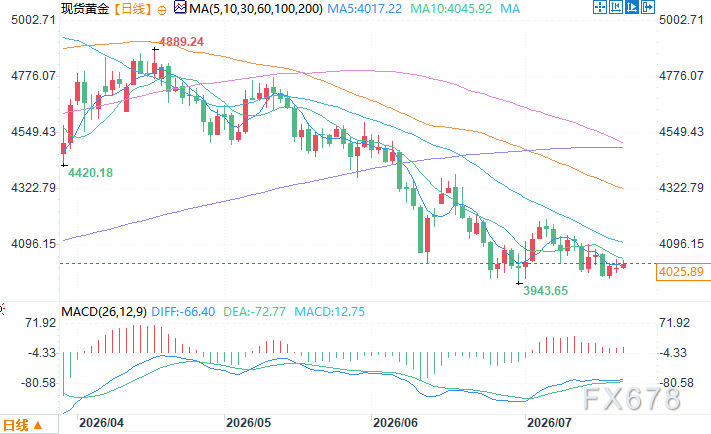
Spot gold daily chart. Source: EasyHuitong
As of 10:04 Beijing time (UTC+8), July 21, spot gold was quoted at $4,022.89 per ounce.
Disclaimer: The content of this article solely reflects the author's opinion and does not represent the platform in any capacity. This article is not intended to serve as a reference for making investment decisions.
You may also like
Shiba Inu rallies to $0.00001004 after exchange debut and Dubai expansion
Nvidia plans to invest $3 billion in SoftBank’s SB Energy, betting on OpenAI's Ohio data center project
Nvidia is reportedly in talks to invest up to $3 billion in SB Energy, a SoftBank subsidiary, as part of a supporting arrangement for providing around $100 billion in credit support to OpenAI's Ohio data center project. The investment is planned to be completed in two phases: $1.5 billion upon signing, and another $1.5 billion when SB Energy goes public—an IPO that could launch as soon as next month, aiming to raise at least $5 billion.
World Liberty Financial Nears Bank Charter After OCC Approval
Cardano Bulls Target $0.25 as Key Warning Signs Emerge

Crypto prices
More


