
China's open-source model Kimi begins to challenge the US technological premium in AI

Recently, U.S.AI hardware stocks have continued to slump. The market might be reacting to a trend many have not fully realized: Chinese open-source models are starting to erode the U.S.AI technology premium.
Kimi K3 soared to first place in the Frontend Code Arena segment ranking. Leading in a single aspect does not mean China’sAI comprehensively surpasses the U.S., but for capital, the signal is clear enough: when Chinese models can match or even surpass certain capabilities ofGPT andClaude at lower costs, the high pricing of closed-source U.S. models is no longer unbreakable.
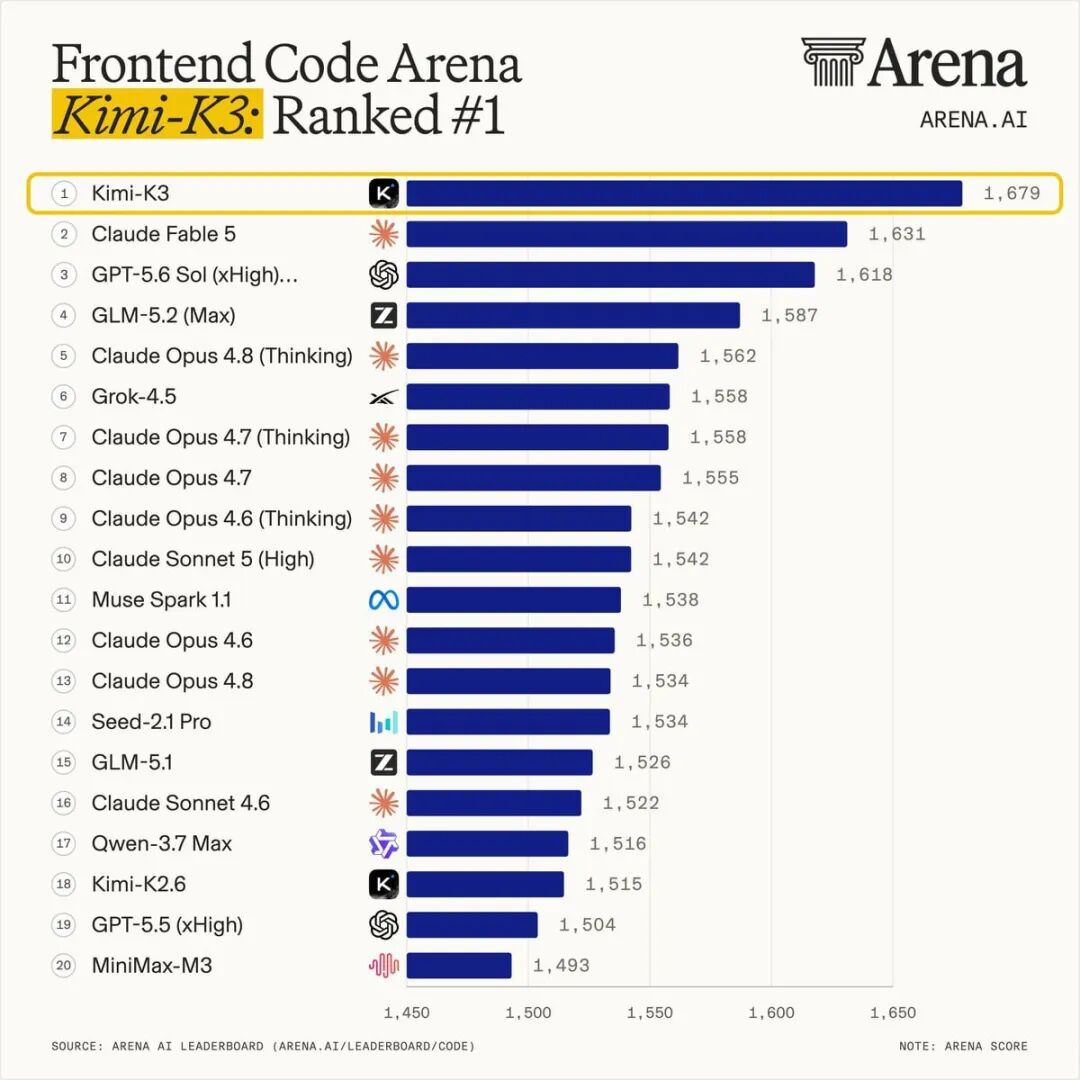
In the short term, due to security and compliance restrictions, U.S. companies are unlikely to directly use ChineseAI services. However, open-source models can be downloaded and deployed domestically or in private clouds. Data does not leave the country, but the cost could be only a fraction of that ofGPT orClaude. In some scenarios, the costs approach only a tenth.
How will the market react next?
According to U.S. Stock Investment Network, U.S. companies increasing their use of open-source models→ GPT andClaude usage is diverted → OpenAI andAnthropic are forced to cut prices → Revenue growth and profit margins come under pressure → Cloud vendors recalculatingAI capital expenditure return rates → The pace of data center construction slows → GPU, server, optical communication, storage and power equipment future revenue expectations are revised down.
This is the most dangerous part. Hardware orders do not need to drop immediately today; as long as the market begins to doubt whether future capital expenditure can continue to accelerate, valuations get hit first. Stock trading has never been about whether there is a shortage today, but whether there will still be a shortage two years from now.
Of course, low-cost models could also stimulate greaterAI usage, eventually increasing the demand for inference computing power. So, this is not a realized fact yet, but rather a secondary risk that capital is beginning to price in.
The real impact of ChineseAI on U.S. stocks may not be in taking away U.S. customers today, but in making the market question:OpenAI andAnthropic can continue to maintain such high pricing in the future and how fast cloud vendors will need to expand infrastructure.
The market's concern is not how much ChineseAI is earning now, but how much less U.S.AI might earn in the future because of it.



Disclaimer: The content of this article solely reflects the author's opinion and does not represent the platform in any capacity. This article is not intended to serve as a reference for making investment decisions.
You may also like
Amazon AWS—The Road to Trillion-Dollar Revenue
Morgan Stanley expects that AWS's computing power will expand from 14GW in 2025 to 120GW by 2035. If the monetization efficiency of computing power reaches $12 per watt, AWS's revenue is expected to exceed $1 trillion. As the scale of the business grows, the profit margin of its AI business may follow the expansion trajectory of its core cloud business, with a long-term EBIT profit margin expected to reach around 30%.
Ethereum (ETH) Breaks Above $1.9K: How Close Is the Push Toward $2K? post-165832 post-165832 post-165832
Capital B buys 5 more Bitcoin, pushing total treasury to 3,145 BTC
Cards Before the Storm: On the Eve of the "AI Stock King" Liquidation, SA Bets Big on Memory Chips, Citadel Fully Hedged, and Jane Street Faces Massive Losses Despite Hundreds of Billions in Hedges
SA, Citadel Investment, and Jane Street have recently released their Q2 holdings reports (13F) for the period ending June 30, 2026.

Crypto prices
More


