
Interpretation of Nvidia's Export Data: Taiwan's June ADP Drops 4% MoM, How Vera CPU and ACIE Will Drive Future Growth

UBS reports a 4% month-over-month drop in Taiwan's ADP equipment exports in June, suggesting a cooling in AI server demand on the surface; at the same time, Morgan Stanley stresses in its NDR that growth is accelerating, spreading to AI labs, cloud vendors, enterprises, and sovereign projects.When comparing the two sources, high-frequency export data does show a weakening, but it's not yet sufficient to prove that Nvidia's orders have peaked.
1. For June, interpret the data as “normalization” first
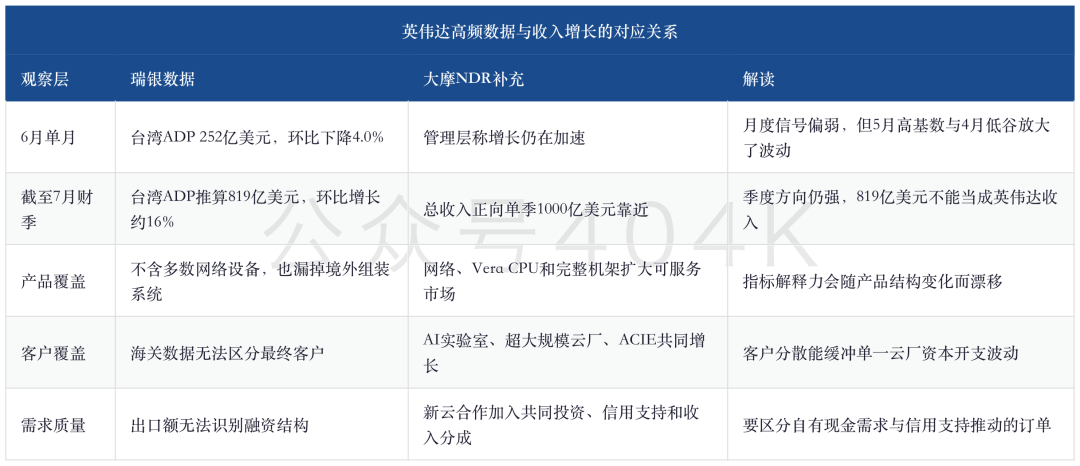
The June decline appears more like a continuation of the sharp volatility since April. According to Taiwan’s Ministry of Finance, total exports in June were $74.83 billion, up 40.3% year-over-year and down 4.6% from May. UBS further isolated ADP (automatic data processing equipment excluding laptops): June exports were $25.2 billion, down 4.0% from May’s $26.3 billion, weaker than the typical seasonal decline of 2.8% for this period.
Judging by this single month, the signal is on the weak side.Looking at the last three months, April saw a 28.4% m-o-m decrease, followed by an 11.5% rebound in May, significantly higher than the typical May seasonal growth of 1.7%. Much of the June dip digested May’s rebound, and the absolute value of $25.2 billion still remains at a historic high. Taiwan export data does not provide evidence of a sharp collapse in AI server orders.
Quarterly accumulation still points to double-digit growth. Historically, July contributes an average of 37% to Nvidia’s July-fiscal ADP exports from Taiwan. If this ratio holds for July, UBS estimates that this fiscal quarter Taiwan’s ADP exports will reach about $81.9 billion, up roughly 16% m-o-m. This $81.9 billion is Taiwan’s estimated export value, not Nvidia’s datacenter revenue; UBS forecasts the latter at $85.1 billion. Both numbers are directionally consistent and point to quarterly growth.
This measure has a clear margin of error.Historically, Nvidia’s datacenter revenue for the July quarter grew by an average of 23.3% q-o-q, while Taiwan’s ADP was 16.1%; the average error for the two forecasts was 7.2 percentage points, with a median of just 0.2 points. Most quarters align in direction, but extreme quarters can diverge significantly. June’s single data point fits better as an early warning signal, not as a financial report answer in itself.
2. ADP figures only measure part of Nvidia’s story
Taiwan’s ADP and Nvidia’s datacenter revenue only overlap on Nvidia servers assembled and exported from Taiwan. Data under Taiwan’s export criteria also includes other manufacturers’ ADP and traditional servers; Nvidia’s revenue, on the other hand, includes processors manufactured in Taiwan and then exported elsewhere for assembly, servers assembled in China and Malaysia, as well as network devices classified under other customs categories.
This discrepancy in criteria is widening.Nvidia’s Q1 FY2027 datacenter revenue was $75.2 billion, with $60.4 billion from compute and $14.8 billion from networking. Networking now accounts for nearly 20% of datacenter revenue, with a higher y-o-y growth rate than compute. Taiwan’s ADP cannot capture most networking value and cannot fully track processor exports followed by system assembly elsewhere.
Morgan Stanley’s NDR adds another layer: Nvidia is expanding its addressable market from GPU to CPU, networking, software, and entire racks.The more the business expands toward complete systems, the weaker the correlation between a single server export category and company revenue. Therefore, if we later see a divergence between Taiwan’s ADP and Nvidia revenue, first check the assembly location, product structure, and networking share, before judging any demand weakness.
3. Three new growth drivers from Morgan Stanley’s NDR
The first is increasing AI lab market share. Management says AI labs account for about 20% of current demand. A major leading-edge model previously ran mainly on custom chips, so Nvidia had little share, but it now reaches almost 50%; other cutting-edge models still rely heavily on Nvidia. This shows that custom chip expansion and Nvidia’s share growth can coexist; the final purchasing result depends on per-token costs and development efficiency.
The second is that hyperscale cloud vendors continue to expand, while increasing Nvidia content per datacenter. This customer type accounts for about half of revenue, with land and electricity beginning to limit buildout. Nvidia’s response is to bundle networking and CPU as well. The company reiterated a $20 billion revenue target for Vera CPU in 2026, with nearly half possibly coming from standalone CPU racks beyond the head node, and large-scale deliveries expected in the second half. These increments are hard to be fully observed in Taiwan’s ADP data.
The third is ACIE—AI Cloud, Industrial, and Enterprise clients. Morgan Stanley states that this segment is now near half of datacenter revenue. Projects for sovereign AI, regional clouds, retail, finance, biotech, and industrial usage launch more slowly but have broader client bases and less competition from custom chips. New cloud partnerships involve joint investment, credit support, and revenue sharing; Nvidia not only sells systems but also may share in GPU cloud’s future revenue.
These percentages should not be summed mechanically.AI labs are grouped by source of demand, hyperscale cloud and ACIE are new customer groups disclosed by the company—the statistical dimensions overlap. A better takeaway is: Nvidia is reducing its reliance on any single client type, single GPU sale, or single assembly path.
4. Rubin and memory: supply constraints continue to reshape system design
Vera Rubin remains the most important product cycle over the next 12 months. Morgan Stanley notes that Rubin Ultra is still planned for 2027 shipment, Kyber racks will switch to better solutions, but 800V power and inter-rack optical interconnect are still advancing as planned. Changes in rack form could impact Taiwan’s assembly value, component value, and recognition timing, but not necessarily final system demand.
Memory offers a better illustration of this mismatch.Management expects memory shortages to last several years, and stressed that compute, networking, and memory can all be optimized together. Morgan Stanley refers to earlier plans to halve low-power memory per rack, but what was confirmed in the meeting was a long-term shortage and system-level adjustments; details of reductions await future product documentation. Reductions in a certain type of memory per rack can occur alongside higher rack shipment volume.
5. $280 vs $288—the difference is in valuation methods
UBS and Morgan Stanley make similar assessments of demand direction, yet their valuation approaches are markedly different. Both reports were released on July 10, using the July 9 closing price of $202.78, same ordinary share and USD denomination, with no cross-date adjustments. UBS’s target price is $280, using 2027 calendar EPS of $15.37 and an 18x P/E; Morgan Stanley’s target is $288, using $13.08 EPS and about a 22x P/E.
UBS assigns higher earnings and a lower multiple; Morgan Stanley, lower earnings but a higher multiple.Morgan Stanley is willing to grant a higher multiple, for reasons including client diversification, CPU and network broadening revenue, multi-year earnings visibility, and more than 50% FCF starting to be returned to shareholders. Nvidia returned about $20 billion to shareholders in Q1 and granted $80 billion new buyback authorization, providing quantifiable cash yield anchors for value investors.
This valuation has clear invalidation scenarios.Morgan Stanley’s bear case is $160, based on sharply slower datacenter growth, accelerating competition from custom chips, falling AI development costs or export restrictions. If new cloud credit support expands but is not met by corresponding end usage and cash receipts, the market will also downgrade the quality of orders.
6. Six metrics to watch next
- July ADP exports from Taiwan. If the historical 37% quarterly contribution holds, the quarterly total should approach $81.9 billion; much lower, and June’s “normalization” explanation is weakened.
- Nvidia Q2 revenue. The company’s public guidance is $91 billion, give or take 2%, not counting China datacenter compute revenue; the actual result will test the deviation between export data and company reported revenue.
- Compute and networking revenue. Whether networking continues to outpace compute will determine if the revenue missed by Taiwan ADP keeps expanding.
- Share of Hyperscale and ACIE revenue. If ACIE remains around half of datacenter revenues, customer diversification logic is justified; if highly concentrated again among a few cloud vendors, volatility resistance will fall.
- Vera CPU execution. The $20 billion target, the proportion of standalone CPU racks, and delivery rhythm in the second half are the easiest new top-line items to verify in the NDR.
- Credit-supported orders cash-in. Look not just at the number of GPUs announced—but at utilization by new cloud clients, take-or-pay contracts, financing costs and revenue sharing.
7. Conclusion
The June data looks more like a yellow light. It requires the market to keep a close eye on July exports and quarterly accumulation, but does not provide evidence that Nvidia demand has peaked. The monthly decline flagged by UBS and the client, product, and business model expansion seen by Morgan Stanley can coexist, because the two reports measure different aspects.
A more reasonable contemporary judgment: Taiwan’s ADP can still point to the direction of hardware shipments, but its explanatory power for Nvidia’s full revenue is diminishing.If July data rebounds, ACIE remains about half the total, and Vera CPU and networking revenue materialize, then the June dip can be classified as normalization; but if quarterly ADP falls significantly short of $81.9 billion, while CPU, networking, and ACIE also stall, only then does demand deceleration shift from noise to trend.


Disclaimer: The content of this article solely reflects the author's opinion and does not represent the platform in any capacity. This article is not intended to serve as a reference for making investment decisions.
You may also like
US STOCKS-Wall Street indexes slip as oil prices rise, retail results awaited
Hedera gains traction as UK FX pilot boosts institutional adoption, HBAR eyes $1 target
Ripple White House Meeting Draws XRP Focus

XRP Price Holds to Near Two-Year Streak, But Charts Flash a Warning Sign

Crypto prices
More


