
Meta Update: $534 Billion AI Capital Expenditure, 59% Increase in Instagram Short Video Ad Prices, and $815 Target Price

TL;DR
1.The main advertising business continues to accelerate. Goldman Sachs expects Meta to reach $60.2 billion in revenue for Q2 2026, up 26.8% year-over-year, with full-year revenue growing 27.0%. The average CPM (cost per thousand impressions) for U.S. ads increased 26% quarter-over-quarter and 8% year-over-year, indicating that growth comes not only from users and time spent, but also from advertisers willing to pay higher prices for better conversion rates.
2.Short videos begin to contribute to pricing. Instagram’s short video ad prices rose 59% year-over-year, significantly outpacing 2% growth for feed ads and 11% for Stories. Short videos account for about 52% of Instagram usage time, while ad impressions nearly reach 53%. The previous worry that short videos would cannibalize high-priced feed ads is now turning into a new revenue increment.
3.$534 billion will be spent over the next 3 years. The model projects Meta’s capital intensity to rise from 54.9% to 60.2% from 2026 to 2028. While revenue growth is enough to support operating profit growth, depreciation and amortization will catch up quickly, putting pressure on both profit margins and free cash flow.
4.Cash flow is the most sensitive part of valuation. Free cash flow drops to $29.5 billion in 2027, and after deducting stock-based compensation, only $4.6 billion remains; over the same period, revenue still grows by 20.1%, and GAAP operating profit hits $106.8 billion. The profit and loss statement looks solid, but truly distributable cash for shareholders is thin, meaning stock price swings could be amplified.
5.$815 valuation relies on two sets of assumptions working simultaneously. Goldman Sachs assigns a 50% weight each to GAAP operating profit valuation and forward free cash flow valuation after deducting stock-based compensation. Based on the report’s benchmark of $600.29, the $815 target price corresponds to about 36% upside.
6.Computing power leasing resembles a construction time gap. Starting from the second half of 2026, Meta will lease out part of its computing power; Goldman Sachs prefers to explain this as a mismatch between the timing of data center construction and internal model demand, rather than the company already having a long-term cloud services advantage. If external leasing continues to expand and internal ad returns do not improve, this judgment will need to be revised downward.

ContentsJoin Knowledge Planet to view the full original report and reference research reports
- I. First Look at Advertising Returns in Q1 and Q2
- II. Instagram Short Videos Have Crossed the Hardest Commercialization Phase
- III. $534 Billion Capex Will First Squeeze Cash Flow
- IV. Free Cash Flow Reveals Time Lag of Return on Investment
- V. How the $815 Target Price is Calculated
- VI.
- VII.
- VIII.
- IX.
Meta's Q2 advertising revenue is still expected to maintain growth of over 20%, with Instagram short video prices and usage time improving simultaneously.The question shifts to whether this round of AI investments can continue driving ad returns higher, and whether, before depreciation and capital expenditures squeeze cash flow, incremental computing power can actually generate enough revenue and profit.
I. First Look at Advertising Returns in Q1 and Q2
Meta’s most valuable signal right now comes from ad prices. Goldman Sachs expects the company’s Q2 2026 revenue to reach $60.242 billion, up 26.8% year-over-year; full-year 2026 revenue to reach $255.176 billion, up 27.0% year-over-year. At a time when the world’s large internet platforms are generally ramping up their AI investments, Meta can still maintain revenue growth above 20%, indicating that ad ranking, content recommendations and creative generation are converting into business outcomes, not just increased server requirements.
Goldman Sachs’ U.S. ad price tracking shows Meta’s average CPM rose 26% quarter-over-quarter, 8% year-over-year.Ad price increases typically come from two sources: fiercer competition among advertisers, or the platform’s ability to deliver higher click, conversion, and sales returns. For a single quarter, it’s hard to fully dissect the two; but combined with Instagram’s usage time, short video ad prices, and company revenue forecasts, the explanation of improved platform efficiency is more convincing.
This change is important for valuation.Meta’s AI capital expenditures have reached the $100 billion level, and the market will not only reward “stronger models” or “better recommendations.” Investors want to see that each unit of incremental computing power brings more ad impressions, higher ad prices, or lower customer acquisition costs. Q2’s revenue growth and ad prices offer the first set of data to gauge returns on this investment.
II. Instagram Short Videos Have Crossed the Hardest Commercialization Phase
The share of short video traffic and ads has nearly matched. Goldman Sachs cites industry data showing short videos accounted for about 52% of Instagram usage time in Q1 2026, and for 53% of ad impressions in Q4 2025. The nearly equal ratios mean Meta has largely integrated short video traffic into the ad system — its monetization density is no longer lagging behind user attention.
Even stronger signals come from pricing.In Q2 2026, Instagram feed ad prices rose just 2% year-over-year; Stories increased 11%; but short video ad prices soared 59%. This substantial lead means advertisers are becoming more receptive to this placement. In the early days, short video growth squeezed feed usage but couldn’t monetize at similar prices; now this drag is reversing, so longer usage time can directly translate to revenue.
Instagram users are also spending more time per day.U.S. users average about 58 minutes per day, and global users about 75 minutes, up from just 37 and 52 minutes respectively in Q2 2021. By Q2 2026, Instagram’s total usage time is expected to be up 15% globally and 13% in the U.S. versus the prior year, with monthly active users globally up just 3%. User growth is not rapid, so revenue growth relies more on per capita usage, ad density, and price hikes.
This set of data gives Meta a triple revenue lever: the recommendation system boosts user time, short videos increase ad inventory, and the ad model sells these additional slots at higher prices.The risks are crystal clear: if short video ad price growth quickly falls back and usage time plus ad density both plateau, income growth becomes dependent again on macro ad demand.
III. $534 Billion Capex Will First Squeeze Cash Flow
Revenue growth can temporarily cover the investments, but cash flow cannot. Meta is still rapidly building out data centers, servers, networks, and related infrastructure.
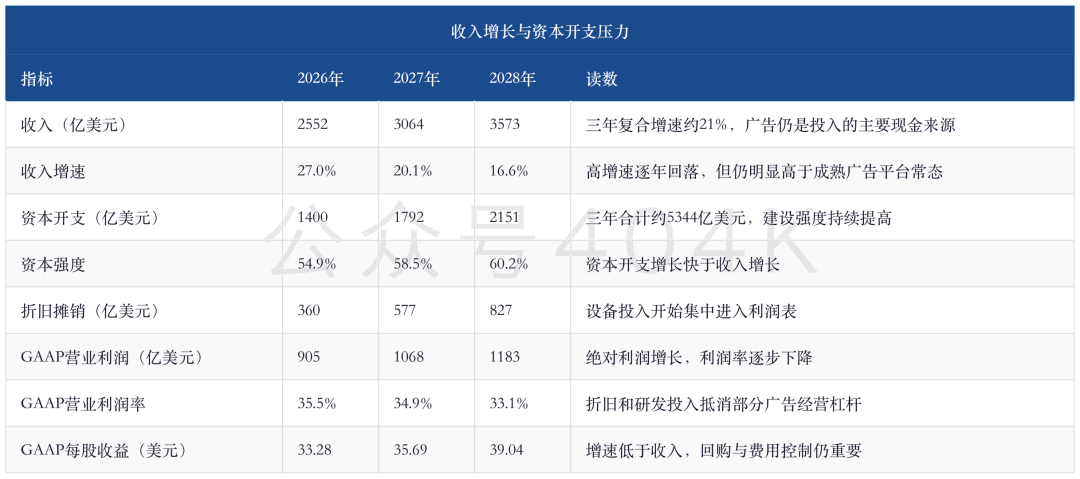
Total investment is about $534.4 billion over three years. The model forecasts annual capital intensity rising from 54.9% to 60.2%, requiring ever more cash for each equipment upgrade cycle.
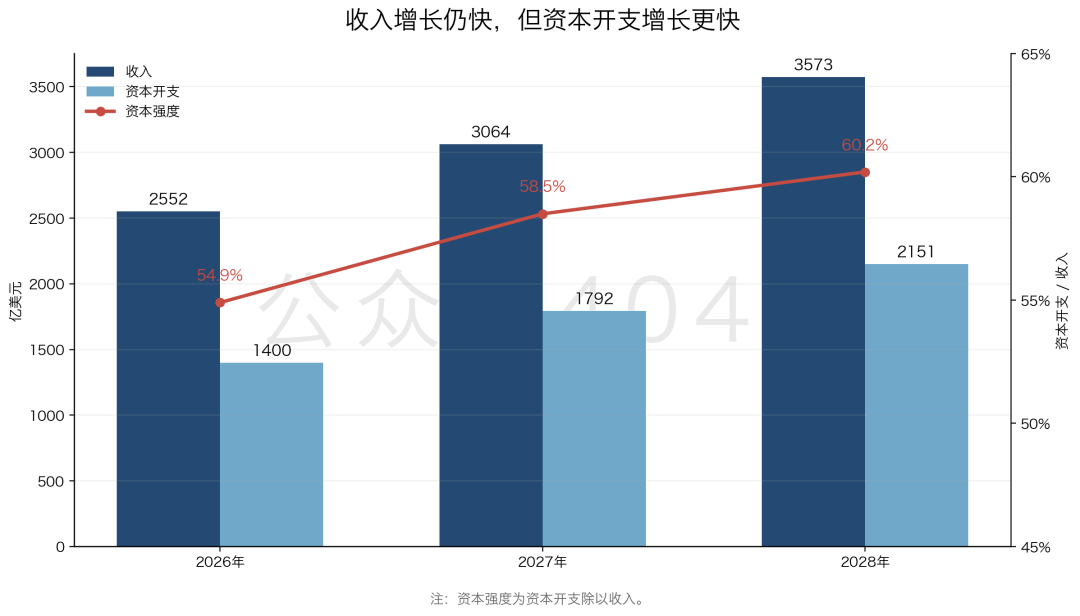
Capex first hits the balance sheet, then is gradually depreciated over the lifespan of equipment and data centers.Because of this, cash flow pressure appears first, followed by increasing impact on profit margins. The model projects depreciation and amortization will nearly double from $36 billion in 2026 to $82.7 billion in 2028; meanwhile, GAAP operating profit keeps rising, but the operating margin gradually declines.
There is a timing difference between capex and depreciation—this is the most easily undervalued part of any model.
IV. Free Cash Flow Reveals Time Lag of Return on Investment
2027 is the cash flow trough in the model. Goldman Sachs expects Meta’s free cash flow that year to fall to $29.5 billion; after deducting stock-based compensation, just $4.6 billion remains before slowly creeping back up. Revenue and operating profits are still rising, but cash flow falls sharply—the reason being capex precedes income realization.
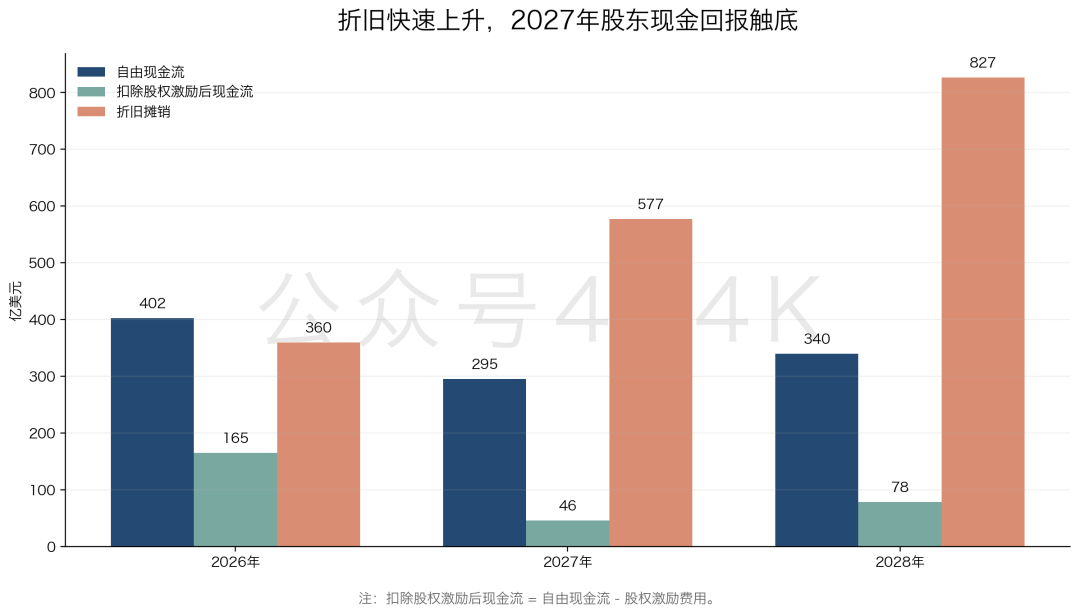
Free cash flow excluding stock-based compensation deserves separate attention.Stock compensation doesn’t consume cash during the period, but increases shares outstanding, diluting per-share value. Excluding it from free cash flow more closely reflects the economic returns to common shareholders. At just $4.6 billion in 2027, this figure is extremely thin for a company with over $1 trillion in market cap, so Goldman Sachs is forced to use longer-term cash flows for valuation.
The market is willing to tolerate short-term cash flow declines if two conditions are met.First, ad revenue continues to grow at nearly 20%, proving that internally deployed computing power is genuinely profitable. Second, from 2028 onward, capex growth slows below revenue growth, so free cash flow expands again. If either condition fails, a 45x forward cash flow multiple will look excessively expensive.
V. How the $815 Target Price is Calculated
The target price simultaneously bets on profit resilience and the restoration of long-term cash flow. Goldman Sachs lowered Meta’s target price from $830 to $815, but maintained a Buy rating. The report uses two corporate valuation methods, each with 50% weighting: one based on GAAP operating profit for the year following the next 12 months, and one based on free cash flow (excluding stock-based compensation) for the fourth year after the next 12 months.
The operating profit method gives a 26x EV/GAAP operating profit multiple, up from 24x. The forward cash flow method uses 45x EV/free cash flow (after stock-based compensation), up from 40x, then discounts at 12% for three years.Higher multiples but a lower target price reflect the model’s greater caution around near-term cash flow and cost pressures, while the valuation framework is more willing to pay up for AI-driven long-term growth.
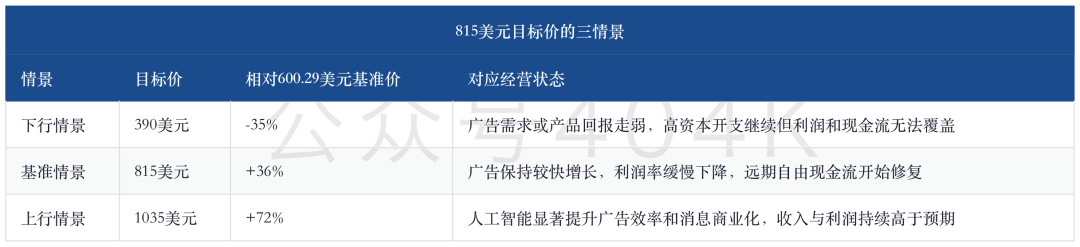
The advantage of this method is that it puts the debate on the table: operating profits reflect Meta’s current ad business earning power, while free cash flow after stock-based compensation represents what’s left for shareholders after heavy investment.The disadvantage is clear: long-term cash flow is highly sensitive to capex, depreciation period, stock-based compensation, and terminal multiples — any minor adjustment can cause significant swings in the target price.
Based on the report’s benchmark price, $815 implies a 36% upside, but this does not mean low-risk returns.The 390-dollar downside scenario is still 35% below the baseline, meaning this is a high risk, high reward investment. If Q2 results only beat on revenue, but fail to improve capex efficiency, the stock could trade on profits first, and then return to worrying about cash flow.
You can view the remaining 30% of the report by joining Knowledge Planet; the full original and reference reports are provided there — you’re welcome to join.


Disclaimer: The content of this article solely reflects the author's opinion and does not represent the platform in any capacity. This article is not intended to serve as a reference for making investment decisions.
You may also like
A two-decade yield high buys the Dollar Index nothing
BlackRock calls Bitcoin key global monetary alternative despite 50% drop from peak
BlackRock calls Bitcoin’s 50% pullback a positioning correction, not a structural break
XRP analysts highlight $0.93 to $1 as key reversal zone, eye major breakout
Crypto prices
More


