
Index inclusion effect fails, SpaceX stock drops over 7% in two days with consecutive breakouts, Wall Street valuation disagreements intensify

Having completed the world's largest IPO and listed for less than a month, SpaceX's share price experienced a dramatic reversal in the secondary market. Even the official inclusion in the Nasdaq 100 Index this week failed to stop its share price from falling consecutively and dropping below the IPO offering price. There is now a significant divergence between short-term market sentiment and Wall Street's grand narrative of its long-term value.
On Wednesday, SpaceX closed at $148.30, finishing below the $150 IPO offering price for the second consecutive day, and losing nearly 7.6% over two days—a cumulative drop of 26.5% from the post-listing high of $201.80 on June 16. Entry into the Nasdaq 100—normally a major positive catalyst—did not lift the share price but instead became a point where profit-takers concentrated their selling. Reports say that after underwriters exercised the "greenshoe" over-allotment option, SpaceX’s IPO last month ultimately confirmed a net fundraising scale of $85.7 billion, securing its position as the largest IPO in history.
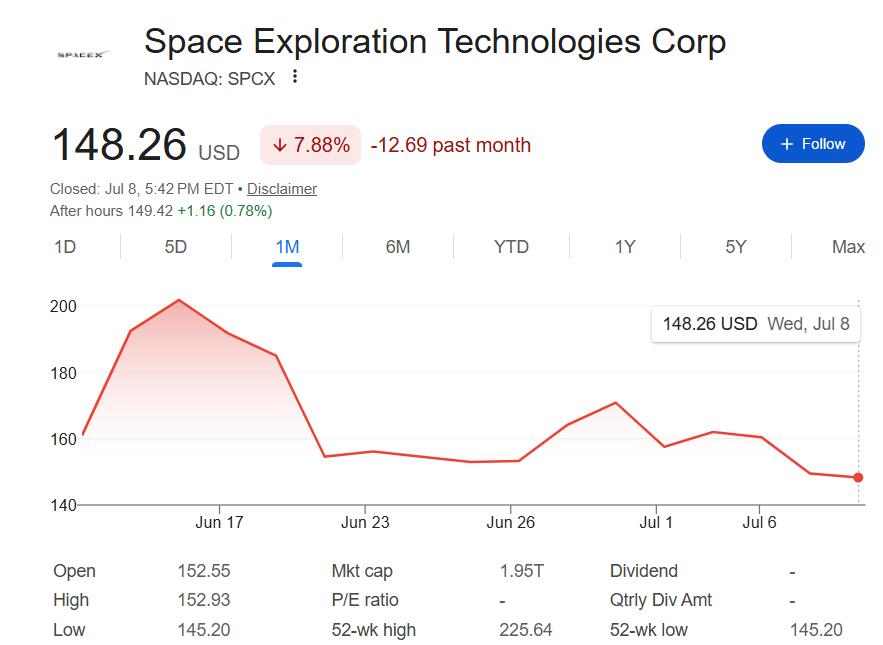
Analysts point out that expectations of inclusion into the Nasdaq may have already been priced in, and the recent overall weakness of the Nasdaq has added extra pressure. Meanwhile, on Tuesday, twelve IPO underwriters collectively released research reports, all giving either a buy or equivalent rating, but this rare show of bullish consensus also failed to hold up the stock price.
Inclusion Effect Fails, Profit-Taking Dominates Short-Term Trend
SpaceX's entry into the Nasdaq 100 Index is a direct result of the Nasdaq revising its listing rules for new stocks, less than a month after its June 12 IPO. Normally, inclusion in major indices would drive ETFs and mutual funds tracking the benchmark to passively buy the relevant stock.
However, the market did not follow this logic. On Tuesday, SpaceX shares plunged nearly 7% in one day; on Wednesday, they hit an intraday low of $145.20—an all-time post-IPO low—dropping almost 2.9% intraday before retracing most of the losses to close down about 0.8%. This marked three consecutive days of declines, with a cumulative 8% drop over that period.
Some analysts and market strategists believe the benefits of Nasdaq 100 inclusion had long been priced in, and, combined with the recent weak environment for the Nasdaq, the anticipated inflows from passive funds were not enough to offset profit-taking by active funds.
Looking back at its performance since listing, SpaceX shares surged sharply in the early days, reaching a closing high of $201.80 on June 16, four days after listing, then entered a volatile downward channel. This recent streak of declines leading to the stock falling below the offering price marks the official end of the post-listing honeymoon period.
Wall Street’s Consensus Bullish View, Large Discrepancies in Valuation Methodologies
Despite pressure on the share price, Wall Street's overall ratings remain optimistic. According to media statistics, SpaceX has received 14 buy ratings, with an average target price of around $247, and an average buy rating target price of about $260—implying a company valuation of roughly $3.4 trillion.
However, there are significant differences in valuation methods and target prices among institutions. Morgan Stanley analyst Adam Jonas gave the highest target price of $300 with an "Overweight" rating, employing a 15-year discounted cash flow model and projecting SpaceX’s revenue to reach $3.3 trillion by 2040, with EBITDA at $2.7 trillion.
Deutsche Bank analyst Edison Yu set a price target of $255, using a sum-of-the-parts valuation for AI, Starlink, and space launch businesses, with a combined valuation of about $3.3 trillion.
RBC analyst Ken Herbert gave a $225 price target, applying a 2029 EBITDA multiple method, valuing SpaceX’s Starlink business at about $63 billion in EBITDA with a 15x multiple, and applying the same multiple to the AI business.
Bank of America analyst Ron Epstein set a target price of $235, emphasizing SpaceX's Starship business as a key variable, and suggesting that if successful, it would reduce orbital launch costs by another 90% compared with Falcon 9.
Raymond James analyst Brian Gesuale gave a stunning target price of $800, corresponding to a valuation over $10 trillion, calling SpaceX "one of the most defining industrial infrastructure companies of the 21st century," using a 27x EBITDA multiple for 2031 as the basis.
Analysts taking a cautious stance are in the minority, with MoffettNathanson giving a Neutral rating and CFRA recommending a sell.
Competitive Landscape Shifts, Blue Origin Completes First External Financing
Just as SpaceX experienced its first post-IPO correction, its main competitor, Blue Origin, is accelerating its capital buildup.
The New York Times revealed that Blue Origin, the private rocket company owned by Amazon founder Jeff Bezos, is completing its first round of external financing at a $130 billion valuation—raising $10 billion, with $4 billion from Coatue Management, another $4 billion from other major investors, and Bezos himself injecting an additional $2 billion. For the past 25 years, Blue Origin's funding has come almost entirely from Bezos personally.
This is Blue Origin’s first-ever introduction of outside capital since its founding. The financing comes as the company faces significant technical setbacks.
Earlier this year, Blue Origin's New Glenn rocket exploded during a static fire test, destroying the company’s only launch pad. In a media interview this May, Bezos said, "We finally have enough clarity about the future direction and financial situation, so now is a good time to bring in external investors."
In terms of business layout, besides its rocket launch business, Blue Origin will also operate TeraWave, a satellite broadband service for large enterprise customers, launching satellites into medium and low Earth orbits via the New Glenn rocket.
Amazon is also launching its consumer-facing Amazon LEO Satellite Internet service, competing with SpaceX’s Starlink—but the latter currently holds a significant lead in the number of satellites in orbit.
Valuation Absorption and Profitability Are the Core Contradictions
The deeper logic behind the current share price pullback lies in the market’s reassessment of SpaceX’s high valuation system. Using the average target price of $260, corresponding to an estimated valuation of about $3.4 trillion, this far exceeds the combined market value of Microsoft and ExxonMobil. The two companies are expected to have combined revenues of nearly $800 billion and EBITDA over $300 billion in 2027—about ten times SpaceX’s expected figures.
SpaceX’s valuation premium depends on the realization of high-speed growth. Bank of America's model projects that the space business will grow at an average annual rate of 8% before 2031, Starlink at 60% per year, and the AI business at nearly 140% annually from 2025 to 2031. In this scenario, SpaceX’s 2031 revenue would approach $800 billion, with EBITDA of about $580 billion.
However, SpaceX has not yet achieved overall profitability. The balance between large capital expenditures and cash flow generation is currently the core concern for investors.
According to the prospectus, SpaceX is projected to achieve revenue of about $18.674 billion in 2025, with first quarter 2026 revenue of $4.694 billion. Until its grand vision is translated into sustainable profitability, the process of digesting the high-level stock price may continue for some time.
Disclaimer: The content of this article solely reflects the author's opinion and does not represent the platform in any capacity. This article is not intended to serve as a reference for making investment decisions.
You may also like
Jane Street holds $1 billion in Bitcoin ETFs as BTC tests key $64,000 level
Altcoins Under $1 That Could Deliver Explosive Growth Soon
Nvidia’s Madison Huang visits LG robot factory as training push ramps up
Ethereum validator queue hits highest level since September 2023
Crypto prices
More


