
The upgrade cycle narrative hits a setback as UBS survey shows Apple's AI features fail to spark a device replacement boom

Apple's AI feature, Apple Intelligence, has failed to become the catalyst for the iPhone upgrade super cycle that Wall Street anticipated. The latest survey from UBS reveals that consumers’ willingness to upgrade their devices early for AI functions continues to decline, further weighing on market confidence in Apple’s AI-driven growth story.
According to the latest report released by UBS analyst David Vogt, UBS Evidence Lab surveyed over 7,500 smartphone users across five major markets and found that about 24% of respondents said they would upgrade their phones early due to Apple Intelligence, down about 500 basis points from the first half of the year. At the same time, the proportion who believe that AI functionality has "no impact" on purchase decisions rose to around 31%, up roughly 300 basis points.
This result shows that Apple's core logic of driving a new hardware upgrade cycle through AI features has yet to materially convert on the consumer side, casting doubt among some investors about the sustainability of further valuation expansion.
The motivational power of Apple Intelligence for device replacement weakens
UBS points out that Apple Intelligence has not yet had a significant pull on user upgrade behavior, and the much-anticipated “AI-driven upgrade cycle” in the market has not materialized. Although demand intent for iPhones in the US, UK, and Germany rose year-over-year by about 300, 600, and 400 basis points respectively—showing relative resilience—analyst Vogt believes that the AI features announced at WWDC26 are unlikely to become key drivers of demand in the short term.
In the context of a cooling AI narrative, the foldable iPhone is becoming one of the few supporting sentiment drivers. Although overall “net interest” in the foldable phone market fell by about 600 basis points to -8%, consumer preference for Apple-branded foldables is noticeably stronger, with a relative premium widening by about 600 basis points to approximately 48%. UBS expects that Apple could launch its first foldable iPhone at the annual event in September, potentially generating incremental sales of around 5 million units initially, equivalent to roughly 2% upside on its iPhone shipment forecast.
Coexistence of shipment growth and valuation constraints—Apple awaits validation from new products
UBS expects Apple’s FY26 iPhone shipments to reach around 261.6 million units, up about 15.7% year-on-year, mainly driven by stronger demand for the iPhone 17 and some pull-forward demand due to potential price increases.
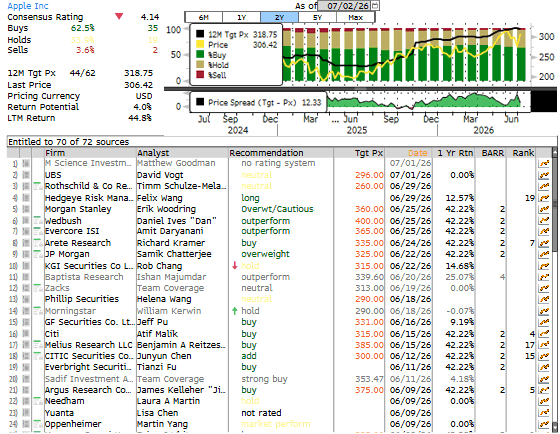
In terms of valuation, UBS maintains Apple’s price target at $296, based on an estimated $9.86 in earnings per share for 2027 and a 30x P/E ratio. The firm believes that the current stock price has partly reflected near-term iPhone demand improvements and the value of AI optionality, but uncertainties in the product roadmap, weak demand in the China market, and pricing factors limit further upside potential for valuation.
According to consensus data, Wall Street remains largely bullish on Apple overall: 35 analysts have a “buy” rating, 19 “hold,” and 2 “sell,” with a 12-month average target price of about $319. Currently, Apple’s share price has returned to above $300. Amid the yet-unfulfilled AI-driven upgrade thesis, the market's focus is gradually shifting from “technology narrative” to “hardware cycle and product rollout pace.”
Disclaimer: The content of this article solely reflects the author's opinion and does not represent the platform in any capacity. This article is not intended to serve as a reference for making investment decisions.
You may also like
Global Long-Term Bond Yields Surge: Fiscal Deficits, AI Bond Issuance, and Traditional Buyers Exit, a “Rate Revaluation” is Underway
The global long-term bond market is undergoing a rare systemic repricing, with yields in the US, Europe, and Japan all reaching multi-year highs. Surging government deficits and a flood of massive bond issuances by AI giants have triggered a "supply deluge," while traditional buyers exit and inflation concerns mount, completely disrupting the balance between bond supply and demand. This worldwide interest rate storm is sharply pushing up borrowing costs, making it clear: unless there is a sudden recession or external shock, the era of persistently high long-term rates shows no sign of ending.
UK job market remains sluggish! Weak labor demand and slower wage growth may present tougher policy choices for the central bank
As domestic and international uncertainties increase, the UK labor market continues to perform sluggishly—with weak corporate demand for labor and wage growth slowing to its lowest level in nearly six years.

Shiba Inu Network Metrics Plunge as Shibariumscan Faces Major Indexing Issue

Is the Fed's Policy Actually Already "Leaning Dovish"? San Francisco Fed's New Neutral Rate Model Provides Theoretical Ammunition for the Hawks
A report from a regional Federal Reserve bank indicates that an estimate of the neutral interest rate suggests the Federal Reserve's policy stance is accommodative.

Crypto prices
More


