
Tesla VP: In Five Years, Autonomous Driving and Humanoid Robots Will Be “Fully Integrated Into Daily Life”

Tesla is positioning autonomous driving and humanoid robots as the core of its next phase of growth. Lars Moravy, VP of Automotive Engineering at Tesla, stated that in the next five years, the “Real-World AI” built by Robotaxi, Cybercab, and Optimus will be fully integrated into work, travel, and home scenarios, ushering human society into a “sci-fi movie-like future.”
On the July 1 Brighter with Herbert show, Lars Moravy revealed that Cybercab is now in the pre-mass production testing phase, with production lines completed and in operation, automation levels exceeding 90%, and the team continuously optimizing manufacturing processes for scale. He emphasized that Cybercab was designed for mass production from its inception, and its eventual output will reach levels “not yet fully understood by the public.”
Meanwhile, the Optimus humanoid robot is also accelerating towards mass production. Lars Moravy stated that the first production line is being installed, with dozens more to be deployed in the future. Robot manufacturing will fully leverage Tesla’s years of experience in automobile manufacturing, supply chain systems, and automation.
The core message conveyed by Lars Moravy is not about a single product, but that Tesla is striving to build a Real-World AI ecosystem spanning factories, roads, homes, and work environments, and believes this system will see substantial implementation within the next few years.
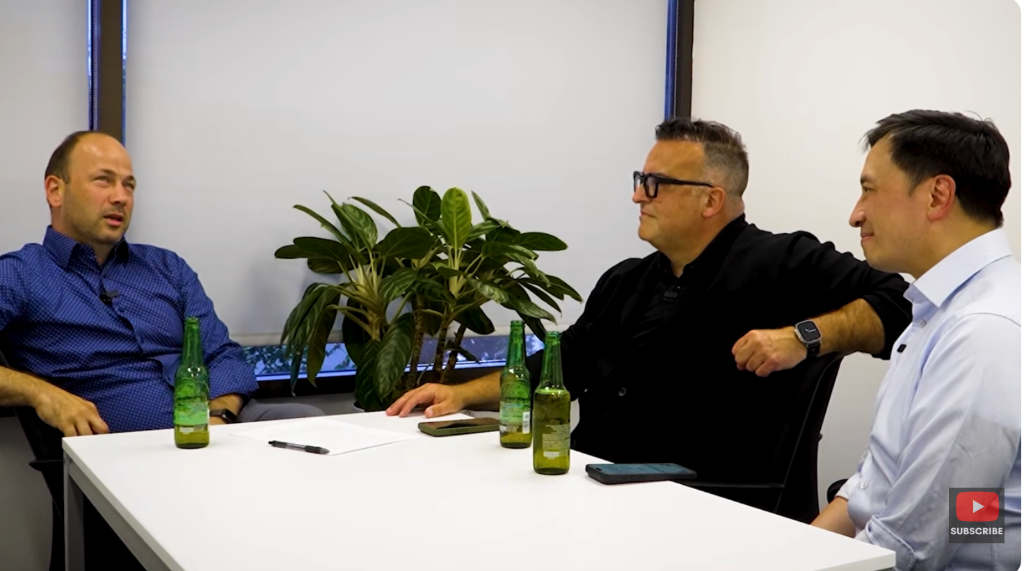 Lars Moravy, first from the left, VP of Automotive Engineering at Tesla
The Five-Year Ultimate Vision: Robotaxi, Cybercab, and Optimus Entering the Real World
When asked what achievement would most surprise the public about Tesla in five years, Lars Moravy gave a very clear answer.
He said that by then, the scale of Real-World AI surrounding people’s lives will be “mind-blowing.”
In his view, this not only means widespread adoption of the Robotaxi network, but also that Cybercab will be operating extensively in urban transportation, and Optimus will be present in factories, businesses, and even households. Beyond that, the company also has more undisclosed product plans.
Lars Moravy noted that if we look back at the past five years and look into the next five years, he believes by then people will truly be living in a world previously depicted only in science fiction movies.
Cybercab Enters the Scaling-Up Sprint: The Focus Is Not Just Autonomous Driving
Lars Moravy revealed that the Cybercab production line is now installed and operational, with every vehicle produced serving simultaneously as a test unit for autonomous driving model training, full vehicle validation, and manufacturing quality optimization.
He said the team is already conducting durability testing (burn-in) on the vehicles — each unit is both a production and test vehicle, with the aim of identifying as many issues as possible before real large-scale production begins.
He stated that Cybercab’s greatest feature is not its autonomous driving capability itself, but that the entire product was restructured around cost and scale from the very beginning.
Unlike traditional Robotaxi solutions which add lots of sensors and computing platforms to existing models, Cybercab uses a brand-new platform designed from the ground up, with every aspect — manufacturing process, body structure, battery, wiring harness, and automated production — all newly designed.
Lars Moravy believes this approach will ultimately result in operating costs far below market expectations, while enabling Cybercab to achieve lower unit costs, greater reliability, improved energy efficiency, and lower per-mile operational expenses.
He emphasized that the biggest market underestimation of Cybercab is not its autonomous driving, but its manufacturing efficiency and capacity for scale.
Optimus Begins Building a Mass Production System—Automobile Manufacturing Experience Will Be Replicated
For humanoid robots, Lars Moravy revealed that Tesla has started setting up the Optimus mass production ecosystem.
He stated that the first production line is being installed, with a large number of automated devices undergoing final testing and to be shipped to the factory for installation. Because robots are much smaller than cars, the entire line offers much higher modularity and the installation and commissioning speed will be significantly faster than for automobile lines.
He said that in the future, about 40 production lines will need to be built to cover all robot components and final assembly.
Lars Moravy believes that Tesla’s greatest advantage is not the robot itself, but its established, mature large-scale manufacturing system.
Whether it's supply chain management, automation equipment, production rhythm control, or supply chain resilience to emergencies—these capabilities, accumulated in the automotive business, can be directly transferred to Optimus.
He reiterated that Tesla enjoys three key advantages in the humanoid robot field: large-scale manufacturing capability, high-performance motor and actuator design expertise, and Real-World AI.
AI Has Deeply Embedded Itself in Tesla Factories and Cars Are Starting to “Check Themselves”
Besides future products, Lars Moravy also introduced AI’s current real-world applications within Tesla.
He said that AI has been widely applied for engineering knowledge management, anomaly detection in manufacturing, equipment monitoring, and quality control. Now, different manufacturing systems are beginning to interact via AI, not just exchange data.
He gave an example: today, Tesla vehicles can already autonomously drive within the factory from the assembly line to the logistics area, as well as self-drive across a squeak & rattle test road, using in-car microphones to identify abnormal noises, vibrations, and other issues, and then automatically generate diagnostic results for the engineering team. Tesla internally calls this system “Full Self Hearing.”
Lars Moravy noted that AI is helping factories detect problems earlier, locate them faster, and is continuously reducing after-sales repair times, thus enhancing overall manufacturing quality.
Manufacturing Capability Remains Tesla’s Biggest Competitive Moat
Regarding Tesla’s long-discussed competitive advantage, Lars Moravy believes that manufacturing capability is still Tesla’s largest moat.
He said that at Tesla, design, manufacturing, automation, and supply chain always belong to one engineering team, avoiding the fragmented development-production divide common in traditional auto companies. This highly integrated organization allows for rapid product iteration, making large-scale innovations like Cybercab and Optimus possible.
Lars Moravy stated that as early as 2014, Tesla began laying the groundwork for today’s autonomous driving and robotics strategies. Now, Cybercab and Optimus are just important milestones in this long-term plan. In the next five years, as Robotaxi, Cybercab, and Optimus continue to roll out, Real-World AI will become an increasingly prevalent part of everyday life.
Disclaimer: The content of this article solely reflects the author's opinion and does not represent the platform in any capacity. This article is not intended to serve as a reference for making investment decisions.
You may also like
PBOC sets USD/CNY reference rate at 6.7990 vs. 6.7972 previous
Euro posts modest gains above 1.1350 as traders await US CPI inflation release
Bitcoin mining activity rises in Ethiopia as country becomes unlikely crypto powerhouse
Jito price recovers – Assessing if JTO can flip $0.67 into support
Crypto prices
More


