Bitget App
Trade smarter
Buy cryptoMarketsTradeFuturesStocksEarnInstitutionAI & More
Hyperliquid: USDH fades to $20mln – Here’s what’s replacing it

Hyperliquid: USDH fades to $20mln – Here’s what’s replacing it

AMBCryptoAMBCrypto2026/06/29 11:01
By:AMBCrypto

Hyperliquid’s [HYPE] stablecoin market is becoming increasingly concentrated as liquidity continues shifting toward USD Coin [USDC] instead of the native USDH.

The trend reflects traders’ preference for deeper liquidity and established settlement assets over newer DeFi-native stablecoins.

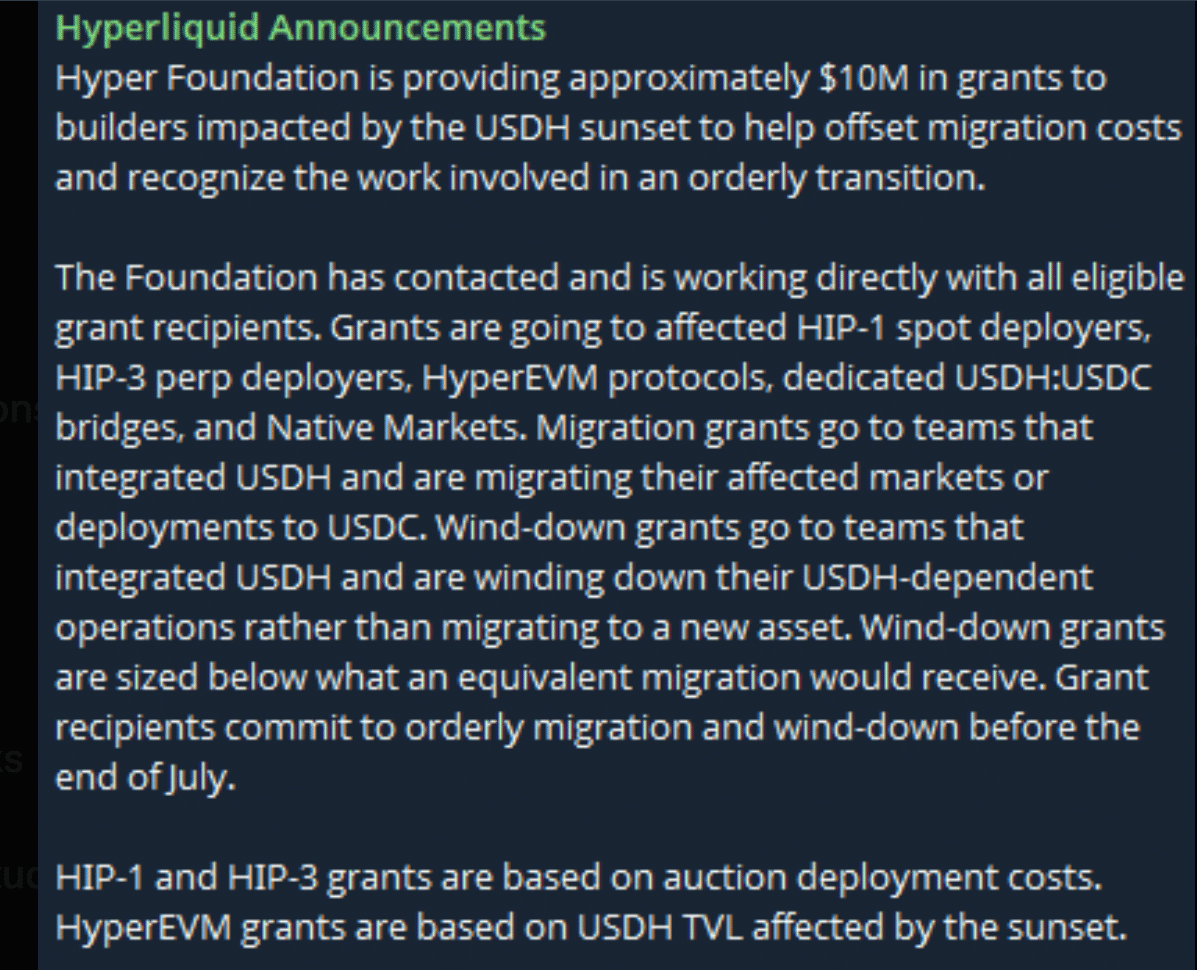
Hyperliquid Foundation has put out roughly $10 million in grants to assist in migration costs and ensure that each of its protocols continues to run smoothly. Those are HIP-1, HIP-3, HyperEVM protocols, bridges, and native markets.
@media only screen and (min-width: 0px) and (min-height: 0px) { div[id^="bsa-zone_1774359638628-7_123456"] { min-height: 50px; transition: min-height 0.3s ease; } } @media only screen and (min-width: 640px) and (min-height: 0px) { div[id^="bsa-zone_1774359638628-7_123456"] { min-height: 90px; } }
AD

Hyperliquid: USDH fades to $20mln – Here’s what’s replacing it image 0 Source: X

In addition, users can swap their USDH for USDC through the same migration paths, reducing friction during the transition.

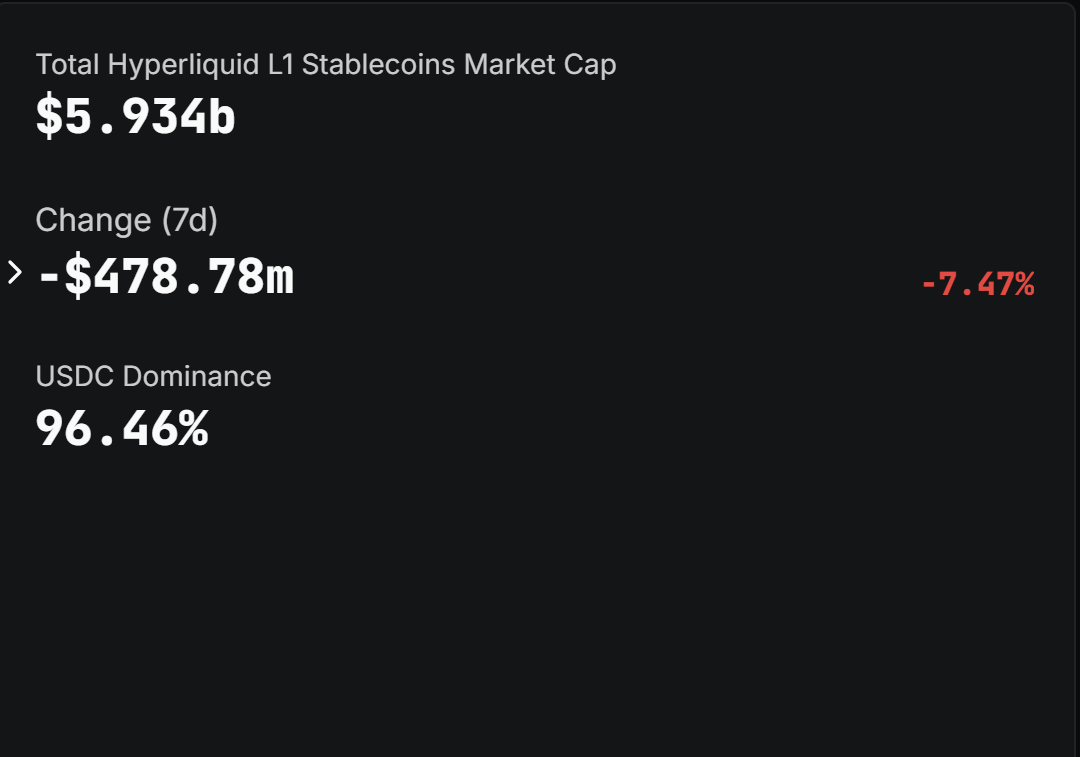
According to DeFiLlama, USDC now dominates Hyperliquid’s stablecoin liquidity.

In fact, USDC accounts for $5.74 billion of Hyperliquid’s $5.96 billion stablecoin pool. Conversely, USDH holdings have fallen sharply to just $20 million.
Hyperliquid: USDH fades to $20mln – Here’s what’s replacing it image 1 Source: DeFiLlama

Meanwhile, Tether [USDT] trails at around $155 million. These figures clearly indicate that network effects are supporting the growing dominance of USDC.

This imbalance suggests network effects are reinforcing USDC’s leadership, making it the preferred collateral across spot and perpetual markets. If institutional activity continues expanding, USDC’s dominance could strengthen further.

Otherwise, USDH would require meaningful utility improvements to regain market share.

Protocol activity reinforces HYPE utility

That orderly migration is already translating into stronger on-chain activity as Hyperliquid continues expanding around its USDC-first model. The shift did not disrupt the user participation.

It allowed for a sustained level of approximately 6,932 Daily Active Addresses and over 315,000 Daily Transactions, according to DeFiLlama data.

Meanwhile, Perpetual Trading Volume remained near $2.8 billion, reinforcing Hyperliquid’s leadership in on-chain derivatives.

Growing activity also generates Annualized Fee Revenue in the hundreds of millions, creating recurring value for the ecosystem. Those fees increasingly flow into HYPE through staking, priority fees, buybacks, and incentives instead of relying mainly on speculation.

If trading activity and USDC liquidity continue growing together, HYPE’s long-term value capture could strengthen further. Otherwise, slower network activity may gradually reduce revenue growth.


Final Summary

  • Hyperliquid [HYPE] transitions from USDH to USDC, strengthening liquidity and supporting continued network growth.
  • Hyperliquid growth now depends on sustained trading activity, with higher network usage supporting stronger fee generation and token utility.
0
0

Disclaimer: The content of this article solely reflects the author's opinion and does not represent the platform in any capacity. This article is not intended to serve as a reference for making investment decisions.

Understand the market, then trade.
Bitget offers one-stop trading for cryptocurrencies, stocks, and gold.
Trade now!

You may also like

CoreWeave default probability exceeds 60%! Jensen Huang "puts out the fire": Financing costs are declining, no need for NVIDIA to backstop

After Jensen Huang's speech, CoreWeave's stock price, which had fallen by as much as 9.5% in early trading, turned positive. The company's five-year CDS rose above 1,190 basis points during Thursday’s session, a historical high reflecting the cost of debt default protection, while yields on some of its corporate bonds have climbed above 15% to 16%. The five-year CDS spreads for Oracle, Amazon, Google’s parent company, and Meta are all at historically high levels. Deutsche Bank analysts believe that as the AI capital expenditure cycle is increasingly supported by debt rather than free cash flow, investors must place greater emphasis on signals from the credit market. Overall, while AI-related financing costs are not yet excessively high, worrying signs have begun to emerge.

华尔街见闻•2026/10/15 21:36
CoreWeave default probability exceeds 60%! Jensen Huang "puts out the fire": Financing costs are declining, no need for NVIDIA to backstop

Wall Street is wary of Bessent making another move to suppress yields; key clues may emerge this Friday

This Friday, major primary dealers of government bonds will receive the U.S. Treasury's routine survey before the refinancing announcement is released. Citigroup expects the survey may hint at a reduction in long-term bond issuance, or even the cancellation of 20-year U.S. Treasury bonds. Morgan Stanley emphasizes: "The next two refinancing announcements will be crucial, especially the one in November, which comes right after the midterm elections."

华尔街见闻•2026/10/15 21:06

Risk aversion outweighs inflation concerns, US and European government bonds rise across the board, US Treasury yields plunge more than 10 basis points intraday

Investors concerned about rising inflation are shifting their focus to the potential impact of high borrowing costs on economic growth. Some commentators have linked the recent decline in U.S. Treasury yields to surging financing costs for AI-related companies, suggesting that pressure in the technology stocks and AI infrastructure sectors is driving funds toward safe-haven assets such as government bonds.

华尔街见闻•2026/10/15 20:27
Risk aversion outweighs inflation concerns, US and European government bonds rise across the board, US Treasury yields plunge more than 10 basis points intraday
