
What caused the market turmoil this week? Goldman Sachs partner: It's not the wash, it's the AI rebalancing

The root cause of this week's intense volatility in global stock markets does not stem from macro concerns triggered by the appointment of a new Federal Reserve Chairman, but rather from a structural rebalancing within the AI investment frenzy—namely, the cyclical nature of storage, extreme position crowding among hedge funds, and a shifting market perception of winners and losers across the AI industry chain. Together, these factors comprise the true driving force behind the current turmoil.
Mark Wilson, Partner at Goldman Sachs Sales and Trading Division, made it clear in his latest report that although several macro signals have emerged since the newly appointed Fed Chair Kevin Warsh took office—such as a sudden drop in break-even inflation expectations, rising real interest rates, and a strong breakout in the U.S. dollar—he does not believe these are the fundamental reasons for this week's stock market swings. He maintains his consistent view: “The stock market is still driving the macro environment, not the other way around.”
The week’s market volatility in a nutshell: Korea's Kospi index triggered circuit breakers twice, Microsoft hit a 52-week low, Amazon broke below its 200-day moving average; the “Magnificent Seven” (Mag7) have collectively lost over 5% since the start of the year, with Apple and Dell both dropping more than 5% in a single day. Meanwhile, Micron recorded an all-time high gross margin—differentiation between beneficiaries and pressured players in the AI supply chain is now becoming more visible than ever in the market.
Wilson’s core conclusion is: This volatility does not signal the end of the AI investment cycle—“We remain in the midst of a historic investment frenzy”—but rather, the market’s judgment on the net winners and losers in this wave is undergoing a profound reassessment.
South Korea Becomes the Epicenter: Leverage Structure Amplifies Vulnerability of the AI Theme
The Korean market has been the focal point for global AI trading volatility this week. Year-to-date, the Kospi Index had at one point risen nearly 100%, yet triggered circuit breakers twice during the week. According to Wilson, half of all circuit breaker days Korea has seen this century have occurred in 2026, with this week alone accounting for 20% of them.
This extreme volatility has structural roots: about 60% of Kospi’s index weight is concentrated in just two stocks, underpinned by tens of billions of dollars in leveraged ETF replication products that magnify any significant movement in either direction. More crucially, recent expansion plans by Samsung and SK Hynix have alerted the market to the fact that the storage industry’s current historically high profit margins will eventually face constraints from increased supply.
Wilson points out that while this is a net positive for the overall supply chain, it exerts direct downward pressure on the storage stocks—which are currently the most crowded beneficiary trades.
Winners and Losers: Structural Repricing Across the AI Industry Chain
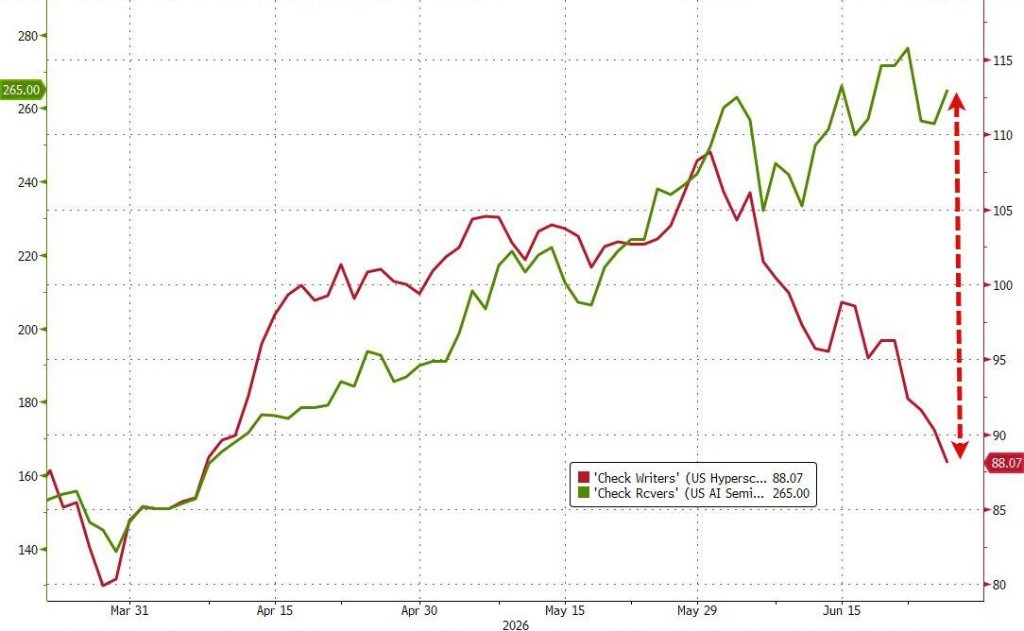
The market’s differentiating logic this week has been strikingly clear: companies making aggressive capital expenditures or facing cost squeezes have been punished, while beneficiaries along the supply chain have continued to rally.
Microsoft not only hit a 52-week low, but its share price also sits lower than its 2021 peak, meaning zero returns over the past five years; Amazon broke below its 200-day average. The Mag7 are down more than 5% in aggregate so far this year.
Elsewhere, terminal manufacturers like Apple and Dell, forced to institute broad price hikes due to soaring storage costs, are passing the record-setting Micron gross margin directly on to consumers. Wilson summarizes this trend as follows: “Those investing in AI (with uncertain returns) and those facing margin compression have seen their share prices punished, while those benefiting from capital expenditure and price increases continue to see sustained share appreciation.”
Storage Cycle: The Reversal Risk Behind Record-High Margins
Wilson believes the evolution of Micron’s profit margins may well become a business school classic in the future, yet the cyclical risks behind it should not be underestimated.
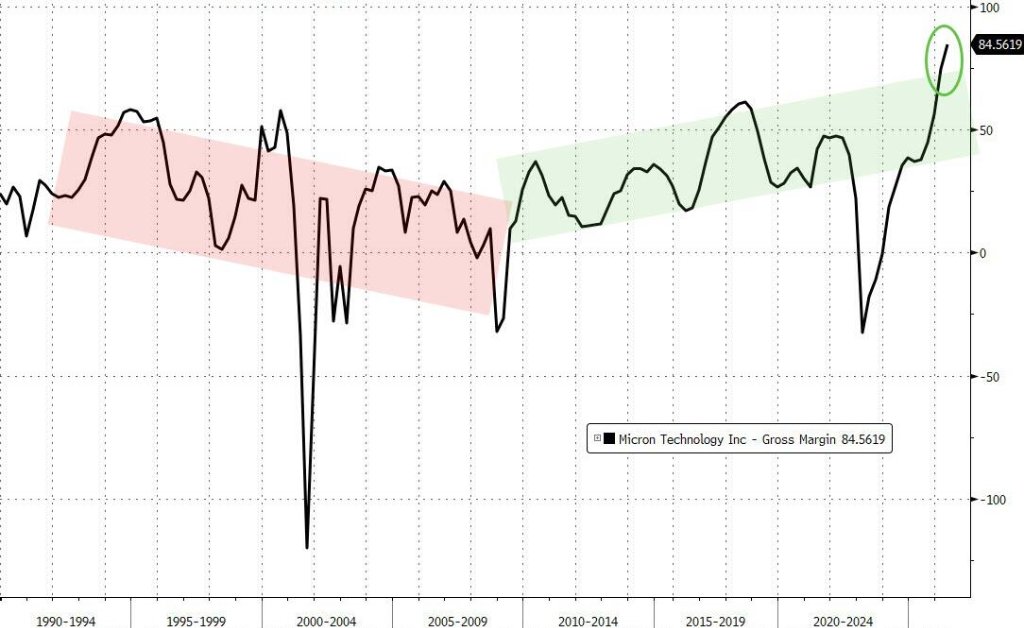
Since the global financial crisis, the storage industry has rapidly consolidated, with profit margins systematically rising during each downturn—an evolution that is well documented, strategically supported, and forms an investable thesis.
However, with Micron’s margins at historic highs and SK Hynix unveiling new capacity plans, Wilson warns investors that this remains, at heart, a cyclical industry. As Samsung and SK Hynix’s new rounds of capacity expansion materialize, today’s supply bottleneck will ease—this is positive for the supply chain as a whole, but for crowded storage stocks that have already benefited greatly, it means tangible valuation pressure.
Hedge Funds: High Leverage and Extreme Crowding Push Risks to the Edge
Goldman Sachs’ Prime Brokerage strategy team’s latest position analysis reveals another layer of deep risk behind this week’s market swings.
The data shows multiple extreme signals emerging simultaneously: overall hedge fund leverage reached all-time highs; since the beginning of the year, hedge funds have been large net sellers of U.S. assets while heavily increasing exposure to Asia (primarily Japan and Korea); and in AI-related holdings, the pace of net long accumulation in storage stocks is double that of semiconductors and utilities.
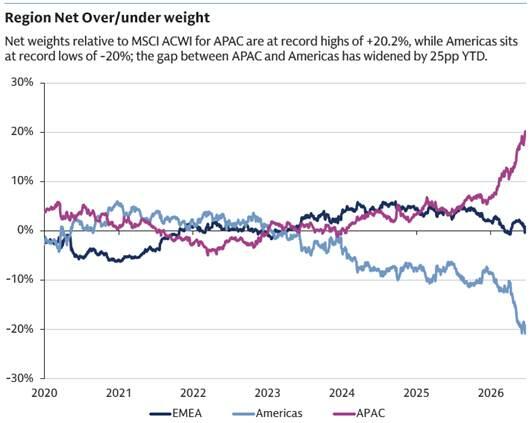
From a performance structure angle, fundamental, systematic, and multi-strategy hedge funds have returned between 14-18% year-to-date—stellar, yet with marked differentiation: systematic and multi-strategy excess returns come mainly from non-AI assets, while fundamental strategies are almost fully reliant on AI themes, with nearly zero alpha from non-AI holdings. The correlation between U.S. and Asian AI positions has reached the 99th percentile on a historical basis—an extreme level; Europe is largely absent from this rally.
Wilson emphasizes that crowding in and of itself is insufficient reason for a contrarian short, but once fundamentals shift, extremely crowded positions will greatly amplify downside risks—exemplified this week by the violent volatility in Korea.
The AI Boom Is Not Over—But the Landscape Is Quietly Shifting
Wilson’s report explicitly rejects the interpretation that this week’s volatility signals a turning point in the AI investment cycle. He argues that the increased volatility is signaling something potentially profound: the structure of net winners and losers in the AI frenzy is undergoing a deep transformation.
He also notes that political pressure on the AI narrative is building. As U.S. mid-term elections approach, the impact of AI on employment will gain more attention. Data show that the share of U.S. tech industry employment has been trending downward for over five years—AI-driven job losses are accelerating, and the industry so far lacks a compelling positive response.
For investors, the key takeaway from the current turbulence is: one can no longer lump everyone together as “AI beneficiaries”—much finer distinctions must be made between capital spenders, those facing margin compression, and supply chain beneficiaries—this will be a key variable in investment decisions for the second half of the year.
Disclaimer: The content of this article solely reflects the author's opinion and does not represent the platform in any capacity. This article is not intended to serve as a reference for making investment decisions.
You may also like
Bitcoin wallet dormant since 2011 becomes active, transfers $538,000
Treasury Proposes Rules Defining Who Can Legally Sell Stablecoins in US
VELVET crypto’s 24% rally squeezes shorts – Why $1.75 is now in focus
Ex-Signature Bank chair launches blockchain-powered instant overseas payments service
Crypto prices
More


