
Under the 'OpenAI Delays IPO' Headline: Oracle and Nebius Lead Hardware Stocks Down, While ServiceNow and Workday Lead a Broad Rally in Software Stocks

OpenAI’s financial troubles trigger a market revaluation, with software stocks soaring and chip stocks under pressure.
Wallstreet News reported that on June 25, The New York Times revealed that OpenAI may delay its IPO plans due to financial pressure, prompting the market to reassess the threat AI poses to traditional software companies.
The software sector saw broad gains on Friday, led by stocks once considered most threatened by AI, such as ServiceNow and Workday, while Oracle, which is closely tied to OpenAI, fell against the trend.
Rishi Jaluria, an analyst at RBC Capital Markets, noted that although market sentiment towards the software industry remains generally negative, "the most pessimistic period may have passed." He added that the notion that "AI will comprehensively replace existing software solutions for enterprises" does not align with reality.
Software stocks rally, former "hardest-hit areas" lead gains
The stocks with the most pronounced gains on Friday were precisely those software companies previously seen as most vulnerable to a wave of AI disruption.
ServiceNow and Workday both rose over 9%, ranking among the top gainers in the S&P 500 for the day.
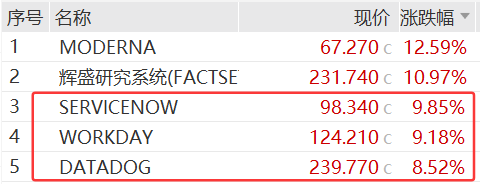 (Top 5 S&P 500 stocks by gain)
Figma and Datadog closed up by more than 10% and 8% respectively; Adobe and Salesforce each added about 5%; Atlassian also rose more than 5%.
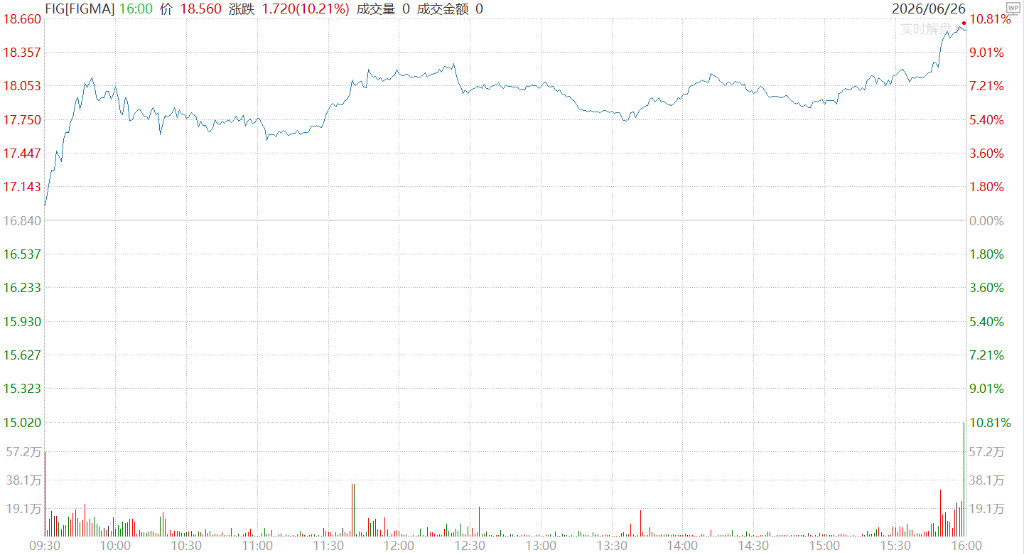
Adam Tindle, an analyst at Raymond James, pointed out that although it's difficult to precisely attribute one-day stock price movements, the biggest gainers on Friday were exactly those companies that the market had previously feared would be eroded by AI, with ServiceNow and Atlassian among them.
Oracle falls against the trend, cloud infrastructure drags on performance
In a stark contrast to the broad software rally, Oracle closed down about 3% on Friday, standing out as an underperformer within the sector.
Morningstar analyst Luke Yang said that the main factor weighing on Oracle’s share price was the news about the delayed OpenAI IPO.
Yang explained that this news is "positive" for the software application segment, but "negative" for the cloud infrastructure segment.
Oracle has a $300 billion cloud services contract with OpenAI, making a part of its business prospects highly tied to OpenAI’s success or failure.
From Oracle's own business structure, the importance of cloud has become increasingly pronounced. In fiscal 2026, Oracle's cloud business revenue grew 39% year-on-year to $34 billion, while software business revenue slightly declined by 1% to $24.5 billion.
Cloud infrastructure companies under pressure, compute providers face guidance risk
Weighed down by news of OpenAI’s financial troubles, emerging cloud infrastructure companies also failed to escape negative impact.
CoreWeave and Nebius Group both fell on Friday, closing down around 2% and 6%, respectively.
Luke Yang pointed out that both firms are highly dependent on AI infrastructure demand. Once market expectations for OpenAI’s growth become more conservative, related cloud computing power suppliers will be more directly impacted.
Eric Jhonsa, a Dutch Asset investment manager, stated on social media that the market has already priced in significant long-term terminal value risk for most SaaS companies, while for some AI infrastructure names, almost no long-term risk has been factored in.
He further pointed out that the progress of advanced models such as GLM 5.2, export control policies, and the trend of companies opting for smaller, cheaper models to cut token costs all indicate that AI compute capex will also face uncertainties in a longer time frame.
Valuation divergence intensifies, AI infrastructure investment logic faces recalibration
This round of market movement has also brought the valuation divergence within AI-related companies to the fore.
Eric Jhonsa noted that Nvidia trades at about 20x forward P/E, Broadcom at about 23x, Marvell at 58x, and Astera a high 116x, with the latter two showing higher stock-based compensation as a share of profit and free cash flow.
He believes this divergence is "absurd" and is under clear mean reversion pressure.
At the same time, some SaaS companies have seen their valuations compressed to 10–15x forward free cash flow (excluding stock-based compensation) while maintaining double-digit annualized recurring revenue and free cash flow growth, which he believes provides a good margin of safety.
On investment strategy, Eric Jhonsa said he remains constructive on AI infrastructure names that only need capital expenditures to grow strongly through 2028 (rather than to 2030 or beyond) to justify valuations, while being cautious or even bearish on those requiring a longer capex cycle to validate their valuations.
He added that buying AI infrastructure stocks at 15–20x their projected 2028 earnings per share makes him much more comfortable than paying 30x or more.
At the macro level, Eric Jhonsa noted that if inflation heats up again in the second half of the year, combined with a slow Fed reaction under political pressure, long-term interest rates could surge. This would be the greatest macro threat to current tech stock valuations.
Disclaimer: The content of this article solely reflects the author's opinion and does not represent the platform in any capacity. This article is not intended to serve as a reference for making investment decisions.
You may also like

Uniswap community votes 74% in favor of UNI burn: Will adoption drive token scarcity?
Buff Technologies soars 40% after unnamed AI giant strikes deal for gamer behavior data
🔥 Bitget US Stock Hotspot Sniper|2026.07.14
Crypto prices
More


