
Michael Burry bets $1.1B against AI stocks, echoing his famous 2008 short

Michael Burry, the hedge fund manager immortalized in “The Big Short” for his prescient bet against the US housing market, is back with another contrarian wager. This time, his target is artificial intelligence.
Through his firm Scion Asset Management, Burry disclosed put option positions with a combined notional value of approximately $1.1 billion against two of AI’s biggest beneficiaries: Palantir Technologies and Nvidia. The Q3 2025 13F filing shows $912 million in notional puts on Palantir and $187 million on Nvidia.
The fine print matters
Before anyone assumes Burry is staking a billion dollars on an AI crash, a quick translation is in order. Notional value is not what Burry actually paid. It represents the total market value of shares the options could theoretically control.
The actual premium paid for the Palantir position was around $9 million. That’s roughly 1% of the headline figure. The options reportedly include longer-dated contracts expiring in 2027 with strike prices well below market levels at the time of disclosure. That means Burry is not betting on a minor pullback. He’s positioning for a significant repricing of these companies.
Burry has publicly criticized AI companies for what he views as poor return-on-invested-capital dynamics. In plain English: these companies are spending enormous sums building AI infrastructure, and Burry doesn’t think the revenue will justify the investment.
A pattern of contrarian conviction
During the 2008 financial crisis, his bet against subprime mortgage securities generated roughly $100 million in profits for Burry personally and over $700 million for his investors. That trade became the subject of Michael Lewis’s bestselling book and a subsequent film.
More recent filings from early 2026 show Burry expanding his bearish tech exposure, adding short positions on the SOXX semiconductor ETF, QQQ, Oracle, and Tesla. He also closed his position in GameStop.
Why crypto investors should pay attention
Burry’s trades don’t involve crypto directly. No Bitcoin puts, no Ethereum shorts. But crypto and tech stocks have become increasingly correlated over the past several years, particularly during periods of risk-off sentiment. When the Nasdaq sells off sharply, Bitcoin and other major tokens tend to follow, at least in the short term.
The AI narrative has also been a tailwind for several crypto-adjacent sectors. AI tokens, decentralized compute projects, and GPU-related plays have all benefited from the broader enthusiasm around artificial intelligence. If institutional investors start questioning AI return dynamics, the skepticism could easily bleed into crypto projects making similar promises about AI integration.
Disclaimer: The content of this article solely reflects the author's opinion and does not represent the platform in any capacity. This article is not intended to serve as a reference for making investment decisions.
You may also like
Nvidia (NVDA.US) plans to invest $3 billion to enter SB Energy: from selling chips to securing the OpenAI "electricity-park-computing power" chain
Analysts point out that Nvidia may be able to intervene early in a critical aspect of GPU order fulfillment by investing in the developer of OpenAI’s data centers.

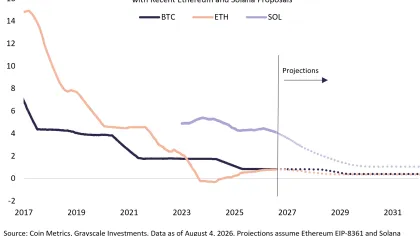
Ethereum and Solana may become scarcer – THESE Grayscale projections say…
‘Bitcoin doesn’t need MSCI’ – Strategy fires back as MSTR deletion odds hit 73%
Five factors are combining to intensify, JPMorgan: Global food crisis may erupt next year
JPMorgan has warned that driven by the combined effects of war, weather, storage, water resources, and waste, a global food crisis may erupt in the first half of 2027. The global food inflation rate is expected to rise from 2.8% in the first half of 2026 to 5% in the first half of 2027. The overlap of a super El Niño and energy shocks will push the Food CPI up by an additional 1.5 percentage points, with emerging markets such as India, Indonesia, and Brazil being the most affected.
Crypto prices
More


