
Bitget App
Trade smarter
Buy cryptoMarketsTradeFuturesStocksEarnInstitutionAI & More
+427 Billion Shiba Inu (SHIB) Added to Centralized Exchanges: Analyzing the Price Effect

+427 Billion Shiba Inu (SHIB) Added to Centralized Exchanges: Analyzing the Price Effect

CryptoNewsNetCryptoNewsNet2026/05/09 10:06
By:CryptoNewsNet
Back to the list

+427 Billion Shiba Inu (SHIB) Added to Centralized Exchanges: Analyzing the Price Effect

+427 Billion Shiba Inu (SHIB) Added to Centralized Exchanges: Analyzing the Price Effect image 0  u.today 16 m
+427 Billion Shiba Inu (SHIB) Added to Centralized Exchanges: Analyzing the Price Effect image 1

Shiba Inu is starting to find some stability, but recent on-chain data still shows traders aggressively reshuffling positions across centralized exchanges. As investors continue to move money around the market, $SHIB saw a significant increase in exchange-related activity, with outflow metrics rising dramatically over the previous 24 hours.

Shiba Inu is back to ascension

The market is attempting to recover from a bearish cycle, as seen on the chart itself. $SHIB has been trending lower for the majority of the last year, continuously trading below long-term moving averages and significant resistance levels.

However, in an effort to reclaim the 50 EMA, the asset recently began to form a gradual ascending structure, making higher lows, without breaking the 100 EMA just yet.
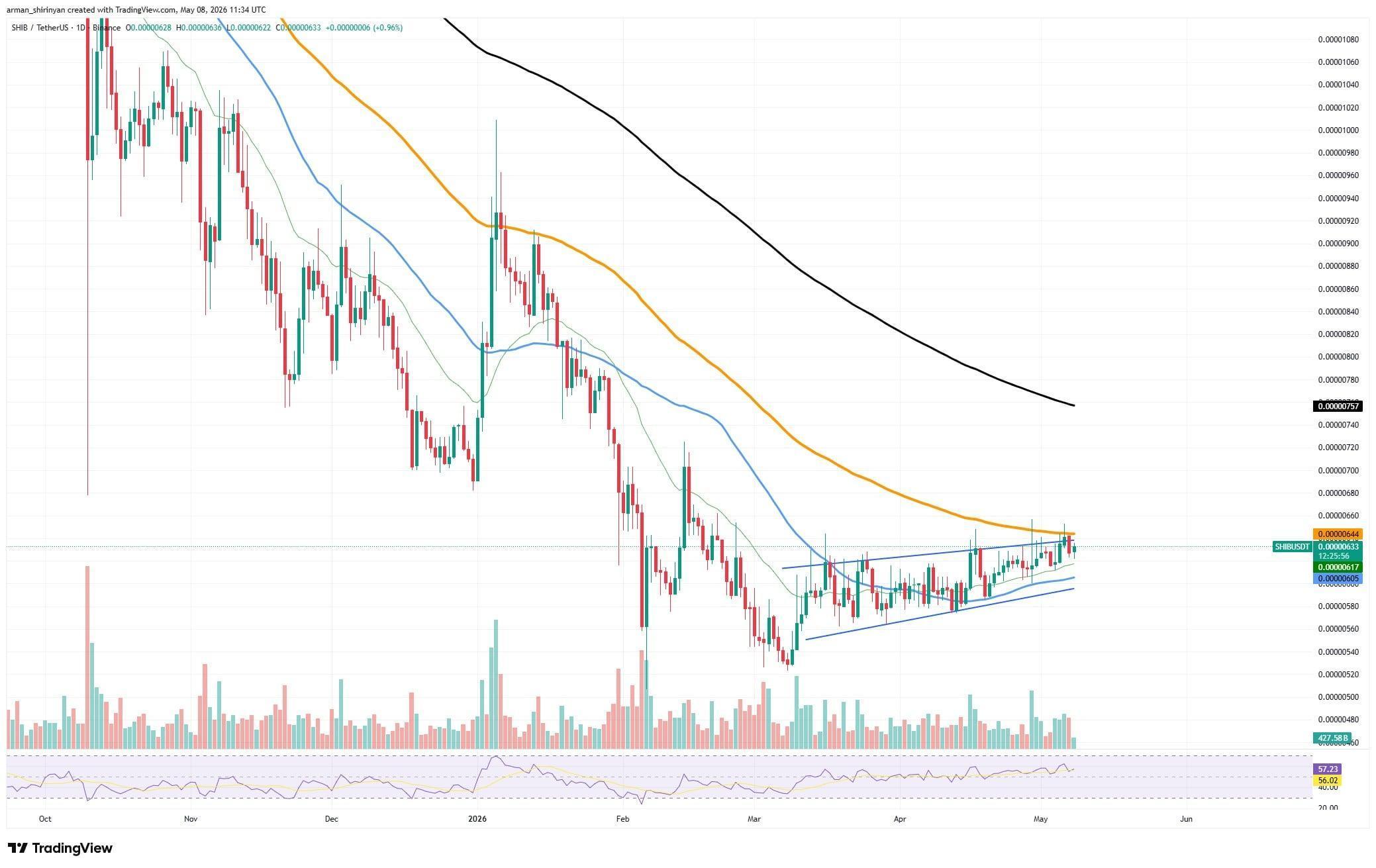
+427 Billion Shiba Inu (SHIB) Added to Centralized Exchanges: Analyzing the Price Effect image 2 $SHIB/USDT Chart by TradingView

Exchange activity is currently the bigger story. The most recent metrics show that exchange reserve levels continued to rise, while $SHIB exchange outflows and inflows both increased.

Over the past day, the Exchange Reserve increased by about 0.17%, indicating that more $SHIB are still parked on centralized trading platforms. That typically indicates increased market activity and possibly higher volatility in the future.

While the Exchange Inflow Mean decreased by about 15% over a seven-day period, the Exchange Outflow Mean decreased by more than 62%. This combination raises the possibility that large holders are reducing their aggressive transfer activity following periods of high movement. In the meantime, overall exchange inflows continue to exceed outflows.

There were about 427.9 billion $SHIB coming into exchanges and 285.7 billion going out. Because exchange inflows are frequently linked to possible selling pressure, particularly in volatile market conditions, this imbalance is significant.

Price action stays below 200 EMA

Additionally, price action is still stuck below the 200 EMA, which is still a significant long-term resistance barrier. Traders will probably be hesitant to declare a complete trend reversal until $SHIB firmly breaks above that level. Increased volatility around current levels should now be anticipated by investors.

Although the exchange metrics indicate that market participants are still very active and continuously repositioning, the chart's improving structure indicates that $SHIB is no longer in freefall.

$SHIB may keep pushing higher and try to break out of its current channel formation if the overall cryptocurrency momentum is still strong. However, growing exchange reserves and high inflows could quickly result in fresh selling pressure if market sentiment deteriorates.

0
0

Disclaimer: The content of this article solely reflects the author's opinion and does not represent the platform in any capacity. This article is not intended to serve as a reference for making investment decisions.

Understand the market, then trade.
Bitget offers one-stop trading for cryptocurrencies, stocks, and gold.
Trade now!

You may also like

VIPAI Asset Sell-Off and Selective Rotation in Crypto

1. Technology stocks fell sharply as investor interest shifted toward energy and selected defensive assets. From October 10 to 16, the Nasdaq 100 declined 5.49% and the S&P 500 fell 1.95%, while the Dow gained 0.67% and WTI crude rose 10.41%. BTC, ETH, and SOL declined 1.27%, 2.65%, and 4.44%, respectively. This week's technology earnings will be an important test of whether revenue growth, margins, and cash flow can justify current valuations. Better-than-expected results could help stabilize markets in the near term. 2. Crypto continues to see pockets of strong activity, but a broad-based altcoin season has yet to materialize. CoinMarketCap's (CMC) Altcoin Season Index stood at 54 as of the October 18 UTC daily observation, below the altcoin-season threshold of 75, while BTC dominance rose to 60.08%. Our proxy leverage ratio fluctuated between 4.00 and 4.07 during the week, showing no sustained increase and suggesting limited appetite for additional leverage. Meanwhile, as major exchanges expand access to traditional financial assets, the recent sell-off in AI-related equities could attract short-term speculative capital away from crypto. Such capital rotation could make it more difficult for a new altcoin season to take hold. 3. Papertrade's loss-to-mine model has generated significant interest across the crypto community. The protocol combines high-leverage derivatives trading with zero slippage and a mechanism that rewards trading losses with PAPER tokens. Across the eight complete UTC days from October 10 to 17, cumulative reported revenue reached approximately $56.08 million, including $51.90 million distributed to token holders. With growing participation from key opinion leaders (KOLs), Papertrade has reportedly ranked among the top three platforms by profitability in the broader market recently. Assets to watch: BTC, ETH, SOL, ARB, OP, SKHYNIX, SKHY, META, TSLA, LRCX, and SPCX. Key research priorities this week: Cash flow performance in technology earnings; the relative discount and holding costs of the two SK Hynix contracts; and U.S. initial jobless claims and PMI data. Weekly market data cover the period through October 16, while research information was verified through October 18. Observation periods are specified separately for each chart.

Bitget•2026/10/19 06:51
AI Asset Sell-Off and Selective Rotation in Crypto