
Panic buying! "Momentum trading" sweeps the US market, "historical extremes" attract market attention

Momentum trading in the US stock market continues to heat up. With multiple bullish factors converging, the chase-for-gains sentiment has spread to junk bonds, cryptocurrencies, and various other assets, prompting warnings from Wall Street.
On Friday, the S&P 500 Index hit a record high while the Philadelphia Semiconductor Index soared 11% over five trading days, marking six consecutive weeks of gains for US stocks.
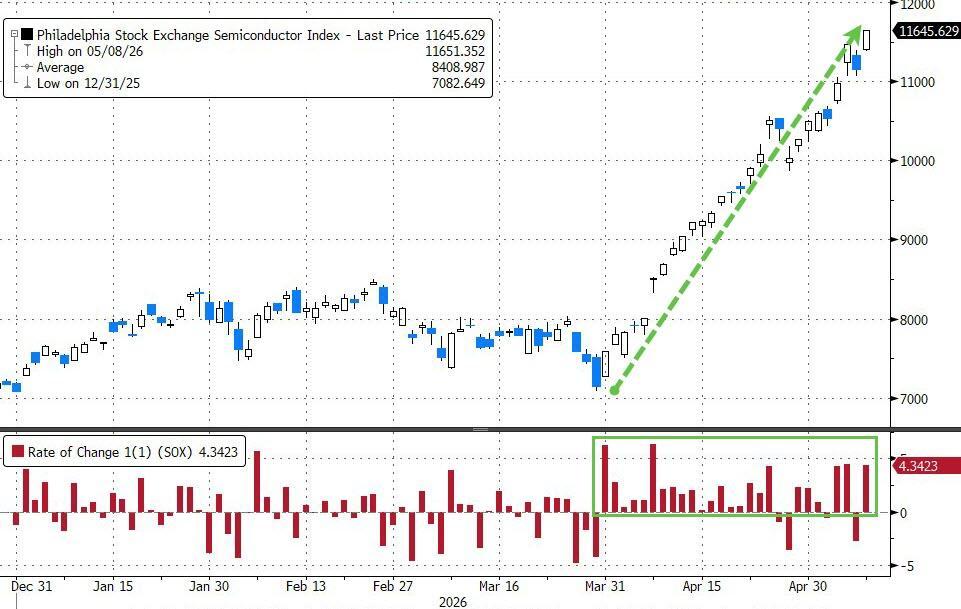
This week, easing tensions in Iran, stronger-than-expected US employment data, and another significant rally in AI chips collectively pushed already overheated momentum trades to new heights. The Momentum Index saw significant fluctuations this week but ultimately closed higher.
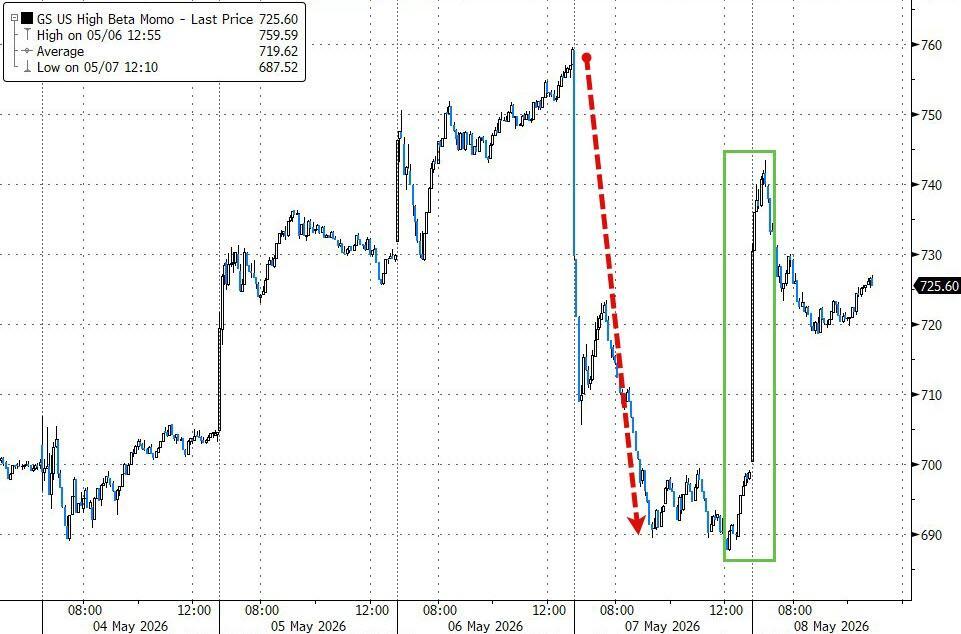
Although about 85% of S&P 500 components beat earnings expectations this season—providing fundamental support for momentum trades—some investors warn that these trades are fragile in the near term, with rotation risks accumulating.
Barclays strategists warn that the momentum run has reached extreme levels that historically tend to precede sell-offs. Goldman Sachs’ trading desk also noted this week that high-momentum stocks are now evidently overvalued, with positioning at near multi-year highs.
Momentum Trading Spreads Across All Assets, Led by Soaring AI Chips
The logic behind momentum trading is simple and direct: buy the biggest gainers and sell the weakest performers.
This strategy was applicable to almost all asset classes this week. Junk bonds, cryptocurrencies, semiconductor stocks—all were swept into the same “risk appetite” playbook.
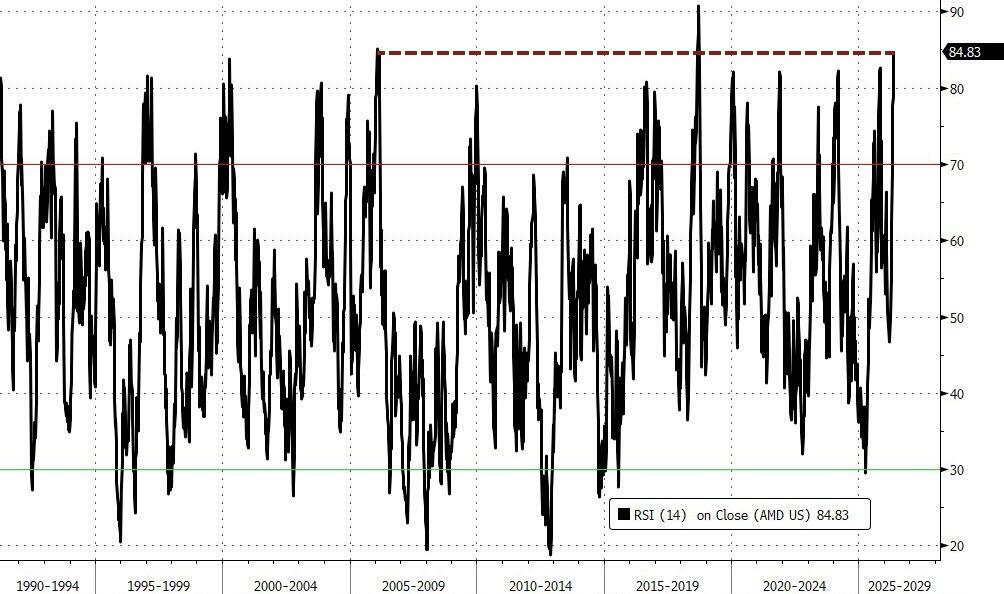
The chip sector was especially outstanding, with AMD’s weekly Relative Strength Index (RSI) approaching historic overbought levels.
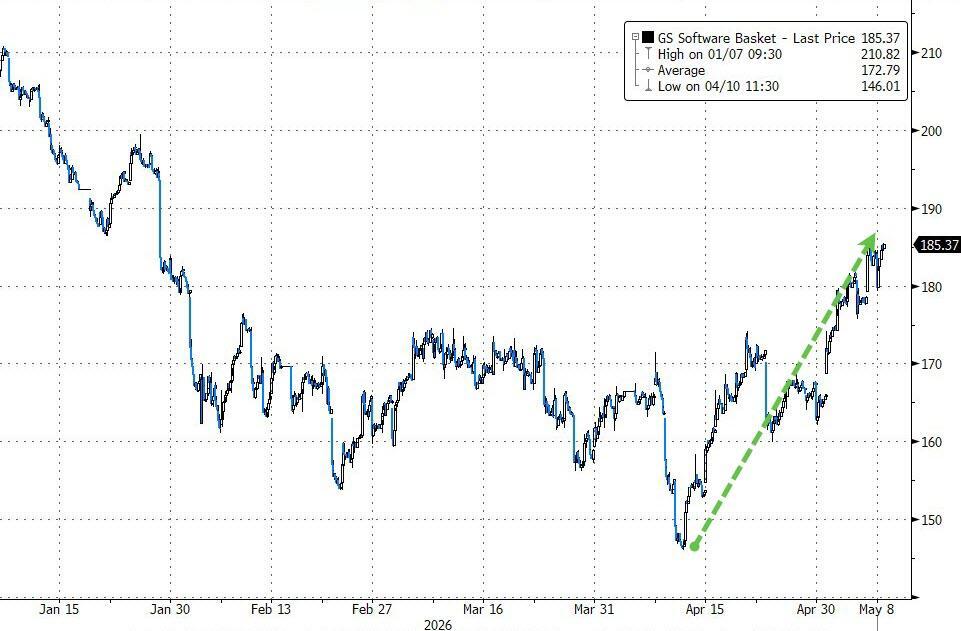
The software sector also rebounded for the fourth consecutive week, with weekly gains exceeding 5%, after a significant plunge earlier this year.
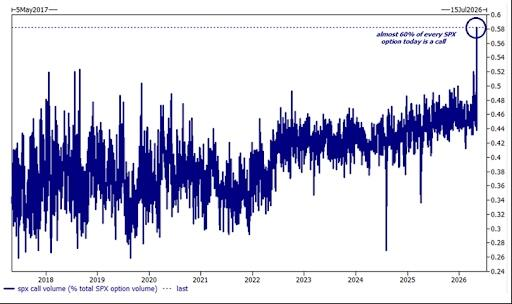
Options data show that as US stocks hit new highs, traders are rushing into call options with near record enthusiasm. The difference between call and put volume in the single-stock options market has reached the highest level in about four years.
The Barclays Equity Party Indicator reveals that bullish sentiment remains elevated among retail investors. Its one-month moving average stands at about 14.3%, nearly three standard deviations above the long-term average.
Wallstreetcn mentioned that this exuberant trading environment reminds analysts of “late-cycle over-optimism.” Greg Boutle, Head of US Equity and Derivatives Strategy at BNP Paribas, commented that the current environment "is starting to feel a bit like the late 1990s."
Mechanical Chasing—Questions About Rally Quality
The internal structure of the market reveals another side to this rally.
According to Bloomberg analysis, this rebound is clearly mechanical: during the early Iran-Israel conflict, institutional investors were generally underexposed. As stock prices rose and volatility dropped, they were forced to add positions, creating a positive feedback loop—higher prices, lower volatility, greater demand for call options, repeating circularly.
However, market breadth continues to deteriorate. The rally is increasingly dependent on large-cap tech, semiconductor, and AI-related stocks, while contributions from other components are shrinking.
The value factor, after a strong first quarter, has turned negative. The low volatility factor has declined for a sixth straight month, while the quality factor (favoring profitable, low-leverage firms) remains under pressure, with its 60-day correlation with the momentum factor near the lowest level in a year.
This is typical of risk appetite rotation—defensive factors recede as speculative factors soar.
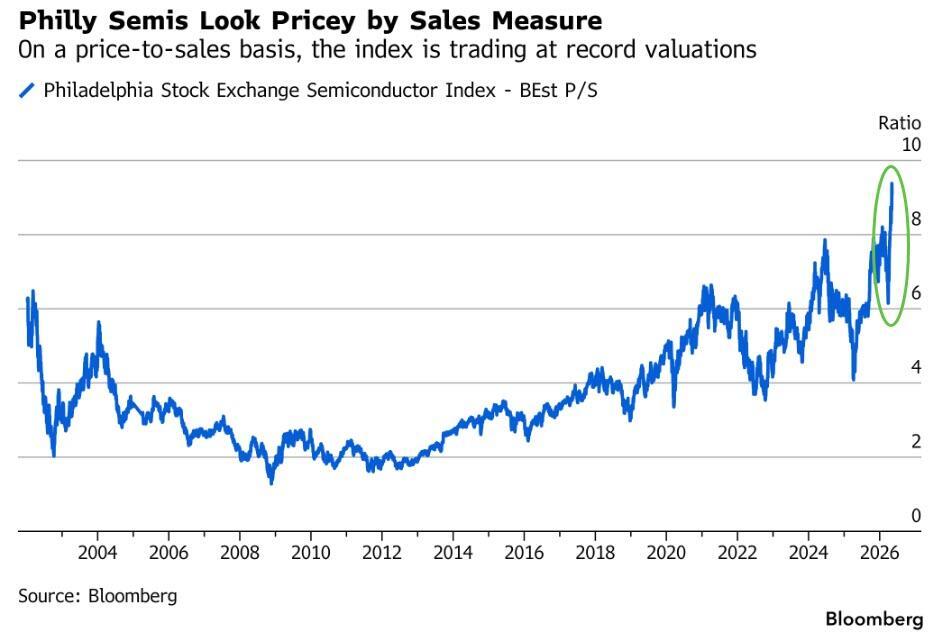
In terms of chip stock valuations, while price-to-earnings ratios (at 24.4 times forward earnings) are below the 2024 peak of 30.4x, the price-to-sales ratio is now at a historical high.
Barclays and Goldman Sachs Issue Dual Warnings: Valuations and Positioning Both at Extremes
Despite the fierce rally, warning signals are intensifying at the institutional level.
Alexander Altmann, Global Equity Tactical Strategy Head at Barclays, noted in a report this week that investors are piling into winning stocks.
This phenomenon has historically preceded the collapse of the momentum factor—such was the case in the 2008 global financial crisis and when the COVID-19 vaccine emerged in 2020.
He warns the current momentum rally has reached extreme levels that have historically signaled a pullback.
Goldman Sachs’ proprietary data likewise show that high-momentum stocks are significantly stretched on valuation, with institutional positioning at multi-year highs.
Michael Romano, Head of Hedge Fund Equity Derivatives Sales at UBS Securities, noted that AI winner stocks are up over 50% since the March lows, stating: “The momentum factor feels very fragile in the short term,” and added:
It may be worth hedging AI winner positions with short-term downside protection.
Thursday’s market provided a brief preview: News of renewed Iran-Israel tensions dealt a heavy blow to leading AI stocks, with the Momentum Index recording its worst one-day performance in three months. However, these losses were quickly recouped on Friday.
Disclaimer: The content of this article solely reflects the author's opinion and does not represent the platform in any capacity. This article is not intended to serve as a reference for making investment decisions.
You may also like
When France and Germany pay for their deficits, fiscal discipline becomes the "moat" of the UK bond market; investors are positioning in advance for a rebound in gilt bonds.
Investors are betting that the new UK Chancellor, Healey, will uphold fiscal discipline and are purchasing gilts in advance. A smooth and steady budget plan is expected to turn the UK from a "risk" in the bond market into a "positive."
Anthropic's $2 Trillion IPO Faces Doubts: Risks of Mismatched Computing Commitments and Revenue
The independent institution New Constructs reported that the Anthropic IPO is absurd, with a valuation of only 150 billion. The main controversy lies in the mismatch between long-term computing power commitments and clients' short-term on-demand procurement models, coupled with macroeconomic headwinds and early investor sell-off pressure, leading to increased market volatility.

Anthropic allocates 5% of shares to set up a fund before IPO, Musk calls for direct distribution to the public
Anthropic announced the establishment of a public welfare fund, initially allocating 5% of its shares. When the company's valuation increases by 50%, another 2% will be added. The aim is to address the impact of AI on employment. Musk suggested directly distributing shares to the public.

AI Stocks Struggle to Rebound: Lacking Three Major Supports, July’s Rally Hard to Replicate
JPMorgan pointed out that due to the absence of ETF bargain-hunting funds, limited room for short covering, and the early termination of the $40 billion buyback by Samsung and SK Hynix, the rebound strength of AI stocks in October may not match that of July. The resurgence of leverage risk could intensify volatility.

Crypto prices
More


