
Tech stocks push Nasdaq, S&P 500 to record highs as Bitcoin taps $75K

US equities and tech stocks gained on Wednesday as investors looked optimistically to a de-escalation of the US-Iran war, while the price of Bitcoin tapped $75,000 amid broader positive momentum across the crypto market.
According to data from Yahoo Finance, the tech-heavy Nasdaq Composite hit a new all-time high of 24,016.02 on Wednesday, closing the trading day with a 1.59% gain, while the S&P 500 tagged its own record high of 7,022.95 after notching a slight gain of 0.8%.
The indexes' performance on the day was led by a 2.08% gain in tech stocks overall. Meanwhile, Bitcoin hit $75,229 on Wednesday, rising 1.07% over the past 24 hours and continuing recent positive momentum that has seen BTC climb nearly 10% over the past two weeks.
The tech and crypto gains come amid suggestions from the White House that US-Iran conflict may be coming to an end. President Donald Trump told Fox Business on Wednesday that he views the war as "very close to being over."
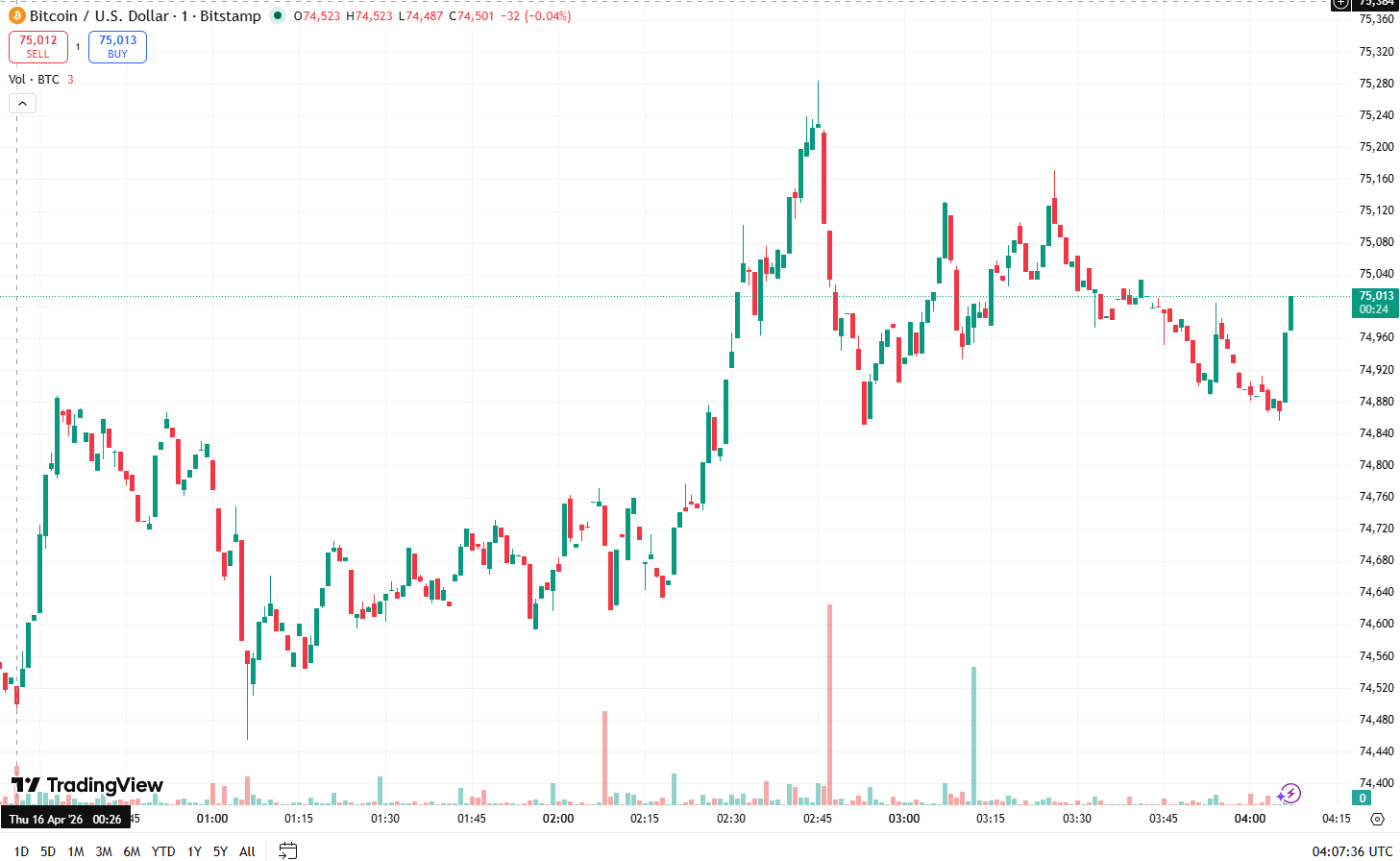 BTC’s 24-hour price performance. Source:
TradingView
BTC’s 24-hour price performance. Source:
TradingView
Trump, however, indicated that this still depends on whether a deal can be struck between the two nations.
"If I pulled up stakes right now, it would take them 20 years to rebuild that country. And we're not finished," he said, adding, "We'll see what happens. I think they want to make a deal very badly."
Commenting on the S&P 500’s recent gains, Fundstrat's chief investment officer, Tom Lee, said there's more room for growth in the near term, arguing that some investors remain parked on the sidelines as they wait to see how the conflict develops.
Speaking with CNBC's "Closing Bell" on Wednesday, Lee argued that the US stock market and economy have been performing well enough despite the Middle East conflict, and added in a post on X that "stocks bottom on bad news,” not good news.
However, Lee said he expects the next leg of the rally to be led by crypto assets such as Bitcoin and Ether, along with the Magnificent Seven tech stocks and the broader software sector.
Disclaimer: The content of this article solely reflects the author's opinion and does not represent the platform in any capacity. This article is not intended to serve as a reference for making investment decisions.
You may also like
Tesla's sports car can really fly!
Tesla's second-generation Roadster was unveiled at the SpaceX test site, marking a significant debut nine years after pre-orders first began in 2017. Mass production is scheduled for 2028. The new vehicle features a fan suction system and compressed air thrusters, enabling genuine "flight." Elon Musk confirmed that this will be Tesla's last model to support manual driving. Analysts predict that sales of 7,000 units in the first year could generate nearly $2 billion in revenue, with extremely high profit margins being its core commercial value.
Earnings season is here! Citadel Securities: The next few weeks will be the real stress test for U.S. stock fundamentals
The US stock market enters Q3 earnings season, with market expectations for S&P 500 earnings per share to grow 27% year-over-year, marking the third highest threshold ahead of earnings seasons since 2010. However, the growth is highly concentrated—Micron and Nvidia alone contribute 36% of expected gains. Retail investors’ weekly net buying surged to $9.1 billion, with semiconductor purchases reaching a historic peak. Citadel Securities warns that index volatility has fallen to its calmest range in nearly 30 years, while individual stock risks are quietly rising, making stock picking preferable to simply increasing index allocations.
Dangerous signal? CoreWeave founders cash out $3.3 billion after IPO
The founder's sell-off objectively avoided a 60% drop in share price, and some have already liquidated nearly 40% of their wealth. Behind this stark contrast, the company is burdened with a massive $52 billion debt, with a five-year default probability exceeding 60%. The current debt stands at $52 billion, and the cumulative negative free cash flow for 2026-2028 is projected to reach $71 billion. Its model of "borrowing at 9% interest to earn a 1% return" has been harshly criticized as the "subprime crisis" of the AI industry. The high-leverage computing power financing game is now facing the market's ultimate test.

Strategy Braces for $2.8B Liquidation Shock as MSCI Changes Index Rules
Crypto prices
More


