
Another round of ceasefire talks reported, is the Iran war really coming to an end! The market seizes this rebound, and the US dollar returns to pre-war levels in a single stroke

On Tuesday (April 14), reports emerged that the United States and Iran are considering a new round of peace talks. The market responded optimistically to this expectation, driving oil prices down and lifting global stock markets, while diminishing some of the safe-haven appeal of the dollar.
European stocks rose as markets are increasingly hopeful that a Middle East agreement will help restore normal energy flows and curb the risk of a global inflation spiral.
Most European stock markets opened higher. Boosted by gains in basic materials and technology stocks, the pan-European Stoxx 600 index rose 0.5%. Germany’s DAX index, which is heavily weighted toward industrials, gained 1%, led by automakers and other companies sensitive to energy prices. The London FTSE 100 inched up 0.1%, supported by a 3.2% increase in precious metals miner Fresnillo, but oil giants BP and Shell limited further upside in the index.
Hopes for a path of diplomatic détente fueled a rebound in US stock futures. Nasdaq 100 futures rose 0.4%, suggesting a tenth consecutive session of gains and potentially the longest winning streak since 2021. S&P 500 futures were up 0.2%. Earlier, the S&P 500 had already erased all declines caused by the war in Monday’s session. The current rally is mainly driven by surging mega-cap tech stocks as the Q1 earnings season kicks off, with a series of results from the likes of JP Morgan and Wells Fargo Bank due out later.
On Tuesday, Asian stock markets advanced and oil prices fell on hopes for further US-Iran peace talks, boosting risk appetite. Japan’s Nikkei index climbed 2.4%, South Korea’s Kospi index rose 2.7%, and China’s Shanghai Composite gained 0.95%.
The US and Iran Expected to Return to the Negotiating Table
According to sources familiar with the matter, as President Donald Trump proceeds with a maritime blockade to contain Iran’s oil exports, the US and Iran are considering negotiations to extend the two-week ceasefire. The goal is to conduct further talks before the truce expires. Reuters reported that both sides may return to Islamabad for further negotiations this week.
US President Donald Trump stated that Iran wants an agreement but added that he would not accept any outcome that allows Tehran to possess nuclear weapons.
Charu Chanana, Chief Investment Strategist at Saxo, said, “The market is trading on hope rather than outcome. Last weekend’s failed talks brought no agreement but did not close the diplomatic door, which is enough to keep stocks moving temporarily higher.”
She added, “The problem is that the market may be pricing in easing tensions faster than there is actual evidence. Therefore, I still expect a news-driven choppy market, rather than a clean trend of improving risk appetite.”
Oil Prices Hold Steady at High Levels
Brent crude fell 0.6% to $98.81 per barrel. The International Energy Agency (IEA) expects that this war will cause global oil demand growth to fall to zero for the first time since the 2020 pandemic.
Analysts at ANZ Bank commented, “The oil market no longer requires the worst-case escalation to justify higher price levels. Supply-demand tightness alone is enough to keep Brent oil prices at or above recent threshold levels.”
Charu Chanana, Chief Investment Strategist at Saxo Markets, noted, “The market was already inclined to believe diplomatic channels would in some form remain open. The significance of this signal is that it makes such hope more concrete, and that has already strengthened the market’s ‘relief trades.’”
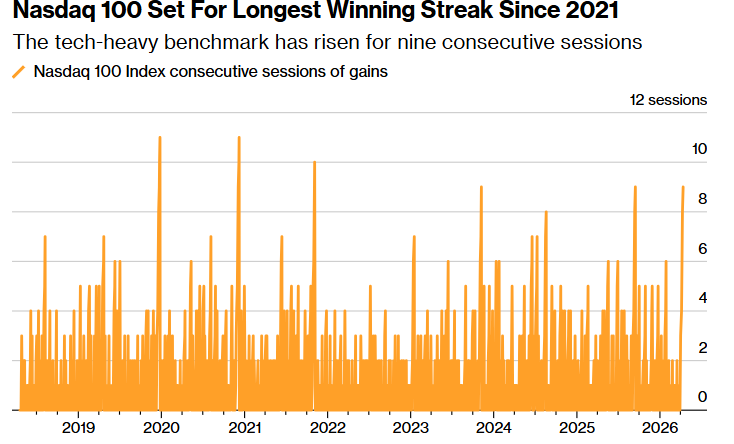
(Source: Bloomberg)
According to the Bank of America’s April Global Fund Manager Survey, market sentiment has hit its most pessimistic level since June last year. The survey was conducted from April 2 to April 9 and covered 193 fund managers with a combined $563 billion in assets under management.
US Bank of America strategists led by Michael Hartnett stated, “Growth expectations saw their biggest downgrade since March 2022, while inflation expectations rose to their highest since May 2021. From a contrarian perspective, this is bullish for risk assets—if a ceasefire can push oil below $84 per barrel. However, it doesn’t mean you can just ‘buy blindly.’”
The survey showed investors expect oil prices to fall to about $84 per barrel by year-end, compared to the current level of around $98.
Focus on Q1 Earnings
Traders are also keeping a close eye on Q1 earnings as the Middle East conflict weighs on the economic outlook. With declining sales in its largest business unit, LVMH fell as much as 3.2% in Paris. JP Morgan, Wells Fargo, and Citigroup will release their earnings later on Tuesday.
Peter Oppenheimer, chief global equity strategist at Goldman Sachs, told Bloomberg TV in an interview, “The current US stock market is already fairly valued. There’s been a decent derating and underlying earnings remain robust. If oil prices continue to recede and concerns about further rate hikes begin to ease, there is still considerable upside for US stocks.”
Meanwhile, Georges Elhedery, CEO of HSBC Holdings, said that the Middle East conflict and broader uncertainty have begun to dampen client sentiment.
Elhedery said in an interview with Bloomberg TV in Hong Kong, “We are saddened and worried by what’s happening in the Middle East. Our concerns are not just about the events themselves but also about how long the situation will last. Unfortunately, some of this uncertainty has started to weigh on overall confidence.”
Bloomberg macro strategist Skylar Montgomery Koning said, “The supply shock caused by Iran is clearly a downside risk for corporate earnings, but with profit expectations holding steady and the market still optimistic about a solution to the situation, these negative impacts are being pushed further out.”
Don’t Forget PPI
Investors will also get the next key reading on March US inflation: the Producer Price Index (PPI), due Tuesday. Like the Consumer Price Index, this measure of wholesale inflation will also reflect the impact of surging energy prices in the first month of the Iran war.
Economists expect the March PPI to rise 1.1% month-on-month, which would be the largest increase in four years. Core PPI, which excludes energy and food, is projected to rise 0.4% for the second straight month, continuing the trend of elevated wholesale inflation pressures since late 2025.
US producer prices may see the biggest jump since 2022
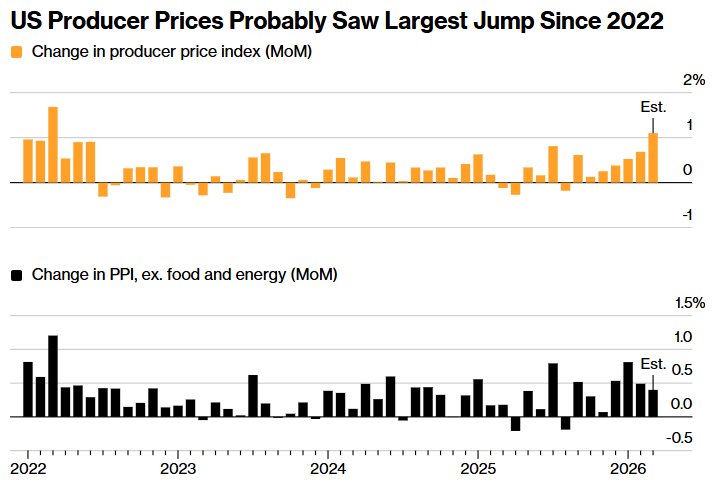
(Source: US Bureau of Labor Statistics, Bloomberg economist survey)
Roberto Scholtes, Head of Strategy at Singular Bank, commented, “Soaring energy prices are pushing up CPI and PPI, but it’s too early to say whether this will feed through materially to core inflation. Moreover, the impact of tariffs is also starting to fade. For now, monetary policy outlook is the main driver in the bond market.”
The Dollar Retreats
The dollar is on track for a seventh straight daily decline, gradually falling back toward pre-war levels.
US Treasuries extended moderate gains, with the two-year yield last down 1.7 basis points at 3.7637%, and the benchmark 10-year yield at 4.279%, down about 1.6 basis points. Christoph Rieger at Commerzbank wrote in a note, “The bond market seems ‘numb and comfortable.’”
Eurozone bond yields also eased with Treasuries. There is large eurozone bond supply on Tuesday, with the Netherlands and Germany conducting government bond auctions, and France issuing a new green OAT bond due in June 2037 via syndication. Germany’s 10-year bond yield fell 3.2 basis points to 3.055%, while France’s 10-year yield fell 4.3 basis points to 3.700%.
Rising energy prices have exacerbated inflation concerns, prompting investors to start pricing in potential rate hikes by several major central banks. This contrasts sharply with prewar expectations for rate cuts or a prolonged pause. As a result, the two-year US Treasury yield is now nearly 40 basis points higher than at the end of February.
Bitcoin rose 1.8% to $74,500.86. Rachael Lucas, a cryptocurrency analyst at BTC Markets, said that if bitcoin breaks above $75,000 with strong trading volume, a larger rally may ensue as short covering could accelerate gains.
Gold rose 0.9%, approaching $4,800.
Investors are watching the US Producer Price Index (PPI) and the NFIB Small Business Optimism Index, both due out later Tuesday, for early signs of how the war is affecting the real economy. The IMF and World Bank Spring Meetings continue in Washington, with markets also awaiting the IMF’s updated global economic outlook, scheduled for 9 a.m. US Eastern Time.
Disclaimer: The content of this article solely reflects the author's opinion and does not represent the platform in any capacity. This article is not intended to serve as a reference for making investment decisions.
You may also like
Siri AI integration: Apple bets on new smart home entry! First display “brain” HomeView debuts, complete smart home accessory set unveiled
The HomeView is priced at $299, featuring a 7-inch square screen and powered by the A18 chip. It comes in both desktop and wall-mounted versions, supports facial recognition linked to Siri AI, and can recognize up to six users. It will not be released in the EU for now, as Siri AI is not available locally. Apple has teamed up with LG and Schneider to launch an Apple Home Collection smart home accessory series, including indoor and outdoor floodlight cameras, video doorbells, thermostats, and door locks. The new generation Apple TV 4K is equipped with the A19 chip, supports Siri AI voice interaction, and is priced at $299. The second-generation HomePod mini is priced at $149, featuring new interactive lighting effects, with both products seeing price increases from previous models. Analysts are optimistic about Apple’s opportunities in expanding its home business, while the foldable iPhone set to begin pre-sale on Friday remains the recent highlight.
Lighter plunges 12% – $2.9M in long liquidations trigger panic exits
SUI Chart Projects a Rally Through Late 2027

AI Trading Logic Shifts! From Japan and Korea to the US, Global Chip Stocks Plummet, Star IPOs Stalled, Changxin Technology Breakthroughs Raise Repeated Alarms
Among AI-related stocks that have risen significantly this year, storage chip stocks are particularly prone to profit-taking; under crowded trading and high valuations, new signs of competition are enough to trigger concentrated selling. According to Wall Street sources, Changxin Technology's 4F² DRAM architecture has provided investors with an opportunity to take profits. While its technological advancements are indeed significant, they should not be directly regarded as an immediate threat to existing manufacturers. The AI rally has not ended and may be entering its next phase, with investors focusing more on realizing profits rather than purely betting on infrastructure expansion.
Crypto prices
More


