
ASML Holding Q1 2026 Earnings Preview: Strong EUV Demand, Gross Margin Pressure in Focus
 Bitget2026/04/14 03:35
1. Investment Highlights at a Glance
ASML Holding is scheduled to release its Q1 2026 financial results on April 15, 2026 (before the U.S. market open), followed by an investor conference call the same day. Consensus estimates point to revenue of approximately €8.2–8.9 billion (midpoint of company guidance around €8.55 billion), representing roughly +12% YoY growth. EPS is expected in the €6.64–7.72 range, delivering double-digit year-over-year growth.
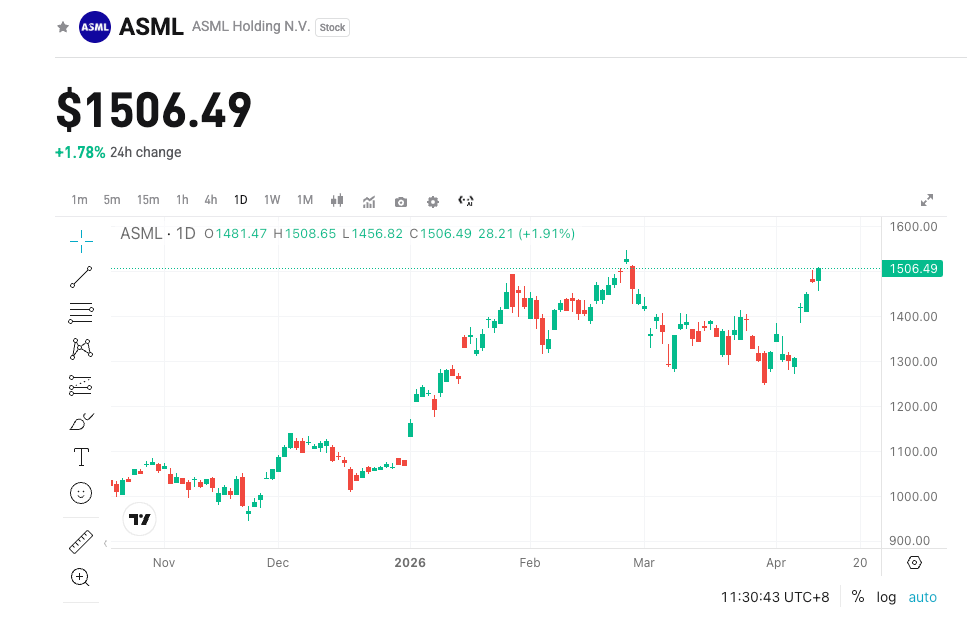
The two most critical investment focuses are AI-driven High-NA EUV momentum and gross margin performance. While semiconductor recovery and logic chip demand remain robust, shifts in product mix and softer service revenue could pressure margins compared to last year. Wall Street generally expects ASML to maintain its strong history of beating estimates, but with the stock trading at elevated valuations, any deviation in guidance could trigger meaningful volatility — creating clear short-term trading opportunities for active investors.
Bitget has now listed ASMLUSDT 10x Perps — Get positioned early and capture outsized returns!
2. Four Key Focus Areas
Focus 1: EUV and High-NA EUV Order and Shipment Momentum
Sustained AI chip demand continues to drive advanced-node investments, with logic customers (especially TSMC and peers) showing strong appetite for EUV systems. High-NA EUV, the next-generation lithography tool, will be closely watched for order confirmations and shipment progress as a key barometer of market confidence.
Key metrics: EUV share of Q1 system sales, High-NA order volume, and any updates to full-year 2026 guidance. Potential outcomes & impact: Stronger-than-expected orders would reinforce the credibility of the €34–39 billion full-year revenue target and support the stock price. Conversely, notable delays could raise doubts about the 2026–2027 growth trajectory.
Focus 2: Gross Margin Trends and Product Mix Dynamics
The company guided Q1 gross margin at 51–53%, down from approximately 54% a year ago, primarily due to a less favorable product mix (more lower-margin systems) and softer service activity. Management’s long-term target remains 57% by 2030.
Key metrics: Actual gross margin delivered, R&D expenses (expected ~€12 billion), and SG&A (~€3 billion). Potential outcomes & impact: Beating the upper end of the guidance or providing a more optimistic full-year margin path would ease concerns over profitability pressure. Missing the range could amplify valuation downside risks, especially given the stock’s premium pricing.
Focus 3: China Exposure and Geopolitical Factors
Mainland China remains an important market for ASML. Despite ongoing export restrictions, DUV system demand has shown resilience. Investors will scrutinize Q1 China revenue contribution and management’s qualitative comments on regional sales trends for the full year.
Key metrics: China sales share and forward-looking commentary. Potential outcomes & impact: Better-than-expected China demand could help offset softness elsewhere. However, further tightening of restrictions or unexpected demand slowdowns may weigh on overall orders.
Focus 4: Full-Year 2026 Guidance Update and Outlook In its Q4 2025 report, ASML provided 2026 revenue guidance of €34–39 billion and gross margin of 51–53%. Any refinement to this outlook or shifts in management tone during the Q1 call will directly influence how the market prices the medium-term growth story.
Key metrics: Adjustments to full-year sales range, margin trajectory, and commentary on customer capex plans. Potential outcomes & impact: An upward revision or bullish comments on AI-driven capital expenditure cycles could act as a positive catalyst. A conservative reaffirmation or cautious tone may trigger profit-taking.
3. Risks and Opportunities in Balance
Upside Catalysts:
- EUV/High-NA orders significantly beating expectations, supported by accelerated logic customer purchases.
- Actual gross margin exceeding the lower end of guidance with a clear path to improvement.
- More optimistic commentary on 2026 and 2027 growth, reinforcing the long AI investment cycle narrative.
Downside Risks:
- Gross margin falling below the 51% guidance floor or slower-than-expected service recovery.
- Unexpected slowdown in China or other regions, or escalation in geopolitical/export restrictions.
- Neutral guidance with cautious tone, amplifying concerns around the stock’s currently elevated valuation.
4. Trading Strategy Suggestions
Bull Case: If Q1 revenue lands near the high end of guidance, gross margin holds at or above 53%, High-NA orders impress, and full-year outlook remains upbeat, the AI semiconductor capex narrative will gain further traction — favoring long positions or adding on dips post-earnings.
Bear Case: If gross margin misses expectations, order data disappoints, or guidance lacks upside, the premium valuation could lead to profit-taking and sentiment deterioration, opening the door for near-term downside.
Key Metrics to Watch:
- Revenue (within or outside the €8.2–8.9 billion range)
- Gross margin (actual vs. 51–53% guidance)
- EPS (vs. consensus €6.64–7.72)
- EUV system orders/shipments and China contribution
Actionable Ideas:
- Positive scenario: Consider taking partial profits on a post-earnings gap-up or adding to positions on any pullback.
- Neutral scenario: Wait for further digestion if results meet expectations without clear beats.
- Volatility traders: Monitor implied volatility moves heading into the print.
Right now, we're also running the limited-time "Lifetime Zero: The Weekly Jackpot IV" event for US stock contracts:
- Lifetime 0 trading fees on US stock contracts + weekly jackpot draws that never stop!
- Participate and stand a chance to win free TSLA, NVDA, and other hot US stocks!
Disclaimer: The above content is for reference only and does not constitute any investment advice.
Disclaimer: The content of this article solely reflects the author's opinion and does not represent the platform in any capacity. This article is not intended to serve as a reference for making investment decisions.
You may also like
Siri AI integration: Apple bets on new smart home entry! First display “brain” HomeView debuts, complete smart home accessory set unveiled
The HomeView is priced at $299, featuring a 7-inch square screen and powered by the A18 chip. It comes in both desktop and wall-mounted versions, supports facial recognition linked to Siri AI, and can recognize up to six users. It will not be released in the EU for now, as Siri AI is not available locally. Apple has teamed up with LG and Schneider to launch an Apple Home Collection smart home accessory series, including indoor and outdoor floodlight cameras, video doorbells, thermostats, and door locks. The new generation Apple TV 4K is equipped with the A19 chip, supports Siri AI voice interaction, and is priced at $299. The second-generation HomePod mini is priced at $149, featuring new interactive lighting effects, with both products seeing price increases from previous models. Analysts are optimistic about Apple’s opportunities in expanding its home business, while the foldable iPhone set to begin pre-sale on Friday remains the recent highlight.
Lighter plunges 12% – $2.9M in long liquidations trigger panic exits
SUI Chart Projects a Rally Through Late 2027

AI Trading Logic Shifts! From Japan and Korea to the US, Global Chip Stocks Plummet, Star IPOs Stalled, Changxin Technology Breakthroughs Raise Repeated Alarms
Among AI-related stocks that have risen significantly this year, storage chip stocks are particularly prone to profit-taking; under crowded trading and high valuations, new signs of competition are enough to trigger concentrated selling. According to Wall Street sources, Changxin Technology's 4F² DRAM architecture has provided investors with an opportunity to take profits. While its technological advancements are indeed significant, they should not be directly regarded as an immediate threat to existing manufacturers. The AI rally has not ended and may be entering its next phase, with investors focusing more on realizing profits rather than purely betting on infrastructure expansion.
Crypto prices
More


