
SEC admits certain crypto enforcement cases delivered no investor benefit

Some past enforcement actions against cryptocurrency companies lacked clear investor benefit and misinterpreted federal securities laws, the US Securities and Exchange Commission (SEC) said on Tuesday.
Since the 2022 fiscal year, the SEC brought 95 actions and $2.3 billion in penalties for “book-and-record violations,” it said in a statement about its enforcement results for 2025.
“Together with seven crypto firm registration-related and six ‘definition of a dealer’ cases, these cases identified no direct investor harm from those violations, produced no investor benefit or protection.”
It also reflected a “bias for volume of cases brought versus matters of investor protection,” a misallocation of resources and a misinterpretation of federal securities laws, the SEC said.
It is the latest example of the regulator’s shift in approach towards enforcement since it came under new leadership under SEC Chair Paul Atkins in April 2025.
His predecessor, former SEC Chair Gary Gensler, has been accused of pursuing a regulation-by-enforcement approach toward crypto. Since his departure, the SEC has adopted a friendlier stance toward digital assets.
SEC said it is shifting its focus to quality over quantity
In the lead-up to Donald Trump’s 2025 inauguration, the SEC enforcement division engaged in an “unprecedented rush” to bring cases and moved ahead with an “aggressive pursuit of novel legal theories,” the agency said.
Atkins said the agency has since shifted away from this approach, ending regulation by enforcement and refocusing on the commission’s core mission by prioritizing cases that provide meaningful investor protection and strengthen market integrity.
“We have redirected resources toward the types of misconduct that inflict the greatest harm—particularly fraud, market manipulation, and abuses of trust—and away from approaches that prioritized volume and record-setting penalties over true investor protection,” he added.
Consulting firm Cornerstone Research reported in November that under Atkins, the number of enforcement actions against public companies, including those involving crypto, decreased by about 30% in fiscal 2025 compared with fiscal 2024.
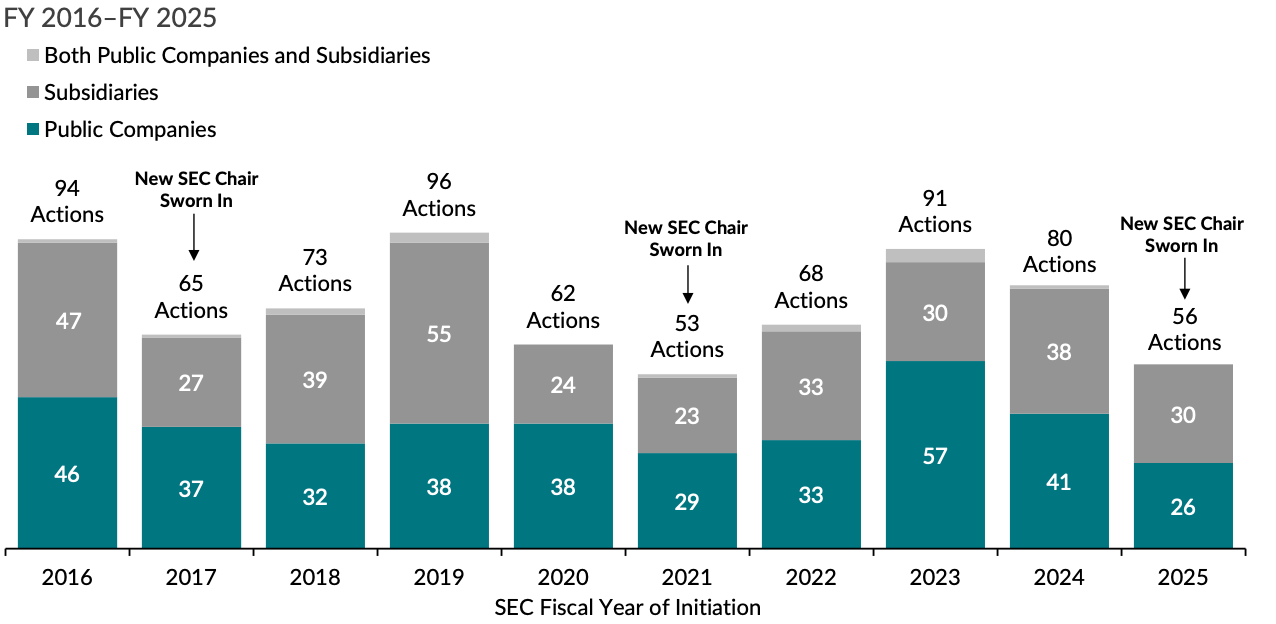 Under Paul Atkins, the number of SEC enforcement actions has dropped. Source: Cornerstone Research
In connection with 2025 enforcement actions, the SEC said it obtained orders for monetary relief totaling $17.9 billion, comprising $7.2 billion in civil penalties and the remainder in disgorgement and prejudgment interest.
Related: Crypto market safe harbor lands at White House for review
“This year’s enforcement results clarify the flaws of these actions and their respective penalties and re-establish the definition and measure of enforcement effectiveness, grounded in Congress’ original intent and focused on bringing actions that actually prevent investor harm instead of headlines and inflated numbers,” the SEC said.
Some crypto companies are still in the firing line
Despite the SEC’s enforcement shift, several crypto companies were still hit with enforcement actions in 2025.
In May 2025, Unicoin and four of its current and former executives were sued by the SEC for allegedly raising $100 million by misleading investors about certificates that purported to convey rights to receive Unicoin tokens and stock. However, the platform has accused the agency of distorting its regulatory statements to build a case.
The SEC also filed a civil complaint against Ramil Ventura Palafox in April 2025, CEO of Praetorian Group International, for allegedly orchestrating a $200 million Ponzi scheme. A parallel criminal case brought by the US Department of Justice resulted in Palafox's February sentence of 20 years in prison.
Magazine: Your guide to surviving this mini-crypto winter
Disclaimer: The content of this article solely reflects the author's opinion and does not represent the platform in any capacity. This article is not intended to serve as a reference for making investment decisions.
You may also like
The 10-year US Treasury yield approaches 5.4%, with the AI halo unable to hide the "inflated" risks of the S&P 500
Behind the S&P 500's record high, only 30% of its constituent stocks are above their 50-day moving average, marking the narrowest market breadth at a record high since 1990. The Russell 2000 has fallen for five consecutive weeks, and high-yield bond yields have soared to 15%. Societe Generale warns that if US Treasury yields rise to 6% and oil prices reach $150, the S&P 500 could fall by more than 20% next year. In addition, some top-performing fund managers have completely exited AI stocks in favor of energy, stating that once financing dries up, it will be "game over."
Oil tanker freight reaches a sixty-year high: shipping oil from the US to China is more expensive than launching a rocket!
The freight for a single barrel of crude oil has soared to $41, approaching half the oil price, and for a single trip, the freight was once enough to buy an oil tanker. The Middle East crisis has led to a structural shortage of shipping capacity in the Strait of Hormuz, coupled with ship-to-ship transfers extending turnaround times. VLCC freight rates have skyrocketed from an annual average of $9.2 million to $77 million—an increase of more than eight times. Refiners’ profits are being rapidly eroded, the average price of second-hand oil tankers has reached a historic high, and, unusually, surpassed the price of new vessels.

Following the Drop but Not the Rise! Silver Trapped in Difficulties
The logic of AI and solar energy demand continues to play out, yet prices are falling against the trend—macroeconomic forces such as a strengthening US dollar and rising real interest rates have completely suppressed fundamentals. Speculative funds offloaded $1.6 billion in a single week, marking a yearly peak, while CTA net short positions reversed by $2.6 billion to the highest level this year. However, Goldman Sachs analysts believe that the extreme short positioning itself is building reversal momentum, highlighting an asymmetry; once macro headwinds subside, a retaliatory rebound could be easily triggered. After a similar shakeout last time, silver surged 15% in six weeks.
Crypto prices
More


