
Whales, sharks buy 61,000 BTC in a month amid global uncertainty

Large Bitcoin holders accumulated 61,568 more Bitcoin over the past month against the backdrop of escalating conflict in the Middle East and macroeconomic uncertainty.
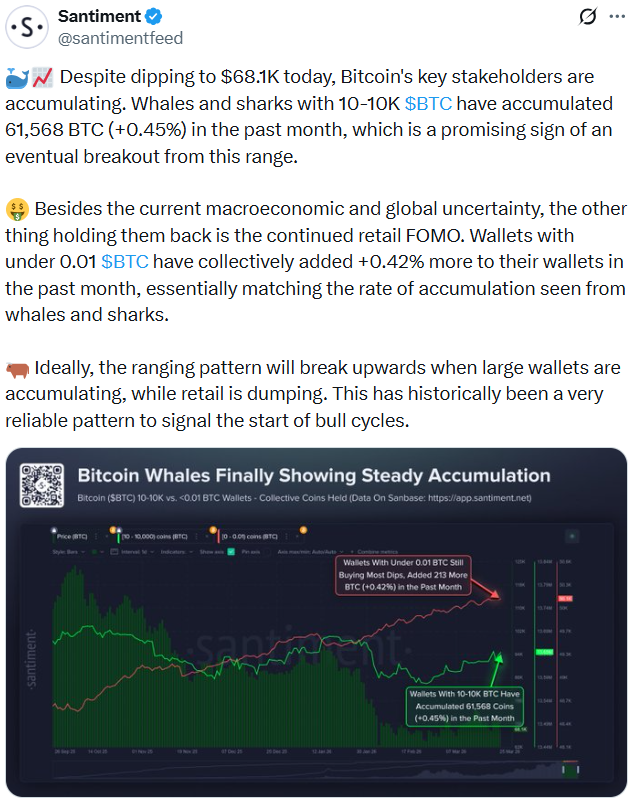
Whales and sharks, defined as those holding between 10 and 10,000 Bitcoin (BTC), have increased their holdings by 0.45%, while wallets with under 0.01 Bitcoin have added 0.42%, or 213 BTC, over the past month, Santiment said in an X post Thursday.
The figures support recent data showing that Bitcoin exchange outflows have persisted throughout March, indicating that Bitcoin holders are accumulating rather than looking to sell.
Santiment analysts added that whale accumulation could be a “promising sign” of an eventual breakout from the range.
“Ideally, the ranging pattern will break upwards when large wallets are accumulating, while retail is dumping. This has historically been a very reliable pattern to signal the start of bull cycles,” the analysts said.
 Source:
Santiment
Source:
Santiment
Tensions in the Middle East escalated in February after the US and Israel launched strikes against Iran. Iran retaliated against several neighboring countries, and the conflict has continued since.
Some whales wait for breakout; small holders driven by FOMO
Some Bitcoin whales are taking a different approach.
On March 19, two Bitcoin whales moved tens of millions of dollars to exchanges as Bitcoin fell and energy prices jumped after attacks on Gulf oil and gas infrastructure deepened during the Iran conflict.
Dominick John, an analyst at Zeus Research, told Cointelegraph that the whales who have been accumulating in the background are likely preparing for the next breakout.
“Whales are scooping up BTC because they’re positioning ahead of a potential breakout, quietly stacking during consolidation periods. Small wallets are chasing the momentum, driven by FOMO during uptrends and the fear of missing the next leg up,” he said.
Related: Binance says US midterms could boost Bitcoin and stocks
“Whales tend to buy in waves, so accumulation could continue if the range holds and macro conditions stay supportive. On the other hand, if retail FOMO overheats, we could see a pause or slight sell-off before the next accumulation phase,” John added.
Fear and greed index in “extreme fear”
Meanwhile, investor sentiment remains deeply uncertain. The Crypto Fear & Greed Index returned a score of 13 on Friday, firmly in “extreme fear” territory.
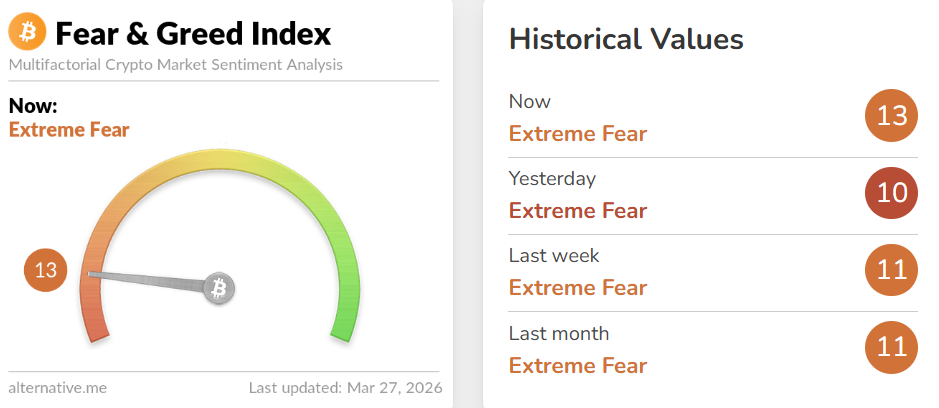 The Crypto Fear & Greed Index has been firmly in “extreme fear” territory. Source: alternative.me
Thursday’s score was 10, and both the prior week and the month of February averaged “extreme fear” ratings as well, according to the index.
Magazine: Banks want to run Vietnam’s crypto exchanges, Boyaa’s $70M BTC plan: Asia Express
Disclaimer: The content of this article solely reflects the author's opinion and does not represent the platform in any capacity. This article is not intended to serve as a reference for making investment decisions.
You may also like
Why hasn't the real estate crisis breached the exchange rate?
AI Predicts SOL: A 1919 Bank Just Chose a Public Chain
Top Validator Says This Article Is a Must-Read for XRP Holders
Japan Makes Permanent Residency 20× More Expensive: 5 Cryptos Worth Risking Before the Next Rally
Crypto prices
More


