
Hard to go long, hard to go short! Nomura strategist: "Current macro volatility, trading poses career risks"; Goldman Sachs analyst: "Cash is king"

The US-Iran ceasefire negotiations remain in a tug-of-war, with the market struggling to find direction amid violent oil price swings. Analysts from Nomura and Goldman Sachs have issued warnings in succession: in the current environment, traders are facing extremely high risks regardless of whether they are bullish or bearish.
Overnight, the US ceasefire proposal was rejected by Iran. After a sharp plunge, oil prices recovered almost all of their losses by the end of the day, but neither the stock market nor the bond market followed oil’s rally lower—both showed a rare divergence. At the same time, bitcoin and gold strengthened against the trend, while the dollar closed largely flat.
Against this backdrop, Nomura strategist Charlie McElligott warned that the current accumulation of macro volatility has resulted in “career-level risk,” with a large number of traders effectively paralyzed;
Goldman Sachs analyst Shreeti Kapa stated bluntly that in a binary risk environment, “cash is king”—given that equity risk premia are close to zero and valuations are at historic highs, holding cash is a reasonable asymmetric position.
Violent Oil Price Swings and Unprecedented Stock-Bond-Crude Divergence
Following news of the ceasefire proposal, WTI and Brent crude fell 6% to 7% from previous session highs before nearly recovering all those losses into the close. However, stocks and bonds did not come under pressure as oil rebounded—the four major US stock indexes all ended higher, though they weakened toward the end of the session.
According to Bloomberg, the negative correlation between the S&P 500 Index and WTI crude has persisted for 17 trading sessions (since March 3), a level only surpassed twice since the start of 2022, highlighting the abnormal structure of the current market.
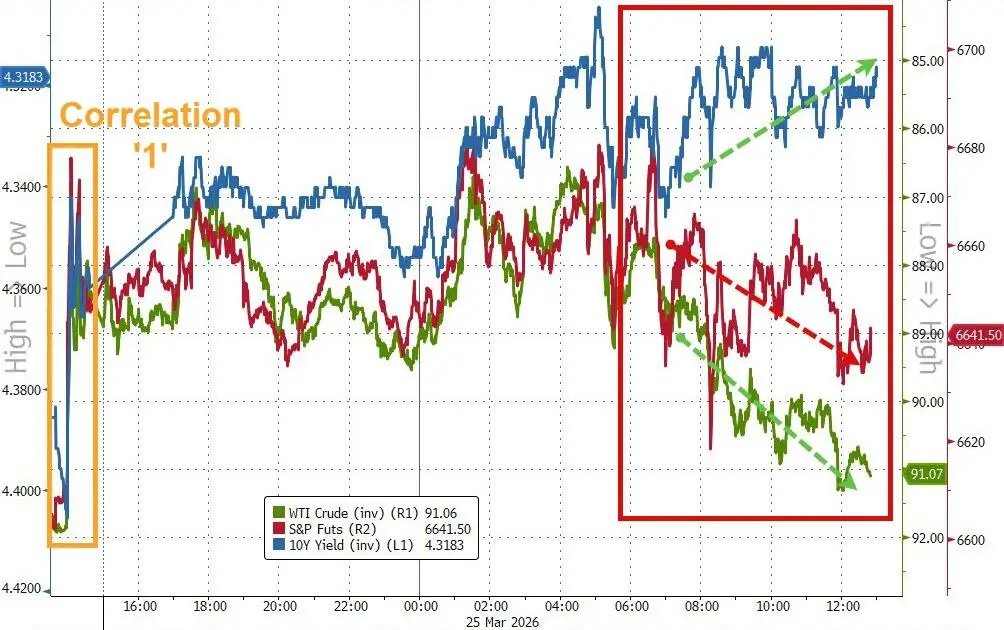
It is noteworthy that nearly all of the day’s stock market gains were concentrated within just a few minutes after the ceasefire news broke; thereafter, the indexes essentially moved sideways. Since the cash open, all four major indexes actually recorded declines and failed to break through key technical resistance levels, with short covering at the open failing to create lasting momentum.
Nomura: Macro Volatility Has Accumulated, Most Traders Are Paralyzed
In his latest commentary, Nomura strategist Charlie McElligott noted that despite the temptation to trade reversals, hedge against volatility squeezes, and sell beta, traders are generally “paralyzed” due to multiple overlapping risks.
McElligott outlined five core pressures: first, the current accumulation of macro volatility has created “career-level risk,” making it extremely difficult to get approval to short puts or tail risk against the backdrop of recent events; second, there is “universal skepticism” about a “quick resolution” to the conflicts, as the structural damage to the global economy from commodity supply shocks and the prospect of central banks raising rates amid fragile growth are unlikely to be resolved quickly.
In addition, he identified three more simultaneous risks: clear signs of deterioration in US employment trends; the continued disruption of industries by artificial intelligence, further impacting the labor market; and the redemption and liquidity crises facing the private credit market.
Goldman Sachs: High Valuations, Diminished Risk Premiums—Cash Is a Sensible Asymmetric Position
Goldman Sachs analyst Shreeti Kapa offered a more macro perspective on the current market. She noted that since the outbreak of the Middle East war, the MSCI Global Index has fallen by about 7% cumulatively. Although this is still a mild decline from a long-term historical perspective, the current valuation environment is much more fragile than past crises.
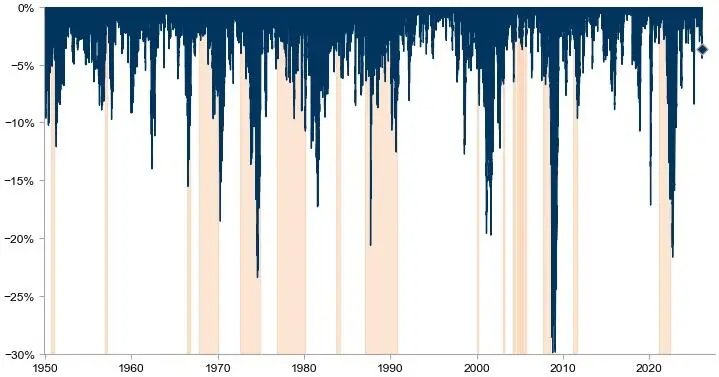
Kapa emphasized that, compared with the energy shock of 2022, current equity valuations are not only higher than the lows of that period but are also above their levels ahead of the last energy shock, and this finding is consistent across multiple valuation metrics. She also pointed out that the market has largely priced in rate shocks, but is still underpricing growth risks—a stark contrast with 2022, when real yields surged from negative, producing much larger rate shocks.
Based on the above, Kapa concluded: in a binary risk environment, optionality and liquidity are more valuable than directional bets. “The investors who outperform in this type of environment are not those who call the bottom correctly, but those who hold cash ready for deployment when uncertainty fades.”
She stated that given that equity risk premium is near zero and valuations across regions and industry sectors are at historic highs, holding cash is essentially a sensible asymmetric position—investors sacrifice virtually no expected returns while gaining significant flexibility.
Disclaimer: The content of this article solely reflects the author's opinion and does not represent the platform in any capacity. This article is not intended to serve as a reference for making investment decisions.
You may also like
Oil tanker freight reaches a sixty-year high: shipping oil from the US to China is more expensive than launching a rocket!
The freight for a single barrel of crude oil has soared to $41, approaching half the oil price, and for a single trip, the freight was once enough to buy an oil tanker. The Middle East crisis has led to a structural shortage of shipping capacity in the Strait of Hormuz, coupled with ship-to-ship transfers extending turnaround times. VLCC freight rates have skyrocketed from an annual average of $9.2 million to $77 million—an increase of more than eight times. Refiners’ profits are being rapidly eroded, the average price of second-hand oil tankers has reached a historic high, and, unusually, surpassed the price of new vessels.

Following the Drop but Not the Rise! Silver Trapped in Difficulties
The logic of AI and solar energy demand continues to play out, yet prices are falling against the trend—macroeconomic forces such as a strengthening US dollar and rising real interest rates have completely suppressed fundamentals. Speculative funds offloaded $1.6 billion in a single week, marking a yearly peak, while CTA net short positions reversed by $2.6 billion to the highest level this year. However, Goldman Sachs analysts believe that the extreme short positioning itself is building reversal momentum, highlighting an asymmetry; once macro headwinds subside, a retaliatory rebound could be easily triggered. After a similar shakeout last time, silver surged 15% in six weeks.
The "Digital Metrics Game" Behind the Trillion-Dollar Valuation: OpenAI and Anthropic's Revenues Are Actually Incomparable
Anthropic counts "total revenue" in its cloud sales, while OpenAI only recognizes the "net revenue" based on profit-sharing. This discrepancy in accounting standards has directly triggered a decline in tech stocks. Even more striking, the highly touted "annualized revenue" is significantly inflated, with OpenAI's actual revenue expected to be only half of this figure. Anthropic's actual revenue also exhibits nearly a 50% gap compared to its reported numbers.
Crypto prices
More


