
Ether Funding Rate Flips Negative: Are ETH Bears Back in Control?

Quick Breakdown
- Ethereum perpetual futures funding rates have flipped negative, meaning shorts pay longs. This indicates growing bearish control as ETH hovers near the crucial $2,000 support level.
- Weak price action, cooling on-chain activity, ETF outflows, and relatively unattractive staking yields are all contributing to reduced bullish conviction and heightened short interest.
- ETH price is increasingly influenced by leveraged positions in derivatives markets. Monitoring funding rates, liquidity zones, and key support/resistance levels helps traders anticipate potential short squeezes, liquidations, and volatility spikes.
Funding rates are a key mechanism in Ethereum perpetual futures that keep futures prices aligned with the spot market. They are periodic payments exchanged between longs and shorts: positive rates mean longs pay shorts, while negative rates mean shorts pay longs. This system balances buyers and sellers and also reveals the ETH market sentiment.
A shift into negative territory is a clear warning that bearish momentum is rising. For Ethereum, this comes at a critical juncture, as ETH is hovering near the psychologically important $2,000 support level.
How the market reacts here could determine whether bulls regain control or bears push prices toward lower liquidity zones, making Ether funding rates an early and essential signal for traders.
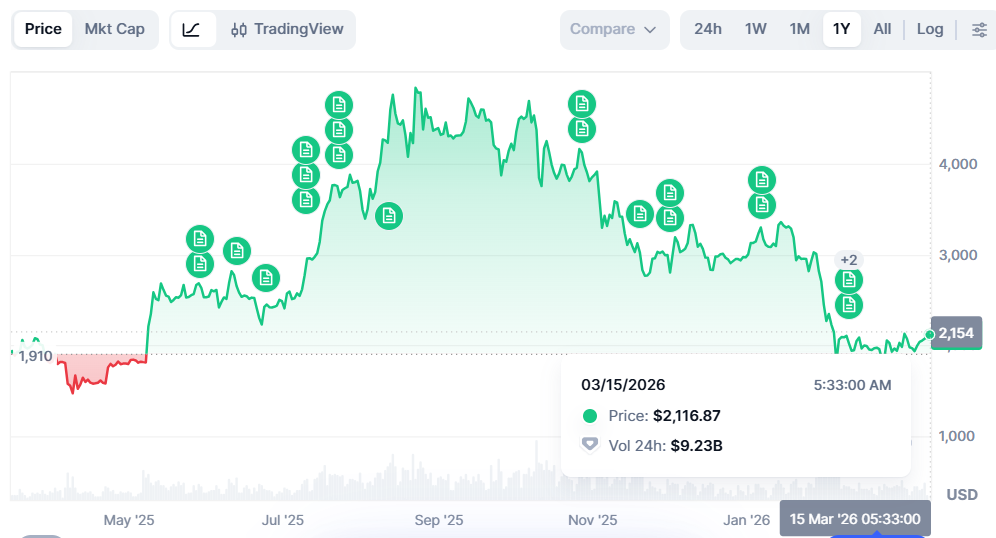 Ethereum Price hovering around $2,000. Source:
CoinMarketCap
Ethereum Price hovering around $2,000. Source:
CoinMarketCap
The Recent ETH Funding Rate Flip
Ethereum’s derivatives markets are signalling a shift in trader sentiment. The perpetual futures funding rate has turned negative, indicating that short positions (bets on falling prices) are paying long positions, a classic sign of bearish dominance.
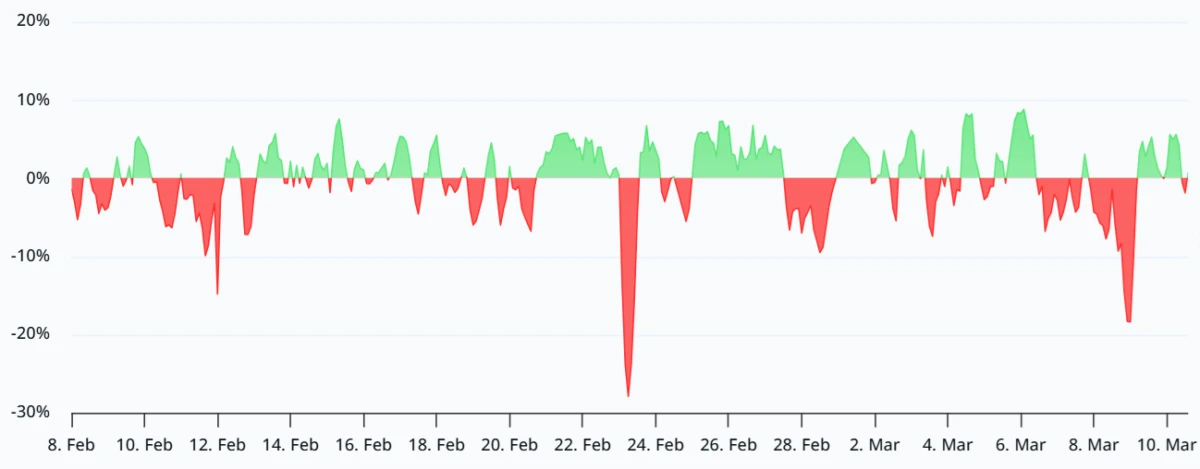 Perpetual futures funding rate has turned negative. Source:
Trading View
Perpetual futures funding rate has turned negative. Source:
Trading View
Notably, this rate has remained below the neutral 6–12% range for the past month, highlighting a sustained lack of confidence in ETH’s near-term price performance. This aligns with the broader context of a 54% price decline over six months, signalling lingering caution among market participants.
Institutional activity reinforces this trend. ETH spot ETFs saw $225 million in outflows, reversing previous inflows, suggesting that large investors are reducing exposure to ETH. Comparatively, Ethereum staking rewards at 2.8% remain less attractive than alternative stablecoin yields at 3.75%, which may further dampen institutional demand.
On-chain metrics also show a cooling network, with weekly base layer fees dropping from $8 million to $2.3 million and stable transaction volumes around 14 million, indicating that the recent Ethereum upgrades and Layer-2 scaling efforts have yet to meaningfully boost usage or demand for prospects.
Key Market Forces Driving the Shift in ETH
Recent shifts in crypto derivatives and on-chain activity highlight the key forces shaping ETH market sentiment and investor positioning.
Price weakness and bearish momentum
ETH has repeatedly failed to stay above $2,100 over the past month, eroding trader confidence. Even short-term gains, like the 7% rise between Monday and Tuesday, have not attracted leveraged bullish positions.
Negative Ether funding rates in perpetual futures indicate that bears are increasingly dominating short-term market sentiment.
Cooling on-chain activity
Ethereum network usage has slowed, with weekly base layer fees averaging $2.3 million, down from $8 million earlier this year, and transaction counts stabilizing around 14 million. Layer-2 rollup initiatives, aimed at improving scalability, have not yet translated into meaningful demand for ETH, limiting bullish catalysts.
Institutional demand and ETF flows
ETH spot ETFs saw $225 million in outflows, reversing prior inflows and signalling weak institutional appetite. Investors are comparing Ethereum staking yields (2.8%) unfavourably to alternative options like stablecoins (3.75%), reducing pressure for new ETH accumulation from large players.
Concerns about Ethereum’s roadmap and development pace
Despite ongoing upgrades, investor confidence is affected by the slow rollout of major features, such as account abstraction and the Hegota fork.
While these improvements promise better wallet flexibility, privacy, and reduced transaction finality times, they are long-term developments, and market participants are focused on short-term performance.
Broader market and investor sentiment factors
ETH has underperformed the broader crypto market since October 2025. Additional pressure comes from high-profile losses, such as the $735 million net loss from Ethereum treasury firm Sharplink (SBET US), which weighs on overall confidence.
Combined with a general market downturn following a $4 trillion crypto market peak, these factors contribute to cautious positioning and negative crypto derivatives metrics.
Historical Context
Historical patterns of negative funding rates often coincide with waning bullish conviction, reminding traders that these moments can lead to either quick corrections or sustained declines, fostering a sense of strategic awareness.
For example, the $2,000–$2,050 region now is comparable to the same zone that preceded a major 4x rally in 2023, illustrating how critical support levels can influence both short-term trading decisions and longer-term market trends.
Past funding flips show that negative rates often coincide with waning bullish conviction and increased leverage on short positions. Historically, these periods have led to two potential outcomes: a brief correction that quickly stabilizes near key support bands, or a sustained bearish trend if sellers overwhelm buyers.
Traders who study prior ETH cycles note that timing entries or exits around these flips can be crucial, holding above $2,000 previously signalled a potential strong rebound, whereas breaches below $1,980 or $1,840 often triggered accelerated liquidations.
The lesson is clear: while negative funding rates highlight heightened short interest, historical patterns suggest the market’s reaction ultimately hinges on whether ETH can reclaim critical resistance levels like $2,120, which could ignite a short squeeze and rapid upside movement.
Implications for ETH Market Sentiment
Ethereum’s recent derivatives activity and funding rate shifts are shaping trader sentiment, highlighting key risks and opportunities for both short-term and medium-term investors.
Short-term vs medium-term control
In the short term, bears appear to be in control, as evidenced by negative funding rates in ETH perpetual futures, which signal strong demand for short positions. Low leveraged long interest shows that traders are reluctant to commit to bullish positions above $2,100, indicating caution and a lack of conviction among buyers.
Over the medium term, signals are more mixed. While ETH has consistently underperformed broader crypto markets since late 2025, neutral options metrics (with put-call premiums around 7%) and Ethereum’s $56 billion total value locked suggest that bullish infrastructure remains intact.
This implies that while bears dominate near-term price action, a full sustained downtrend isn’t fully confirmed, leaving the market poised for potential reversals if bullish catalysts emerge.
Derivatives vs spot influence
Ethereum’s current price movement is largely shaped by crypto derivatives trading. Futures and perpetual contracts amplify price swings as traders take leveraged positions, and Ether funding rates provide insight into prevailing market sentiment. Increased short positions can pressure ETH downward, even if spot market buyers remain steady.
Spot trading, by contrast, reflects measured accumulation and long-term investor confidence rather than rapid speculative activity. Because spot volume is less reactive, crypto derivatives often act as a leading indicator for price trends, meaning that sharp movements in futures markets can foreshadow near-term spot price behaviour before it fully materializes.
Risk management insights
Traders and institutional investors should closely monitor critical technical levels, including resistance around $2,120–$2,000 and support zones near $1,980–$1,840, where liquidity pockets could trigger buying or selling pressure.
Funding rates, leverage exposure, and open interest provide early warning signs for potential short squeezes or liquidation cascades, especially in a market currently tilted toward bearish positions.
Understanding how crypto derivatives influence overall market dynamics is crucial for risk management. Active monitoring of these metrics allows traders to time entries and exits more effectively, anticipate volatility spikes, and avoid being caught in sudden market moves driven by leveraged positions.
Are Bears in Control or Just Testing the Waters?
The recent negative Ether funding rates in ETH futures, weak ETF demand, and declining on-chain activity show bears are controlling the short-term market. Reluctance to take leveraged longs above $2,100 and continued underperformance since late 2025 reinforce caution, though Ethereum’s $56 billion TVL and neutral options metrics indicate full bearish dominance is not yet confirmed.
For ETH traders, the clear takeaway is that negative funding acts as an early warning of short-term downward pressure, but the trend is not irreversible. Key catalysts, such as renewed ETF inflows, changes in staking yields, or increased spot buying, could shift market dynamics quickly. Monitoring crypto derivatives activity, liquidity pockets, and technical support levels will be crucial for navigating potential volatility and positioning for a reversal.
Disclaimer: The content of this article solely reflects the author's opinion and does not represent the platform in any capacity. This article is not intended to serve as a reference for making investment decisions.
You may also like
Gold price holds critical $4,100 support, but can it break $4,200 as inflation risks loom?
Hinkal joins Mastercard Crypto Partner Program for private stablecoin payments
Chipmaker earnings growth cools to 136% as AI boom lifts S&P 500
Updated: Delta Air Lines warns that as fuel prices hit profits, airline capacity will tighten further
Delta Airlines lowers its annual profit forecast due to an expected increase in fuel costs to $6 billion. The CEO stated that ticket prices have risen by about 20% this year, with limited passenger resistance. Analysts warn that maintaining high ticket prices in 2027 is critical for improving profitability. The article includes comments from the earnings call and analyst remarks. Rajesh Kumar Singh/Shivansh Tiwary, Reuters Chicago, October 9 - Delta Airlines (DAL.N) said on Friday that, despite strong travel demand and rising ticket prices, soaring fuel costs have forced it to cut its 2026 profit expectations by nearly a quarter. So, the airline industry may need to further limit flight growth next year to protect profitability. This warning highlights the increasingly tough challenges faced by U.S. airlines. While strong demand and restricted seat growth have allowed airlines to significantly raise ticket prices and offset higher fuel costs, aggressively increasing flights to capture more demand may intensify competition, making it harder to maintain high fares and protect profits. Based in Atlanta, Delta now expects its annual fuel expenditure to increase by about $6 billion compared to last year—about $2 billion higher than its July forecast—due to the Iran war (link) causing global jet fuel prices to spike. Airlines worldwide are preparing for a prolonged fuel shock. Michael O’Leary, CEO of Ryanair Group RYA.I, said Thursday that high jet fuel prices could persist for another 12-18 months (link), adding more pressure on airlines to raise fares and control costs. https://www.reuters.com/graphics/AUTOMATED-20261008/A4A-JET-FUEL-DAILY-1Y/xmpjwjnmbvr/chart.png “In a high-cost environment, you can’t simply grow your way out,” Delta CEO Ed Bastian said on the earnings call. He noted that the industry has already taken steps to restrict capacity, but more measures will be needed next year to improve profitability. Bastian said Delta raised ticket prices about 20% this year, and passenger resistance has been limited. He is confident that even if fuel costs eventually drop, the high fares can still be maintained. Delta lowered its adjusted annual earnings per share forecast from the July prediction of $6.50-$7.50 to $5.10-$5.60. According to LSEG data, the midpoint of the new range is below analysts’ average expectation of $5.46. Third-quarter adjusted earnings per share were $1.72, four cents below analysts’ average forecast. In midday trading, shares of Delta dropped 1.7%, United Airlines UAL.O fell 1.4%, and both American Airlines AAL.O and Southwest Airlines LUV.N were down about 1%. Delta partly shields itself from rising fuel costs by owning a refinery outside Philadelphia (link), which is expected to generate over $700 million in profits this year. Even with this buffer, the airline expects its fourth-quarter fuel price to rise from $3.61 per gallon in Q3 to $4.25 per gallon. Delta forecasts adjusted fourth-quarter earnings per share to be between $1.15-$1.65, with the $1.40 midpoint roughly matching analysts’ average expectation of $1.39. Fare increases Government data shows that in the first eight months of 2026, U.S. airlines spent $42.9 billion on fuel, an increase of $13.2 billion compared to the same period last year despite slightly reduced consumption. According to the U.S. Bureau of Labor Statistics, strong demand and limited seat growth pushed average U.S. airline ticket prices up by about 25% year-on-year between April and August. https://www.reuters.com/graphics/USA-AIRLINES/FUEL/lbpgdnbzwvq/chart.png Analysts at Melius Research said that despite surging fuel costs, Delta’s ability to raise fares helps keep second-half profits roughly stable. Still, they warn that the company’s profit margin has struggled to improve over the years. “It is critical for margin improvement to maintain or raise fares in 2027,” they wrote in their research report. With industry capacity growth expected to accelerate in Q4, this challenge will likely become even tougher. Deutsche Bank analysts expect the proportion of fuel costs recouped through revenue measures to fall in Q4 and predict full recovery won’t happen until early 2027. Bastian noted that low industry returns are another reason for limiting capacity growth. He said Delta will be cautious with its 2027 capacity plan until the fuel price outlook becomes clearer. He added that international routes may account for a larger share of Delta’s capacity expansion compared to domestic routes. Currently, Delta says its premium cabins and corporate travel business remain strong, and its economy cabin business is gradually improving. With Q4 ticket bookings already exceeding 60%, Delta expects revenue to increase about 20% year-on-year, despite limited capacity growth. Executives said early booking trends for Q1 2027 are also encouraging. (For the convenience of non-native English speakers, Reuters automatically translates its reports into several
Crypto prices
More


