
UK review recommends crypto donation pause over foreign interference risk

Philip Rycroft, a former senior civil servant, recommended that the UK government impose a temporary moratorium on political donations made in crypto assets in an independent review published on Wednesday.
“The government should legislate in the Representation of the People Bill to introduce a moratorium on political donations made in cryptoassets,” Rycroft wrote in the report, which was commissioned by the government in December 2025.
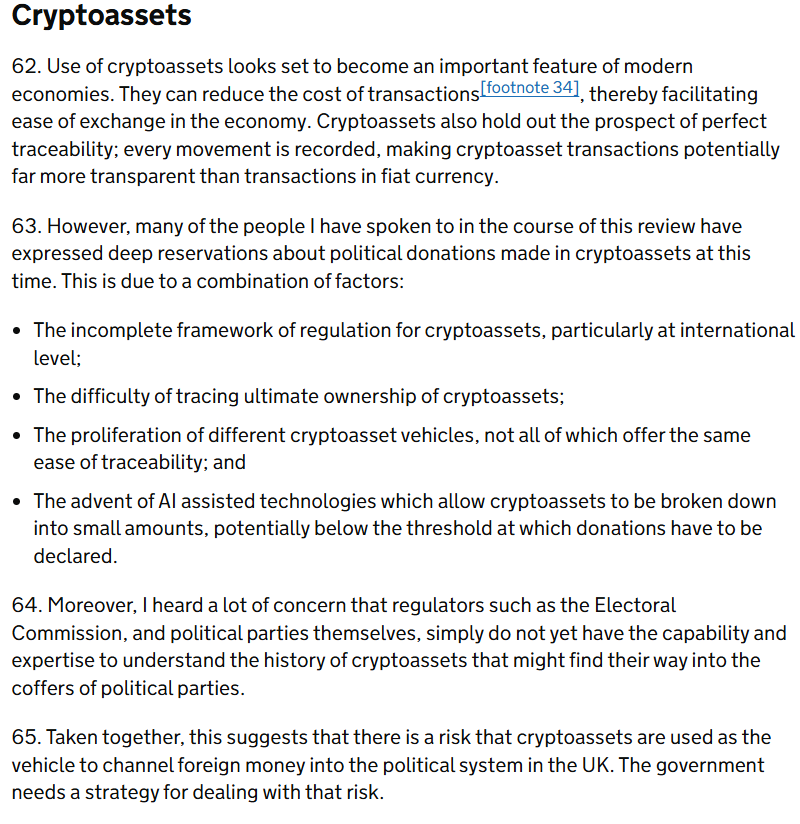
The review said crypto assets could provide a route for foreign money to enter the UK political system because of incomplete regulation, the difficulty of tracing the “ultimate ownership” of some assets, and the possibility of breaking larger donations into smaller transfers. It noted that donations below 500 British pounds ($669) fall outside the normal permissibility test, while formal reporting thresholds for political parties are higher.
The review comes a week after a separate report by the Joint Committee on the National Security Strategy called on the government to impose an immediate moratorium on crypto donations to political parties until the Electoral Commission produces statutory guidance ahead of the next general election.
 The Rycroft Review: Report of the independent review into countering foreign financial influence and interference in UK politics. Source: gov.uk
Rycroft leaves room for future crypto donations
Rycroft wrote that the scale of crypto political donations is currently unknown because none have yet reached the reporting threshold that would require disclosure to the Electoral Commission.
Still, the report argued that political crypto donations could be allowed under “tight supervision” by the Electoral Commission and through UK-regulated cryptocurrency exchanges.
Rycroft added that the temporary pause in the political crypto donations should not be seen as a “prelude to an outright and permanent ban,” but rather an “interlude” allowing the regulatory environment to catch up to the reality of crypto.
The recommendation comes amid wider scrutiny of crypto and foreign-linked money in British politics. Reform UK, led by Nigel Farage, received a record $12 million political donation from crypto investor Christopher Harborne in the third quarter of 2025 and another $4 million donation in the fourth quarter of 2025. Reform UK was the first political party to start accepting crypto donations in May 2025.
UK lawmakers reportedly started considering a ban on political cryptocurrency donations in December 2025. They are currently legal in the country, subject to permissible rules under the Electoral Commission guidance.
In January, seven senior UK Labour Party MPs urged Prime Minister Keir Starmer to ban crypto donations to political parties.
Disclaimer: The content of this article solely reflects the author's opinion and does not represent the platform in any capacity. This article is not intended to serve as a reference for making investment decisions.
You may also like
Gold price holds critical $4,100 support, but can it break $4,200 as inflation risks loom?
Hinkal joins Mastercard Crypto Partner Program for private stablecoin payments
Chipmaker earnings growth cools to 136% as AI boom lifts S&P 500
Updated: Delta Air Lines warns that as fuel prices hit profits, airline capacity will tighten further
Delta Airlines lowers its annual profit forecast due to an expected increase in fuel costs to $6 billion. The CEO stated that ticket prices have risen by about 20% this year, with limited passenger resistance. Analysts warn that maintaining high ticket prices in 2027 is critical for improving profitability. The article includes comments from the earnings call and analyst remarks. Rajesh Kumar Singh/Shivansh Tiwary, Reuters Chicago, October 9 - Delta Airlines (DAL.N) said on Friday that, despite strong travel demand and rising ticket prices, soaring fuel costs have forced it to cut its 2026 profit expectations by nearly a quarter. So, the airline industry may need to further limit flight growth next year to protect profitability. This warning highlights the increasingly tough challenges faced by U.S. airlines. While strong demand and restricted seat growth have allowed airlines to significantly raise ticket prices and offset higher fuel costs, aggressively increasing flights to capture more demand may intensify competition, making it harder to maintain high fares and protect profits. Based in Atlanta, Delta now expects its annual fuel expenditure to increase by about $6 billion compared to last year—about $2 billion higher than its July forecast—due to the Iran war (link) causing global jet fuel prices to spike. Airlines worldwide are preparing for a prolonged fuel shock. Michael O’Leary, CEO of Ryanair Group RYA.I, said Thursday that high jet fuel prices could persist for another 12-18 months (link), adding more pressure on airlines to raise fares and control costs. https://www.reuters.com/graphics/AUTOMATED-20261008/A4A-JET-FUEL-DAILY-1Y/xmpjwjnmbvr/chart.png “In a high-cost environment, you can’t simply grow your way out,” Delta CEO Ed Bastian said on the earnings call. He noted that the industry has already taken steps to restrict capacity, but more measures will be needed next year to improve profitability. Bastian said Delta raised ticket prices about 20% this year, and passenger resistance has been limited. He is confident that even if fuel costs eventually drop, the high fares can still be maintained. Delta lowered its adjusted annual earnings per share forecast from the July prediction of $6.50-$7.50 to $5.10-$5.60. According to LSEG data, the midpoint of the new range is below analysts’ average expectation of $5.46. Third-quarter adjusted earnings per share were $1.72, four cents below analysts’ average forecast. In midday trading, shares of Delta dropped 1.7%, United Airlines UAL.O fell 1.4%, and both American Airlines AAL.O and Southwest Airlines LUV.N were down about 1%. Delta partly shields itself from rising fuel costs by owning a refinery outside Philadelphia (link), which is expected to generate over $700 million in profits this year. Even with this buffer, the airline expects its fourth-quarter fuel price to rise from $3.61 per gallon in Q3 to $4.25 per gallon. Delta forecasts adjusted fourth-quarter earnings per share to be between $1.15-$1.65, with the $1.40 midpoint roughly matching analysts’ average expectation of $1.39. Fare increases Government data shows that in the first eight months of 2026, U.S. airlines spent $42.9 billion on fuel, an increase of $13.2 billion compared to the same period last year despite slightly reduced consumption. According to the U.S. Bureau of Labor Statistics, strong demand and limited seat growth pushed average U.S. airline ticket prices up by about 25% year-on-year between April and August. https://www.reuters.com/graphics/USA-AIRLINES/FUEL/lbpgdnbzwvq/chart.png Analysts at Melius Research said that despite surging fuel costs, Delta’s ability to raise fares helps keep second-half profits roughly stable. Still, they warn that the company’s profit margin has struggled to improve over the years. “It is critical for margin improvement to maintain or raise fares in 2027,” they wrote in their research report. With industry capacity growth expected to accelerate in Q4, this challenge will likely become even tougher. Deutsche Bank analysts expect the proportion of fuel costs recouped through revenue measures to fall in Q4 and predict full recovery won’t happen until early 2027. Bastian noted that low industry returns are another reason for limiting capacity growth. He said Delta will be cautious with its 2027 capacity plan until the fuel price outlook becomes clearer. He added that international routes may account for a larger share of Delta’s capacity expansion compared to domestic routes. Currently, Delta says its premium cabins and corporate travel business remain strong, and its economy cabin business is gradually improving. With Q4 ticket bookings already exceeding 60%, Delta expects revenue to increase about 20% year-on-year, despite limited capacity growth. Executives said early booking trends for Q1 2027 are also encouraging. (For the convenience of non-native English speakers, Reuters automatically translates its reports into several
Crypto prices
More


