
Finance Requires Both Speed and Brakes

If blockchains are able to implement strategic braking mechanisms, their speed will surpass any other financial infrastructure.
Written by: Prathik Desai
Translated by: Block unicorn
Small annoyances can sometimes be life-saving.
Think about that persistent seatbelt reminder chime in your car. It's an incessant nuisance, and plenty of people have complained about it. Yet it’s this ongoing alert that prompts countless people to buckle up their seatbelts. And the outcome? According to the Insurance Institute for Highway Safety (IIHS), in the U.S. alone, these persistent reminders save about 1,500 lives every year. Truly a life-saving device.
Minor irritations can also help you save a lot of money.
One annoying aspect of modern banking is when you think you’ve completed a wire transfer, only to be interrupted. You’ve entered the account number, routing number, and the recipient’s name. At this point, the bank doesn’t immediately process the transfer; instead, it pauses to confirm that the recipient’s name matches the account information. This extra step interrupts the flow. In product team terms, this is friction. However, this pause has become one of the most effective payment security measures globally.
The Confirmation of Payee service provided by Pay.UK enables individuals and institutions in the UK to make transfers, now covering over 99% of all payment channel transactions. The volume of checks has grown from 14,000 per month in June 2020 to over 70 million per month by July 2025. It has reduced “account mistake” transactions by 59% and end-user economic losses by 20% to 40%.
This is essential at a time when the financial industry has spent over a decade striving for frictionless transactions. We’ve seen every attempt imaginable—“one-tap”, “one-swipe”, “single-click trading”—all aiming to make money flow seamlessly in the background. The financial industry's instinct is often to view every pause as a flaw. As finance has evolved, it’s become ever more obsessed with seamlessness. Yet this development continually reminds us that some so-called “frictions” are in fact necessary brakes to prevent the system from breaking down.
The Need for Brakes in Traditional Finance
Today, the financial industry embeds these restrictions into every new piece of infrastructure it builds.
In the U.S., brokers with market access privileges must implement risk control measures to limit their financial exposure and ensure regulatory compliance. When the SEC enacted Rule 15c3-5, it stated that the rule was designed to address risks associated with automated high-speed trading and prevent unrestricted access to the exchanges.
The reason finance keeps learning this lesson the hard way is simple: when the brakes fail, the resulting damage often exceeds what institutions can bear and recover from.
In 1987, on Black Monday, the Dow Jones Index plunged 22% in a single day. The Brady Commission recommended a “pause button” in circuit breakers, specifying a 15-minute trading halt when losses reach certain thresholds. Without these restrictions, Black Monday wiped out $1.7 trillion in global market value in a single day. Adjusted for inflation, this loss is now over $4.7 trillion, more than the current GDP of Germany, the world’s third-largest economy.
These brakes have taught finance that sometimes, the only way to keep the system running is to briefly stop the machine. In other cases, a brief pause is enough to resolve the issue.
In August 2012, Knight Capital Group suffered a software glitch that caused its computers to buy and sell millions of shares in just 45 minutes. The malfunction led to a $440 million loss in under an hour, nearly bankrupting the market-maker. Knight Capital had optimized for speed, which is crucial in market trading. But an uncontrolled, brakeless system—even the fastest—can crash in a moment. The lesson? The faster the system, the more important the brakes.
The retail financial industry itself also faces many issues.
For years, brokers have sought to make high-risk products easy to operate in order to drive retail user growth. Their persistence eventually cost them trust. In its 2021 disciplinary action against Robinhood, FINRA cited the firm for failing to properly vet clients for options trading, heavily relying on unregulated automated “approval robots.” The investor protection nonprofit claimed Robinhood’s systems approved customers based on inconsistent or illogical information. FINRA said the system allowed applicants with clearly questionable risk profiles to get approved.
Robinhood’s system was optimized to process applications quickly and minimize wait times for potential clients. What it lacked was a meaningful pause between curiosity and a sense of security. It was fast, but brakeless.
The Strange Case of Crypto
The recent Aave-CoW incident in crypto has elevated the need for braking mechanisms in finance to a whole new level.
On March 12, 2025, a user executed a $50 million swap via CoW Swap (a DEX aggregator designed to protect users from sandwich bots), integrated into Aave’s frontend. Due to insufficient liquidity, the user ended up with only $36,930 worth of tokens while paying $50 million.
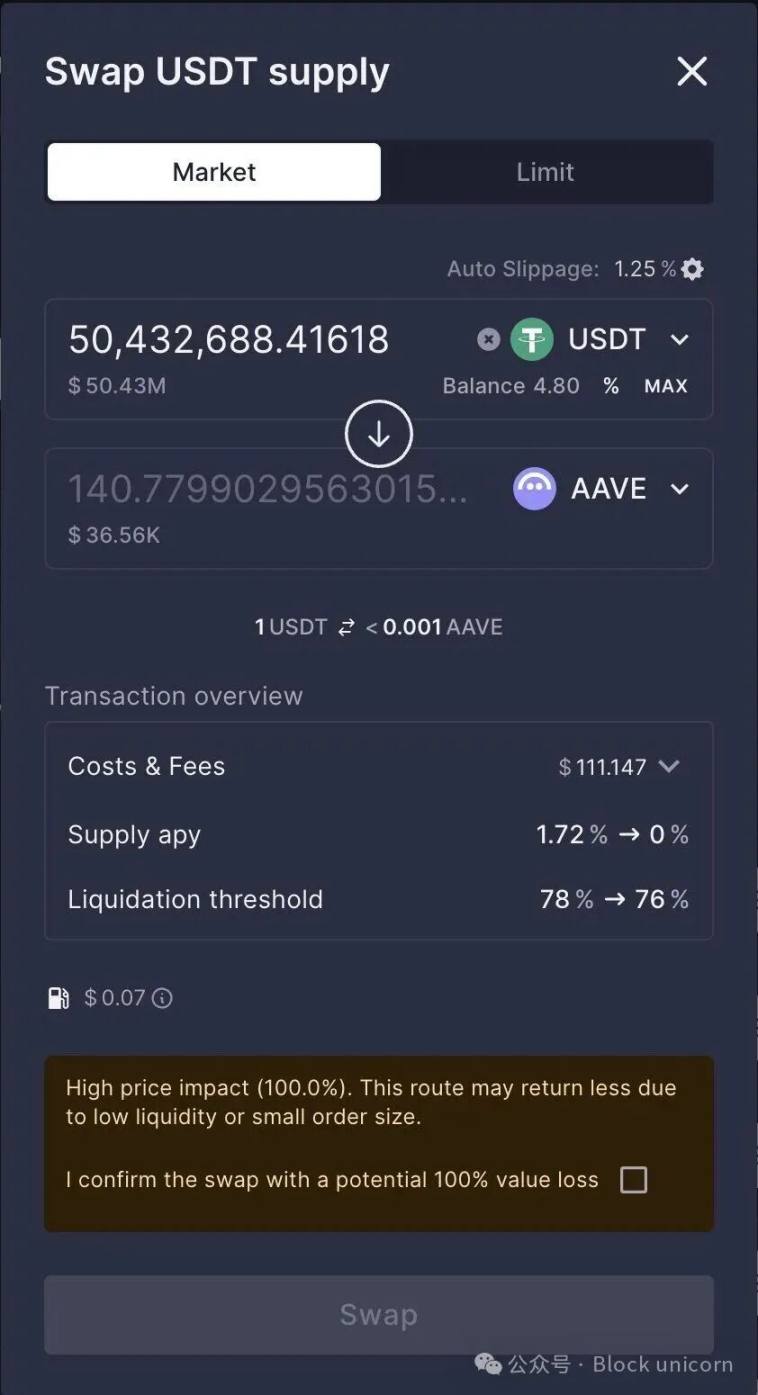
Although Aave explained in its post-analysis that the user ignored explicit high price impact warnings, founder and CEO Stani Kulechov posted on X that Aave’s team “will look into how to improve these protections.”
Jargon aside, one thing is clear: the rapid interface let a disastrous trade proceed faster than the system could react. While it’s tempting to question the user’s judgment and ignorance of warnings, treating this as an isolated incident is both convenient and counterproductive for the future of blockchain and other new financial infrastructures.
If crypto wants to avoid repeating history, the solution lies in building a smarter execution layer. Some DeFi trading protocols are already moving in this direction.
For example, Definitive.Fi believes that large on-chain transactions shouldn’t just pick technically feasible paths. They should be simulated before submission, tested against actual market conditions, split into smaller portions if necessary, and routed through more liquidity pools. As such, a good trading system should not only check if it can complete the transaction itself, but also search for the optimal path to fill the order.

For any emerging infrastructure, trust and extra protection are not optional features—especially in finance. A product that makes trading, lending, or moving funds smooth and easy can drive rapid growth, but when something goes wrong, the consequences are severe. All the traditional finance cases above follow this pattern. Systems try to minimize visible points of friction—even the necessary restrictions—obscure complexity, and hope that a smooth user experience will earn more consumer trust.
But confidence in finance is rarely built this way. It usually emerges when financial institutions identify key moments for intervention and take unpleasant but necessary steps to prevent destructive actions. Pay.UK’s Confirmation of Payee mechanism is an example. While being repeatedly asked to confirm bank account names is hardly a pleasant experience, it does effectively stop errors that could result in severe and irreversible losses.
Aave’s Stani understands this well. That’s why he admits customers aren’t always sure about the flow of their orders, who the payor is, or if there’s a better trading channel. In emerging fields like crypto and blockchain, this understanding is especially important, as few users know the technical details of transactions or the consequences of each click. In this context, recognizing pain points and acting on them is crucial to building user trust.
The challenge is that there’s a fine line between an effective brake and random inconvenience or friction. Good brakes do not completely slow things down—they apply just enough resistance at precisely the right moment. In the Aave-CoW case, we can think of a good brake as an economic sanity check: it enables the system to scan more venues before routing, prevents order intent from being exploited, simulates execution before committing, and splits large trades to avoid penalizing users for size. These mechanisms are key to making financial infrastructure trustworthy.
This distinction is important, because there are still pain points that demand a solution in finance: unnecessary paperwork, inefficient compliance that slows everything down, hidden fees disguised as process, and overly complicated signup flows that scare off new users.
These shouldn’t be defended. Implementing “brakes” isn’t about making products ugly or adding pop-up ads—it’s about designing a pause when the user is about to make an irreversible decision based on incomplete information. This is especially true when clients are handling large orders in low-liquidity markets, selling high-risk products, exploring new payment methods, or executing one-click actions—where risk is immediately apparent and speed is not the primary concern.
There are also business lessons here.
The financial industry often says protections should be built after product/market fit. That’s the wrong sequence. In finance, safeguards are a fundamental part of product/market fit. When implemented well, protections don’t even act as a hindrance. Pay.UK demonstrates that Confirmation of Payee isn’t just an optional anti-fraud feature—it has become an expected and practical service for clients using the system.
Emerging financial infrastructure like blockchains aim to earn trust and withstand errors, scandals, and market shocks just like traditional finance. But that’s not easy. They have to be more proactive in thinking about how to win trust before winning users, because only after gaining trust do the users come; the reverse isn’t guaranteed.
If blockchains are able to implement strategic braking mechanisms, their speed will surpass any other financial infrastructure.
Disclaimer: The content of this article solely reflects the author's opinion and does not represent the platform in any capacity. This article is not intended to serve as a reference for making investment decisions.
You may also like
Chipmaker earnings growth cools to 136% as AI boom lifts S&P 500
Updated: Delta Air Lines warns that as fuel prices hit profits, airline capacity will tighten further
Delta Airlines lowers its annual profit forecast due to an expected increase in fuel costs to $6 billion. The CEO stated that ticket prices have risen by about 20% this year, with limited passenger resistance. Analysts warn that maintaining high ticket prices in 2027 is critical for improving profitability. The article includes comments from the earnings call and analyst remarks. Rajesh Kumar Singh/Shivansh Tiwary, Reuters Chicago, October 9 - Delta Airlines (DAL.N) said on Friday that, despite strong travel demand and rising ticket prices, soaring fuel costs have forced it to cut its 2026 profit expectations by nearly a quarter. So, the airline industry may need to further limit flight growth next year to protect profitability. This warning highlights the increasingly tough challenges faced by U.S. airlines. While strong demand and restricted seat growth have allowed airlines to significantly raise ticket prices and offset higher fuel costs, aggressively increasing flights to capture more demand may intensify competition, making it harder to maintain high fares and protect profits. Based in Atlanta, Delta now expects its annual fuel expenditure to increase by about $6 billion compared to last year—about $2 billion higher than its July forecast—due to the Iran war (link) causing global jet fuel prices to spike. Airlines worldwide are preparing for a prolonged fuel shock. Michael O’Leary, CEO of Ryanair Group RYA.I, said Thursday that high jet fuel prices could persist for another 12-18 months (link), adding more pressure on airlines to raise fares and control costs. https://www.reuters.com/graphics/AUTOMATED-20261008/A4A-JET-FUEL-DAILY-1Y/xmpjwjnmbvr/chart.png “In a high-cost environment, you can’t simply grow your way out,” Delta CEO Ed Bastian said on the earnings call. He noted that the industry has already taken steps to restrict capacity, but more measures will be needed next year to improve profitability. Bastian said Delta raised ticket prices about 20% this year, and passenger resistance has been limited. He is confident that even if fuel costs eventually drop, the high fares can still be maintained. Delta lowered its adjusted annual earnings per share forecast from the July prediction of $6.50-$7.50 to $5.10-$5.60. According to LSEG data, the midpoint of the new range is below analysts’ average expectation of $5.46. Third-quarter adjusted earnings per share were $1.72, four cents below analysts’ average forecast. In midday trading, shares of Delta dropped 1.7%, United Airlines UAL.O fell 1.4%, and both American Airlines AAL.O and Southwest Airlines LUV.N were down about 1%. Delta partly shields itself from rising fuel costs by owning a refinery outside Philadelphia (link), which is expected to generate over $700 million in profits this year. Even with this buffer, the airline expects its fourth-quarter fuel price to rise from $3.61 per gallon in Q3 to $4.25 per gallon. Delta forecasts adjusted fourth-quarter earnings per share to be between $1.15-$1.65, with the $1.40 midpoint roughly matching analysts’ average expectation of $1.39. Fare increases Government data shows that in the first eight months of 2026, U.S. airlines spent $42.9 billion on fuel, an increase of $13.2 billion compared to the same period last year despite slightly reduced consumption. According to the U.S. Bureau of Labor Statistics, strong demand and limited seat growth pushed average U.S. airline ticket prices up by about 25% year-on-year between April and August. https://www.reuters.com/graphics/USA-AIRLINES/FUEL/lbpgdnbzwvq/chart.png Analysts at Melius Research said that despite surging fuel costs, Delta’s ability to raise fares helps keep second-half profits roughly stable. Still, they warn that the company’s profit margin has struggled to improve over the years. “It is critical for margin improvement to maintain or raise fares in 2027,” they wrote in their research report. With industry capacity growth expected to accelerate in Q4, this challenge will likely become even tougher. Deutsche Bank analysts expect the proportion of fuel costs recouped through revenue measures to fall in Q4 and predict full recovery won’t happen until early 2027. Bastian noted that low industry returns are another reason for limiting capacity growth. He said Delta will be cautious with its 2027 capacity plan until the fuel price outlook becomes clearer. He added that international routes may account for a larger share of Delta’s capacity expansion compared to domestic routes. Currently, Delta says its premium cabins and corporate travel business remain strong, and its economy cabin business is gradually improving. With Q4 ticket bookings already exceeding 60%, Delta expects revenue to increase about 20% year-on-year, despite limited capacity growth. Executives said early booking trends for Q1 2027 are also encouraging. (For the convenience of non-native English speakers, Reuters automatically translates its reports into several
AI and Quantum: Trump's $6 Billion Plan Could Also Impact Bitcoin
Wall Street giants to release financial reports next week: stock trading revenue expected to approach $19 billion, "everyone is a winner" may be a thing of the past
According to analyst expectations compiled by Bloomberg, the combined equity trading revenue of the five major U.S. banks in the third quarter will approach $19 billion, but fixed income trading revenue is expected to drop to its lowest point of the year, and M&A activity has also cooled. Meanwhile, AI-driven cash optimization tools may lead to deposit outflows, sparking concerns about bank stocks in the market. Analysts believe that while the profit performance of each bank may further diverge, market concerns about the impact of AI may be overblown.
Crypto prices
More


