
Governments need CBDCs to improve financial inclusion among citizens

Opinion by: Xin Yan, co-founder and CEO of Sign.
Financial exclusion remains one of the most persistent challenges for national governments. World Bank data highlights how more than 1.3 billion adults remain unbanked, without access to a financial account. These people rely on cash, creating a ‘cash-digital divide’, which excludes them from the formal economy.
To bridge the divide, governments need to promote CBDCs actively. As a trusted, risk-free alternative to physical cash, CBDCs are ideal instruments for the financially excluded demographic. With a seamless entry point to the financial ecosystem, mass adoption of CBDCs is a vital catalyst and a foundational pillar for achieving universal financial inclusion.
Wider access to financial institutions is key to stimulating a country’s growth. As more people invest and participate in the formal economy, the total capital base will expand, leading to greater financial stability. Further, bringing people within the formal economy ensures the benefits of policy rate changes reach the masses, bolsters regulatory oversight and prevents fraud.
Most people within the low-income demographic depend on cash payments because cash is easy to use, accepted everywhere, does not incur transaction charges and functions as a trusted medium of exchange.
The infrastructure needed to handle cash creates a gap between the unbanked population and the formal economy.
Financial inclusion as government policy
Establishing physical touchpoints to manage, store and handle cash at remote locations is resource-intensive. That’s why most service providers back out of offering cash-dependent financial services due to the high operational expenses.
Cash transactions also don’t leave a digital record, leading to an information vacuum for financial service providers. Consequently, institutions club the entire unbanked population as a high-risk group, denying access to insurance and credit markets.
Related: US lawmakers warn temporary CBDC ban isn’t enough, demand ‘permanent’ block
The lack of access to affordable digital payments and the absence of transaction history erode financial well-being and hinder a country’s economic growth. In this scenario, widespread access to formal financial services becomes an important government agenda.
Some central banks consider financial inclusion to be a key component of their mandate and adopt policies to ensure universal access to the formal economy. To this end, some central banks have considered issuing CBDCs to fast-track the process of developing an inclusive financial ecosystem.
CBDCs can accelerate financial inclusion
According to a 2023 study by Kosse and Mattei referenced by the IMF, about 60% of emerging and low-income countries consider financial inclusion to be one of the top three motivations for issuing a CBDC. The high confidence in CBDC stems from its properties to become the ideal bridge to the formal economy for the unbanked demographic.
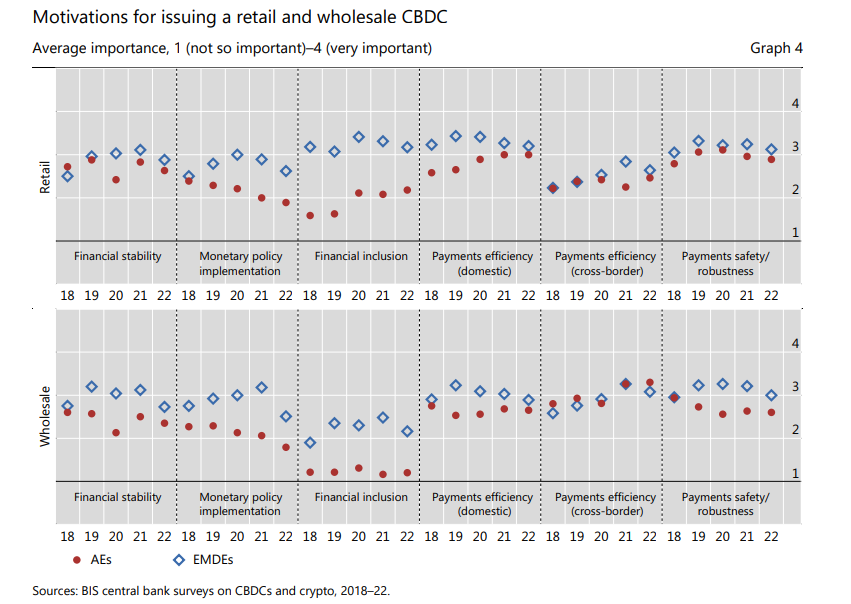 Source: BIS Central Bank Surveys on CBDCs and Crypto.
CBDCs can operate via a two-tier distribution model. This model allows both commercial banks and non-banking entities to reach the financially excluded demographic. Besides expanding the financial ecosystem’s reach, non-banking intermediaries lower the high overhead costs of legacy branch-based banking.
As a significant portion of the unbanked population doesn’t have stable internet or mobile connectivity, offline transaction support is necessary. Experts have noted how CBDCs are being designed to support robust offline capabilities. Exploring high-potential technologies for short-range communication ensures resilient CBDC payments in remote areas where there is limited connectivity.
As a public-sector digital infrastructure, CBDCs are designed to prioritize public welfare over commercial profit. Stripping away the bloated overhead of legacy intermediary layers, CBDCs enable a highly optimized cost structure.
Instead of burdensome charges, users benefit from marginalized transaction costs that are de minimis, ensuring the network remains both accessible to the unbanked and economically resilient for the sovereign issuer.
Moreover, the underbanked population is more likely to trust CBDCs as a digital alternative to cash because they are aided by a credible institution. Unlike the liquidity constraints of private financial entities, CBDCs will always remain a direct liability of the central bank, making them somewhat safe.
Most importantly, CBDCs provide a portal for the financially excluded population to participate in the formal economy. It happens through the smooth exchange of transaction data between CBDCs and the broader financial services industry.
CBDCs can support privacy-preserving data sharing, allowing users to voluntarily share their transaction history to build credit scores to access savings, credit, and insurance services.
In the absence of formal credit history, lenders can use CBDC transaction data as a legitimate source to evaluate financial behavior and creditworthiness. Service providers would therefore be able to measure a customer’s risk profile and verify identity to offer credit and other financial products.
Toward CBDC mass adoption
CBDC usage is subject to digital literacy, electricity infrastructure, and access to hardware. Data shows that nations have already made enormous progress on all these fronts.
The 2025 Global Findex Database from the World Bank Group has reported that 86% of adults now own a mobile phone. Also, 79% of adults now have a bank account, and 61% are making digital payments across low and middle-income economies.
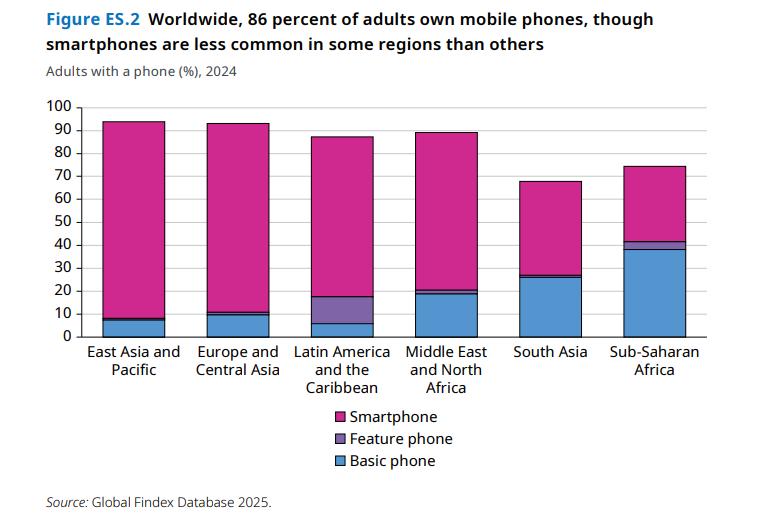 Source: Global Findex Database, 2025.
The report interestingly states that “despite high mobile phone ownership and growth in account ownership, 1.3 billion people still lack financial accounts.” This group of people have phones, personal ID, and SIM cards, which are necessary for a digitally enabled account.
Yet, they remain financially excluded from the formal economy.
In this situation, CBDCs remain one of the primary products that can offer safe, affordable, and convenient financial services to consumers.
Central banks and national governments must adopt a holistic approach and use CBDCs to help the financially inexperienced demographic integrate with the formal economy.
Opinion by: Xin Yan, co-founder and CEO of Sign.
Disclaimer: The content of this article solely reflects the author's opinion and does not represent the platform in any capacity. This article is not intended to serve as a reference for making investment decisions.
You may also like
Chipmaker earnings growth cools to 136% as AI boom lifts S&P 500
Updated: Delta Air Lines warns that as fuel prices hit profits, airline capacity will tighten further
Delta Airlines lowers its annual profit forecast due to an expected increase in fuel costs to $6 billion. The CEO stated that ticket prices have risen by about 20% this year, with limited passenger resistance. Analysts warn that maintaining high ticket prices in 2027 is critical for improving profitability. The article includes comments from the earnings call and analyst remarks. Rajesh Kumar Singh/Shivansh Tiwary, Reuters Chicago, October 9 - Delta Airlines (DAL.N) said on Friday that, despite strong travel demand and rising ticket prices, soaring fuel costs have forced it to cut its 2026 profit expectations by nearly a quarter. So, the airline industry may need to further limit flight growth next year to protect profitability. This warning highlights the increasingly tough challenges faced by U.S. airlines. While strong demand and restricted seat growth have allowed airlines to significantly raise ticket prices and offset higher fuel costs, aggressively increasing flights to capture more demand may intensify competition, making it harder to maintain high fares and protect profits. Based in Atlanta, Delta now expects its annual fuel expenditure to increase by about $6 billion compared to last year—about $2 billion higher than its July forecast—due to the Iran war (link) causing global jet fuel prices to spike. Airlines worldwide are preparing for a prolonged fuel shock. Michael O’Leary, CEO of Ryanair Group RYA.I, said Thursday that high jet fuel prices could persist for another 12-18 months (link), adding more pressure on airlines to raise fares and control costs. https://www.reuters.com/graphics/AUTOMATED-20261008/A4A-JET-FUEL-DAILY-1Y/xmpjwjnmbvr/chart.png “In a high-cost environment, you can’t simply grow your way out,” Delta CEO Ed Bastian said on the earnings call. He noted that the industry has already taken steps to restrict capacity, but more measures will be needed next year to improve profitability. Bastian said Delta raised ticket prices about 20% this year, and passenger resistance has been limited. He is confident that even if fuel costs eventually drop, the high fares can still be maintained. Delta lowered its adjusted annual earnings per share forecast from the July prediction of $6.50-$7.50 to $5.10-$5.60. According to LSEG data, the midpoint of the new range is below analysts’ average expectation of $5.46. Third-quarter adjusted earnings per share were $1.72, four cents below analysts’ average forecast. In midday trading, shares of Delta dropped 1.7%, United Airlines UAL.O fell 1.4%, and both American Airlines AAL.O and Southwest Airlines LUV.N were down about 1%. Delta partly shields itself from rising fuel costs by owning a refinery outside Philadelphia (link), which is expected to generate over $700 million in profits this year. Even with this buffer, the airline expects its fourth-quarter fuel price to rise from $3.61 per gallon in Q3 to $4.25 per gallon. Delta forecasts adjusted fourth-quarter earnings per share to be between $1.15-$1.65, with the $1.40 midpoint roughly matching analysts’ average expectation of $1.39. Fare increases Government data shows that in the first eight months of 2026, U.S. airlines spent $42.9 billion on fuel, an increase of $13.2 billion compared to the same period last year despite slightly reduced consumption. According to the U.S. Bureau of Labor Statistics, strong demand and limited seat growth pushed average U.S. airline ticket prices up by about 25% year-on-year between April and August. https://www.reuters.com/graphics/USA-AIRLINES/FUEL/lbpgdnbzwvq/chart.png Analysts at Melius Research said that despite surging fuel costs, Delta’s ability to raise fares helps keep second-half profits roughly stable. Still, they warn that the company’s profit margin has struggled to improve over the years. “It is critical for margin improvement to maintain or raise fares in 2027,” they wrote in their research report. With industry capacity growth expected to accelerate in Q4, this challenge will likely become even tougher. Deutsche Bank analysts expect the proportion of fuel costs recouped through revenue measures to fall in Q4 and predict full recovery won’t happen until early 2027. Bastian noted that low industry returns are another reason for limiting capacity growth. He said Delta will be cautious with its 2027 capacity plan until the fuel price outlook becomes clearer. He added that international routes may account for a larger share of Delta’s capacity expansion compared to domestic routes. Currently, Delta says its premium cabins and corporate travel business remain strong, and its economy cabin business is gradually improving. With Q4 ticket bookings already exceeding 60%, Delta expects revenue to increase about 20% year-on-year, despite limited capacity growth. Executives said early booking trends for Q1 2027 are also encouraging. (For the convenience of non-native English speakers, Reuters automatically translates its reports into several
AI and Quantum: Trump's $6 Billion Plan Could Also Impact Bitcoin
Wall Street giants to release financial reports next week: stock trading revenue expected to approach $19 billion, "everyone is a winner" may be a thing of the past
According to analyst expectations compiled by Bloomberg, the combined equity trading revenue of the five major U.S. banks in the third quarter will approach $19 billion, but fixed income trading revenue is expected to drop to its lowest point of the year, and M&A activity has also cooled. Meanwhile, AI-driven cash optimization tools may lead to deposit outflows, sparking concerns about bank stocks in the market. Analysts believe that while the profit performance of each bank may further diverge, market concerns about the impact of AI may be overblown.
Crypto prices
More


