
Crypto industry ties were a liability in Illinois primary

Not all voters are sold on crypto, and in Illinois, the crypto industry lobby failed to secure a victory, despite spending millions.
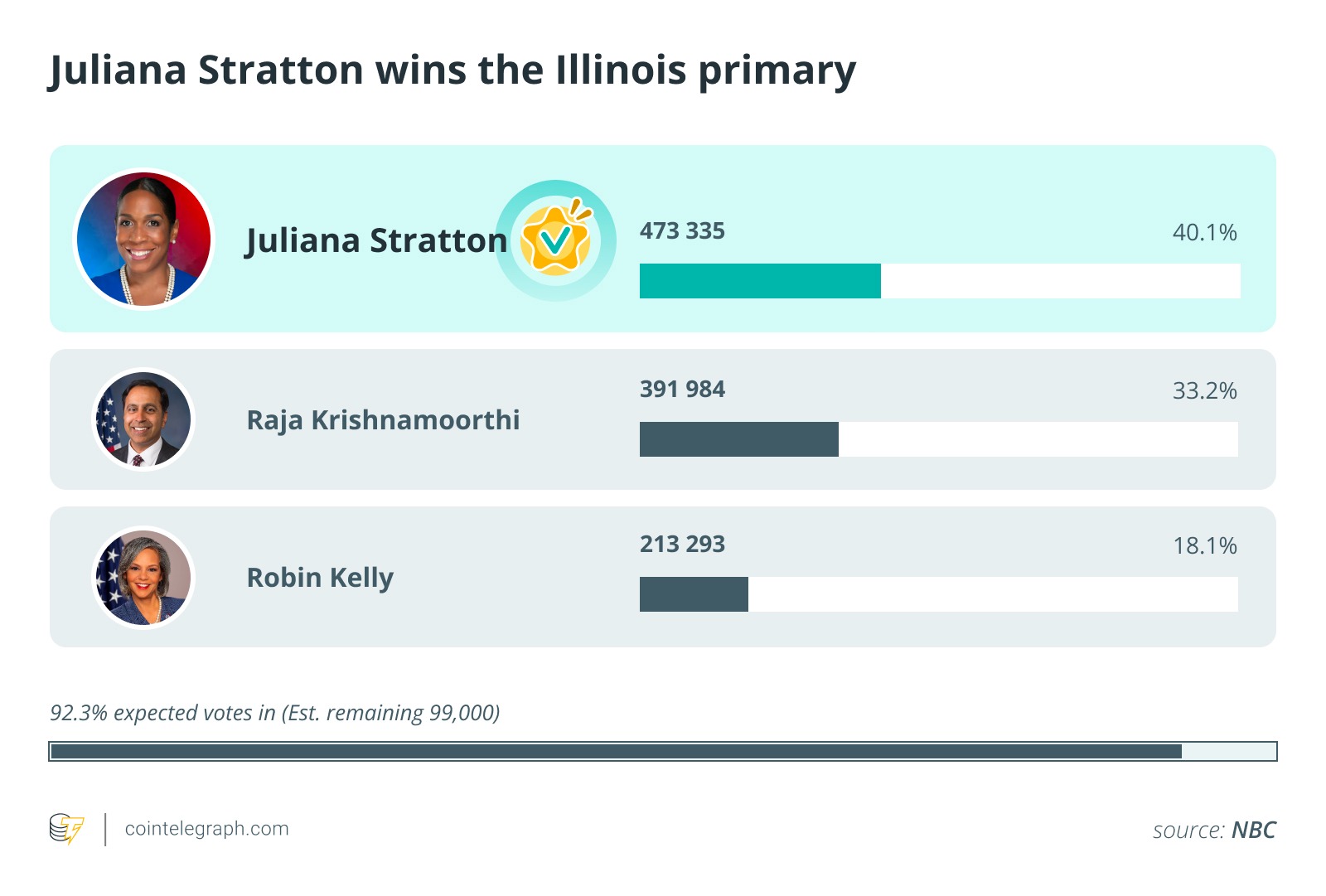
On Tuesday, Illinois Lieutenant Governor Juliana Stratton won a primary election for a rare open US Senate seat in her state. She is expected to win in the general election and take the seat of retiring Democratic Senator Dick Durbin.
In the primary, she won over two other candidates, Representative Raja Krishnamoorthi, who currently represents Illinois’ 8th Congressional district, and Representative Robin Kelly from Illinois’ 2nd.
The crypto lobby spent millions on ads supporting Krishnamoorthi. But ties to the industry may have been more of a liability among progressive voters.
“MAGA-backed crypto bros” finance Krishnamoorthi
In the months leading up to the election, Stratton ran on a progressive platform to oppose US President Donald Trump and, according to the Chicago Sun-Times, was the only candidate to openly oppose Immigration and Customs Enforcement (ICE). She also supported a higher minimum wage than Krishnamoorthi or Kelly.
As the primary race got closer, political action committees (PACs), notably Fairshake and Protect Progress, began to pour millions of dollars into the election.
Their motivations were clear. Ensuring that the industry has another crypto-friendly senator could be crucial as the Senate continues to work on the CLARITY Act.
Krishnamoorthi was a strong supporter of the GENIUS Act, which provided favorable regulations for stablecoins. He also voted for the CLARITY Act and the Financial Innovation and Technology for the 21st Century Act. This earned him an “A” rating with Stand With Crypto, a cryptocurrency advocacy organization tracking legislative records and attitudes.
Stratton’s campaign drew particular attention to the crypto dollars in the final weeks of the election. The Chicago Sun-Times estimated that Fairshake spent over $8 million.
In a March 3 video posted to X, Stratton said that Krishnamoorthi was “relying on his Trump-aligned allies” to tear her down with millions of dollars in attack ads. “His MAGA-backed crypto bros are dumping $7 million into this race to try to stop me. Illinoisans aren't buying it,” she wrote.
The connection of crypto with Trump and Republicans more broadly is understandable. Marc Andreessen, one of the founders and major donors to Fairshake, has previously expressed his support for Trump, and said he’d be voting for him in 2024. Trump and his family members are themselves part of crypto investment schemes.
And the money doesn’t lie. Fairshake is technically non-partisan, but it has spent more in support of Republican candidates. According to Open Secrets, some 62% of its expenditures support Republicans and oppose Democrats, while 37% of its expenditures support Democrats and oppose Republicans.
This didn’t appear to sit well with voters, nor with other officials representing Illinois. Senator Tammy Duckworth claimed that Krishnamoorthi could be "compromised" by industry interests, an idea the representative denied.
A 2025 poll found that Illinois voters held largely favorable opinions about cryptocurrencies, but many also supported restrictions. Some 47% of Democratic voters would support “policies restricting the growth of cryptocurrency and blockchain technology.”
Overall, 36% of Illinois voters “would be more likely to support elected officials who support restrictions on cryptocurrency and blockchain technology.”
Some election observers pointed out that Stratton had taken significant donations from current Illinois Governor JB Pritzker. But one Chicago voter told The Washington Post, “How many billionaires are supporting Raja?” The governor, by contrast, was “supporting his own lieutenant governor. That’s a non-issue for me. He should be doing it.”
Crypto lobby ramps up as midterms approach
The Illinois primary is just one of many races in which the crypto industry will spend money on ads and other support materials this year.
At the end of 2025, Fairshake alone had $190 million in cash on hand, $131 million of which it raised in the last half of the year.
Lawmakers and activists alike are concerned about the undue influence this could have on the midterm election outcomes. Senator Elizabeth Warren, a noted skeptic of the crypto industry, said that the Illinois primary would be “the test case for whether or not they can buy whatever candidate they want for Senate in Illinois and many of the congressional seats.”
Saurav Ghosh, the director of the Campaign Legal Center, previously told Cointelegraph, “This kind of influence buying ultimately undermines the democratic process by marginalizing everyday Americans, ensuring that their voices and interests take a backseat to the crypto industry’s deregulatory desires.”
The increasing association with crypto, MAGA and Trump could also prove problematic for keeping industry interests in Washington. Trump has negative approval ratings in all but 8 of the 50 states. Republicans are also facing predominant disapproval in the polls. If crypto becomes a byword for a Republican economic agenda, it may not work favorably in the midterms.
Political operatives have noted that, for the crypto lobby to retain influence, it needs to remain bipartisan. Democratic Representative Sam Liccardo told Politico last year, “I don’t think anybody in this town would recommend that an industry put their eggs in one party’s basket.”
In Congress, there are still a significant number of Democrats who are pro-crypto, or at the very least, not entirely opposed to the blockchain industry.
Filecoin Foundation chair Marta Belcher said, “Many policymakers on both sides of the aisle support crypto. I don’t think crypto is a partisan issue, just like ‘the internet’ isn’t a partisan issue. I don’t think, in 2025, either party can be ‘anti’ an entire technology if they’re thinking seriously about America’s future.”
Disclaimer: The content of this article solely reflects the author's opinion and does not represent the platform in any capacity. This article is not intended to serve as a reference for making investment decisions.
You may also like
Chipmaker earnings growth cools to 136% as AI boom lifts S&P 500
Updated: Delta Air Lines warns that as fuel prices hit profits, airline capacity will tighten further
Delta Airlines lowers its annual profit forecast due to an expected increase in fuel costs to $6 billion. The CEO stated that ticket prices have risen by about 20% this year, with limited passenger resistance. Analysts warn that maintaining high ticket prices in 2027 is critical for improving profitability. The article includes comments from the earnings call and analyst remarks. Rajesh Kumar Singh/Shivansh Tiwary, Reuters Chicago, October 9 - Delta Airlines (DAL.N) said on Friday that, despite strong travel demand and rising ticket prices, soaring fuel costs have forced it to cut its 2026 profit expectations by nearly a quarter. So, the airline industry may need to further limit flight growth next year to protect profitability. This warning highlights the increasingly tough challenges faced by U.S. airlines. While strong demand and restricted seat growth have allowed airlines to significantly raise ticket prices and offset higher fuel costs, aggressively increasing flights to capture more demand may intensify competition, making it harder to maintain high fares and protect profits. Based in Atlanta, Delta now expects its annual fuel expenditure to increase by about $6 billion compared to last year—about $2 billion higher than its July forecast—due to the Iran war (link) causing global jet fuel prices to spike. Airlines worldwide are preparing for a prolonged fuel shock. Michael O’Leary, CEO of Ryanair Group RYA.I, said Thursday that high jet fuel prices could persist for another 12-18 months (link), adding more pressure on airlines to raise fares and control costs. https://www.reuters.com/graphics/AUTOMATED-20261008/A4A-JET-FUEL-DAILY-1Y/xmpjwjnmbvr/chart.png “In a high-cost environment, you can’t simply grow your way out,” Delta CEO Ed Bastian said on the earnings call. He noted that the industry has already taken steps to restrict capacity, but more measures will be needed next year to improve profitability. Bastian said Delta raised ticket prices about 20% this year, and passenger resistance has been limited. He is confident that even if fuel costs eventually drop, the high fares can still be maintained. Delta lowered its adjusted annual earnings per share forecast from the July prediction of $6.50-$7.50 to $5.10-$5.60. According to LSEG data, the midpoint of the new range is below analysts’ average expectation of $5.46. Third-quarter adjusted earnings per share were $1.72, four cents below analysts’ average forecast. In midday trading, shares of Delta dropped 1.7%, United Airlines UAL.O fell 1.4%, and both American Airlines AAL.O and Southwest Airlines LUV.N were down about 1%. Delta partly shields itself from rising fuel costs by owning a refinery outside Philadelphia (link), which is expected to generate over $700 million in profits this year. Even with this buffer, the airline expects its fourth-quarter fuel price to rise from $3.61 per gallon in Q3 to $4.25 per gallon. Delta forecasts adjusted fourth-quarter earnings per share to be between $1.15-$1.65, with the $1.40 midpoint roughly matching analysts’ average expectation of $1.39. Fare increases Government data shows that in the first eight months of 2026, U.S. airlines spent $42.9 billion on fuel, an increase of $13.2 billion compared to the same period last year despite slightly reduced consumption. According to the U.S. Bureau of Labor Statistics, strong demand and limited seat growth pushed average U.S. airline ticket prices up by about 25% year-on-year between April and August. https://www.reuters.com/graphics/USA-AIRLINES/FUEL/lbpgdnbzwvq/chart.png Analysts at Melius Research said that despite surging fuel costs, Delta’s ability to raise fares helps keep second-half profits roughly stable. Still, they warn that the company’s profit margin has struggled to improve over the years. “It is critical for margin improvement to maintain or raise fares in 2027,” they wrote in their research report. With industry capacity growth expected to accelerate in Q4, this challenge will likely become even tougher. Deutsche Bank analysts expect the proportion of fuel costs recouped through revenue measures to fall in Q4 and predict full recovery won’t happen until early 2027. Bastian noted that low industry returns are another reason for limiting capacity growth. He said Delta will be cautious with its 2027 capacity plan until the fuel price outlook becomes clearer. He added that international routes may account for a larger share of Delta’s capacity expansion compared to domestic routes. Currently, Delta says its premium cabins and corporate travel business remain strong, and its economy cabin business is gradually improving. With Q4 ticket bookings already exceeding 60%, Delta expects revenue to increase about 20% year-on-year, despite limited capacity growth. Executives said early booking trends for Q1 2027 are also encouraging. (For the convenience of non-native English speakers, Reuters automatically translates its reports into several
AI and Quantum: Trump's $6 Billion Plan Could Also Impact Bitcoin
Wall Street giants to release financial reports next week: stock trading revenue expected to approach $19 billion, "everyone is a winner" may be a thing of the past
According to analyst expectations compiled by Bloomberg, the combined equity trading revenue of the five major U.S. banks in the third quarter will approach $19 billion, but fixed income trading revenue is expected to drop to its lowest point of the year, and M&A activity has also cooled. Meanwhile, AI-driven cash optimization tools may lead to deposit outflows, sparking concerns about bank stocks in the market. Analysts believe that while the profit performance of each bank may further diverge, market concerns about the impact of AI may be overblown.
Crypto prices
More


