
Even with the escalating situation in Iran, gold prices remain unmoved—the real "mastermind" behind the scenes is actually this?

FXMarkets, March 23—— The price movement of gold is determined less by pure geopolitical headlines and more by how these events shape inflation, monetary policy expectations, and real interest rates. Currently, it is still macro forces, rather than just geopolitics, that are driving the price of gold.
Recent price trends indicate that geopolitical factors alone are no longer sufficient to drive gold prices higher.
Macro factors, especially real yields, the US dollar exchange rate, and interest rate expectations, remain the key constraints limiting further gains for gold.
Safe-haven demand has been overshadowed by higher energy prices, a stronger dollar, and shifts in rate expectations.
Macro forces outweigh geopolitics
Despite the escalation of the Iran war, gold prices have fallen approximately 14% since the outbreak, highlighting that macro factors—especially rates, the US dollar, and cross-asset allocation—continue to dominate short-term price action.
This pattern is consistent with previous shock events: in the early stages, liquidity needs tend to outweigh safe-haven demand.
The reaction of gold in 2022 provides a useful reference point. When the Russia-Ukraine conflict began, gold prices initially rallied, but as the inflation shock transmitted into rates, the US dollar, and investor flows, this uptrend gradually faded.
More broadly,
Energy prices complicate the inflation outlook
Geopolitical tensions have pushed up energy prices, increasing the risk of persistently high inflation and making the path to monetary easing more complicated.
A “higher for longer” rate environment will keep real yields elevated, a headwind for gold. Last week, the Federal Reserve kept rates unchanged, and Chair Powell emphasized that further easing requires clearer progress on inflation; however, some economists still expect two 25-basis-point rate cuts later this year (in September and December).
Nonetheless, a stagflation backdrop (slowing growth accompanied by persistent inflation) should continue to support gold over the medium to long term.
Central bank demand remains supportive, but the pace may slow
Central banks continue to support gold demand, but the pace of buying has slowed.
According to the World Gold Council, net purchases in January were 5 tons, well below the 27 tons/month average in 2025, reflecting weaker momentum at the start of the year. Still, flows indicate that the structural interest remains: purchases from Uzbekistan were offset by sales from Russia, while new buyers like Malaysia and a potential return of Korean banks suggest that the demand base is gradually broadening.
While official sector demand remains structurally supportive (reflecting an ongoing trend of reserve management away from the US dollar), it is unlikely to drive short-term price volatility. Central banks may selectively accumulate reserves during periods of price weakness, but short-term price moves will remain dominated by investment flows.
ETF outflows weigh on gold prices
ETF flows remain a key demand driver for gold. Persistent outflows in recent weeks have weighed on prices, with holdings giving up much of the early-year gains since the outbreak of the Iran war. Historically, movements in ETF positioning have been closely correlated with gold prices and expectations for US monetary policy.
If there is a move toward a Fed rate cut later this year, it may trigger a new round of inflows and support prices; however, a “higher for longer” rate environment may mean continued ETF outflows remain a headwind.
Outlook remains constructive, but short-term risks are rising
Despite increased short-term risks, the overall outlook for gold remains constructive.
Gold is still up about 6% year-to-date, making the market vulnerable to profit-taking. However, any deeper correction could attract buying, especially from central banks and long-term investors.
Ultimately,
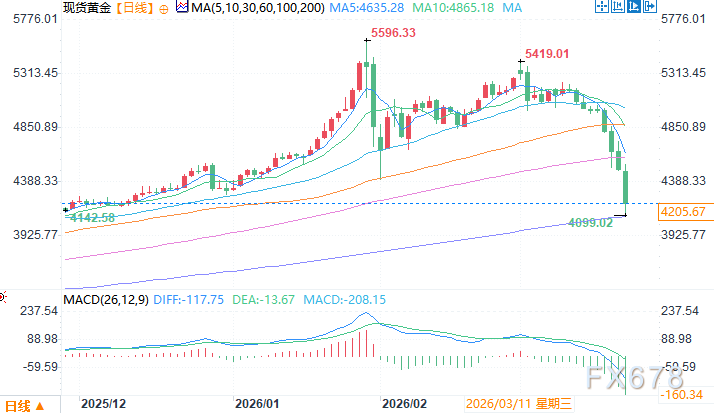
Spot Gold Daily Chart Source: Yihuizone
GMT+8, March 23, 15:41 Spot Gold quoted at $4205.67/ounce
Disclaimer: The content of this article solely reflects the author's opinion and does not represent the platform in any capacity. This article is not intended to serve as a reference for making investment decisions.
You may also like
Standard Chartered maintains $250 year end target for SOL despite price drop
SpaceX to Acquire Low-Band Spectrum Portfolio From Grain Management in Mobile Connectivity Push
06:50 AM EDT, 10/09/2026 (MT Newswires) -- SpaceX (SPCX) shares rose early Friday after the rocket and satellite company agreed to acquire a nationwide low-band spectrum portfolio from investment firm Grain Management as it seeks to establish Starlink Mobile as a major US mobile carrier. SpaceX will buy Grain Management's entire portfolio of up to 14 megahertz of paired spectrum in the 800 MHz band, the companies said in separate statements late Thursday. The deal is subject to the Federal Communications Commission's approval and other customary closing conditions. SpaceX's stock gained 3.7% in the most recent premarket activity. The companies did not disclose the financial terms, and neither immediately responded to MT Newswires' request for comment on the reported transaction value. SpaceX will pay about $8 billion in cash for the assets, The Wall Street Journal reported Thursday, citing people familiar with the matter. Grain Management, which specializes in digital infrastructure, acquired the 800 MHz spectrum portfolio from T-Mobile US (TMUS) in August in exchange for $2.9 billion in cash and all of Grain's 600 MHz spectrum licenses. "This prime low-band spectrum addresses one of the key remaining technical gaps that will pave the way for Starlink Mobile to become a major mobile carrier in the US," SpaceX said in its statement. Following regulatory approval, SpaceX intends to combine its satellite-to-mobile constellation in space with a terrestrial deployment that will enable Starlink Mobile's signals and services to reach customers from both the ground and space, according to the companies. SpaceX said most existing mobile devices already support the band. "Our spectrum expertise allows us to connect the strategic value of these assets with the technologies and operators that can realize their potential," Grain Management Chief Executive David Grain said in a separate statement. "This agreement with SpaceX brings that capability to bear at extraordinary scale." Shares of Verizon Communications (VZ), AT&T (T)
Delta Air Lines Lowers Profit Forecast as Fuel Cost Increase Outpaces Ticket Price Growth
Delta Air Lines lowers its annual profit forecast due to a $6 billion increase in fuel costs; sharply rising ticket prices test travelers’ willingness to pay. The company’s refinery business is expected to generate $700 million in profits to help offset the impact of fuel costs. Rajesh Kumar Singh, Reuters Chicago, October 9 – Delta Air Lines (DAL.N) lowered the midpoint of its annual profit forecast by nearly a quarter on Friday, as surging fuel costs offset the positive effects of strong travel demand and higher ticket prices. This downgrade highlights the increasingly severe challenges faced by U.S. airlines: if fuel prices remain high, will passengers be willing to accept further price hikes? Airlines have already increased ticket prices considerably this year, and analysts warn that further hikes could test travelers’ willingness to continue spending. The Atlanta-based airline expects its annual fuel spending to increase by about $6 billion compared to last year. Its third-quarter fuel expenses jumped 62% year-on-year to $4.1 billion, more than $500 million higher than July’s expectations. When asked about the reasons for the revised forecast, Delta CFO Erik Snell told reporters, “It’s entirely a fuel issue,” noting that crude oil and refined jet fuel prices have both increased since the summer. Delta now expects adjusted annual earnings per share of $5.10–$5.60, down from its July forecast of $6.50–$7.50. According to data from London Stock Exchange Group (LSEG), the new median of $5.35 is below analysts’ average forecast of $5.46. The company expects an adjusted pre-tax profit of $4.5 billion in 2026. According to LSEG, third-quarter adjusted earnings per share were $1.72, slightly below the average analyst forecast of $1.76. Its adjusted operating margin dropped from 11.1% to 9.4%. Delta is the first major U.S. airline to report third-quarter earnings; its competitors United Airlines (UAL.O), American Airlines (AAL.O), and Southwest Airlines (LUV.N) will release their results later this month. Ticket Price Increases According to the U.S. Bureau of Transportation Statistics, in the first eight months of 2026, U.S. airlines spent $42.9 billion on fuel for scheduled flights, nearly $13.2 billion more than in the previous year, despite a slight decrease in fuel consumption. Strong demand and limited seat growth have helped airlines pass higher fuel costs onto passengers. According to the U.S. Bureau of Labor Statistics’ Consumer Price Index, over the five months ending in August, average U.S. airfares increased about 25% year-on-year. With fuel prices remaining high and industry capacity growth set to further accelerate in the fourth quarter, analysts are closely watching whether airlines including Delta can raise ticket prices further without suppressing travel demand. Deutsche Bank analysts expect the industry’s proportion of fuel costs recouped through revenue to decline in the fourth quarter, with full recovery not expected until early 2027. Delta says demand remains strong. Snell noted that with fourth-quarter bookings already near 60%, the company expects revenue to increase by around 20% year-on-year. According to LSEG, Delta forecasts fourth-quarter adjusted earnings per share of $1.15–$1.65, with the median $1.40 roughly in line with analysts’ average expectation of $1.39. Refinery Advantage Delta holds an advantage over other major U.S. airlines: it owns a refinery near Philadelphia, which Snell expects will generate $700 million in profits this year. “We own a refinery, which gives us a hedge—part hedge—on fuel prices that no other airline has,” he said. Delta acquired the Monroe refinery in 2012, which processes crude oil into jet fuel and other products. While Delta must still pay market prices for fuel consumed by its airline operations, refinery profits remain within the company. When the price spread between crude oil and refined products widens, this helps offset fuel cost pressures for airlines sourcing externally. However, this protection depends on refinery margins; when margins fall, the refinery may also incur losses. Nevertheless, the refinery can only partially ease the impact of rising fuel prices. Even with an expected refinery benefit of 40 cents per gallon, Delta forecasts its fuel cost to rise from $3.61 per gallon in the third quarter to $4.25 per gallon in the fourth quarter. Snell said fuel costs are expected to remain high for some time. “Ultimately, fuel prices will come down. As to when, we’re not sure,” he said. (For the convenience of non-native English speakers, Reuters offers automated translations of its reports into several other languages. Due to possible errors or lack of context in automated translations, Reuters does not guarantee the accuracy of automated translation texts and provides them only for reader convenience. Reuters assumes no responsibility for any damages or losses from use of automated translation featur
SUI Price Pullback Sparks Debate: Correction or Next Buying Opportunity?
Crypto prices
More


