
Korean stocks crash again! Kospi plunges over 6% in early trading, triggering "sidecar sell-off" for the sixth time this year. Investment banks warn: This is a "textbook bubble."

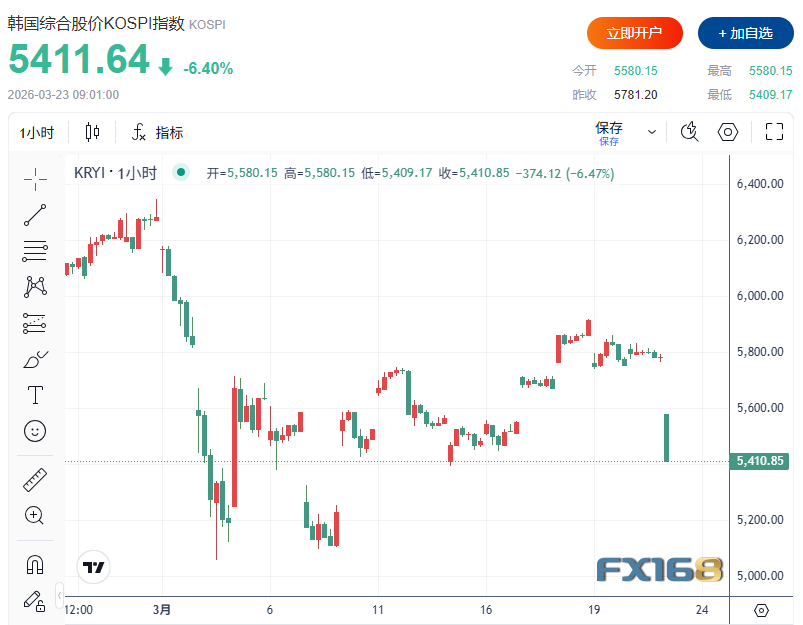
South Korea's stock market came under heavy selling pressure again in early trading on Monday, March 23. As signs of further escalation in the US-Iran conflict emerged, both the Korea Composite Stock Price Index (Kospi) and the Growth Enterprise Market index Kosdaq opened lower and continued to decline. Kospi plunged over 6% during trading, prompting the Korea Exchange to activate the "sidecar" mechanism for the sixth time this year, temporarily halting program trading on Kospi for five minutes.
According to a notice from the Korea Exchange (KRX), program trading on Kospi was suspended for five minutes from 9:18 am that day. The so-called "sidecar" mechanism is an automatic temporary restriction imposed by the exchange when the Kospi 200 futures index drops by 5% or more and remains at that level for at least one minute. This aims to curb short-term market volatility that could be intensified by program selling.
At the time of writing, the Kospi index stood at 5,411.64 points, marking a drop of over 374 points from the previous trading day, a decline of 6.40%. The index opened at 5,580.15 points, down 201.05 points, or 3.48%, from the prior close, indicating that strong risk aversion dominated the market right from the opening bell.
(Image source:FX168)
From the perspective of capital flows, on the main board market of the Korea Exchange, individual investors bucked the trend by buying a net 908 billion won, becoming the major supporting force. Foreign and institutional investors however made substantial retreats, with net sales of 554.4 billion won and 373.1 billion won, respectively, reflecting the rapid escalation of concerns about short-term risks from offshore capital and professional institutions.
Blue Chip Stocks Plunge, Main Board Leaders Under Pressure Across the Board
In terms of market performance, almost all large-cap blue-chip stocks on the main board weakened. Samsung Electronics dropped more than 4%, SK Hynix fell over 5%, and industry leaders such as Hyundai Motor, LG New Energy, SK Square, Samsung Biologics, Doosan Enerbility, Hanwha Aerospace, and Kia also posted losses, indicating that selling pressure has spread from a few sectors to the market's core assets as a whole.
Meanwhile, the Kosdaq market was not spared. As of 9:10 am, the Kosdaq stood at 1,118.72 points, down 42.80 points or 3.68% from the previous trading day. It had opened at 1,129.86, down 31.66 points, or 2.73% from the prior close.
In the Kosdaq market, foreign investors net bought 69.9 billion won against the trend that day, while individual and institutional investors net sold 47.1 billion won and 19.1 billion won, respectively. Among sector leaders, only Sam Chun Dang Pharm—the newly crowned largest by market capitalization—posted gains; whereas popular stocks such as EcoPro, Alteogen, EcoPro BM, Rainbow Robotics, ABL Bio, LEENO Industrial, Peptron, Kolon TissueGene, and LigaChem Biosciences mostly declined.
US-Iran Conflict Escalation Becomes Major Trigger for South Korea Stock Sell-off
Analysts generally attribute this round of sharp declines in South Korean stocks to the sudden deterioration of the Middle East situation. As the US-Iran conflict continued to escalate, market concerns about potential disruptions to energy supply, rising imported inflation, and declining global risk appetite intensified rapidly. South Korea, being highly reliant on energy imports, felt the impact particularly acutely.
US President Trump recently issued another tough threat regarding the Strait of Hormuz, mentioning “scorched earth”-style attacks. On the 21st local time, Trump declared on the social platform Truth Social that if Iran does not “fully open the Strait of Hormuz without threats” within 48 hours, the US will attack multiple Iranian power plants, “starting with the largest and reducing it to ashes.”
Almost simultaneously, Iran launched missile strikes on Dimona in southern Israel. Dimona is the location of Israel’s nuclear facilities, and this attack was seen as retaliation for previous US and Israeli strikes on Iran’s key uranium enrichment site in Natanz. As both sides continue to issue hardline statements and escalate military actions, concerns over the war’s potential to expand have grown notably.
After a Year of Surging Gains, Volatility and Bubble Concerns Rise for South Korea Stocks
In fact, prior to the coordinated US-Israel strike on Iran, South Korea’s stock market was in the midst of a strong uptrend. Last Friday, Kospi closed at 5,781.2 points, up 152% from the 52-week low of 2,293.7 points set on April 9, 2025, and 119% higher than the 2,637.1 points of a year ago. On February 27, just a day before the missile attack, Kospi briefly surged to an intraday historic high of 6,347.41 points.
However, as Middle East war risk was increasingly priced into asset valuations, market volatility rapidly intensified. On March 3, Kospi plunged 7.24% in a single day; the next day, it dropped another 12.06%, marking the largest daily loss on record; and on March 5, it rebounded sharply by 9.63%, all highlighting the current state of extreme market volatility.
In this rollercoaster process, South Korea's stock market twice triggered circuit breakers in three trading days, suspending trading for 20 minutes each time. Since then, the sidecar mechanism has also been triggered several times, with program trading repeatedly halted. Although there were attempts to recover after sharp corrections, Kospi has failed to regain the 6,000 mark, indicating that market confidence at high levels remains fragile.
The Kospi 200 Volatility Index (VKospi), which reflects the level of market panic, soared to a historical high of 81.99 earlier this month and has since remained above 50. Such levels are typically regarded as important signals of markets entering panic mode and suggest that investors remain on high alert for future trends.
Foreign Capital Withdrawal and Retail Chasing Coexist; International Institutions Warn of 'Bubble'
Against this backdrop, debate over whether a bubble has developed in the Korean stock market has rapidly intensified. According to a recent report by Bank of America, the current pattern in South Korea’s market is "a textbook example of a bubble." The report stated that the sharp volatility in Kospi now shares features with those seen during the 1997 Asian Financial Crisis, the 1999 Internet bubble, and the 2008 Global Financial Crisis.
Bank of America also pointed out that retail investors have been the driving force behind this historic rally, forming a typical "classic bubble environment." Since the start of the year, South Korea's individual investors have net bought 22.16 trillion won in Kospi stocks, while foreign investors have net sold 37.53 trillion won, and institutional investors have bought a net 9.69 trillion won—revealing a distinctive pattern of "retail buying, foreign selling" in the market structure.
However, some analysts believe concerns about a bubble in South Korean equities might be overblown. NH Investment & Securities analyst Na Jeong-hwan noted that although the South Korean government continues to implement policies to "reduce the Korea discount," in terms of price-earnings ratio, the market overall still lies in the undervalued zone. With earnings expectations being continuously revised upward, Kospi's expected PE ratio for the next 12 months is about 9.5 times, still lower than the ten-year average of 10.5 times.
In addition, some argue that the ongoing semiconductor supercycle may continue to support South Korea’s stock market. Hana Securities analyst Lee Jae-man highlighted that excluding Samsung Electronics and SK Hynix, the semiconductor and hardware sectors only account for about 5% of the combined market value of Kospi and Kosdaq, still below the peak of 6.5% seen in the past. This suggests stocks in these sectors still have room for further appreciation.
Overall, South Korea’s stock market is currently at a sensitive juncture where “geopolitical shocks” intersect with “post-rally volatility recalibration.” In the short term, the escalation of the US-Iran conflict, high oil prices, and foreign capital outflows are clearly continuing to pressure the market. But in the medium to long term, earnings recovery, policy support, and the semiconductor cycle still give some investors reason to remain bullish. Under these mixed bull-and-bear drivers, it is likely that South Korean equities will continue to experience high volatility in the near future, and the debate over whether a "bubble" has formed will continue to simmer.
Disclaimer: The content of this article solely reflects the author's opinion and does not represent the platform in any capacity. This article is not intended to serve as a reference for making investment decisions.
You may also like
Delta Air Lines Lowers Profit Forecast as Fuel Cost Increase Outpaces Ticket Price Growth
Delta Air Lines lowers its annual profit forecast due to a $6 billion increase in fuel costs; sharply rising ticket prices test travelers’ willingness to pay. The company’s refinery business is expected to generate $700 million in profits to help offset the impact of fuel costs. Rajesh Kumar Singh, Reuters Chicago, October 9 – Delta Air Lines (DAL.N) lowered the midpoint of its annual profit forecast by nearly a quarter on Friday, as surging fuel costs offset the positive effects of strong travel demand and higher ticket prices. This downgrade highlights the increasingly severe challenges faced by U.S. airlines: if fuel prices remain high, will passengers be willing to accept further price hikes? Airlines have already increased ticket prices considerably this year, and analysts warn that further hikes could test travelers’ willingness to continue spending. The Atlanta-based airline expects its annual fuel spending to increase by about $6 billion compared to last year. Its third-quarter fuel expenses jumped 62% year-on-year to $4.1 billion, more than $500 million higher than July’s expectations. When asked about the reasons for the revised forecast, Delta CFO Erik Snell told reporters, “It’s entirely a fuel issue,” noting that crude oil and refined jet fuel prices have both increased since the summer. Delta now expects adjusted annual earnings per share of $5.10–$5.60, down from its July forecast of $6.50–$7.50. According to data from London Stock Exchange Group (LSEG), the new median of $5.35 is below analysts’ average forecast of $5.46. The company expects an adjusted pre-tax profit of $4.5 billion in 2026. According to LSEG, third-quarter adjusted earnings per share were $1.72, slightly below the average analyst forecast of $1.76. Its adjusted operating margin dropped from 11.1% to 9.4%. Delta is the first major U.S. airline to report third-quarter earnings; its competitors United Airlines (UAL.O), American Airlines (AAL.O), and Southwest Airlines (LUV.N) will release their results later this month. Ticket Price Increases According to the U.S. Bureau of Transportation Statistics, in the first eight months of 2026, U.S. airlines spent $42.9 billion on fuel for scheduled flights, nearly $13.2 billion more than in the previous year, despite a slight decrease in fuel consumption. Strong demand and limited seat growth have helped airlines pass higher fuel costs onto passengers. According to the U.S. Bureau of Labor Statistics’ Consumer Price Index, over the five months ending in August, average U.S. airfares increased about 25% year-on-year. With fuel prices remaining high and industry capacity growth set to further accelerate in the fourth quarter, analysts are closely watching whether airlines including Delta can raise ticket prices further without suppressing travel demand. Deutsche Bank analysts expect the industry’s proportion of fuel costs recouped through revenue to decline in the fourth quarter, with full recovery not expected until early 2027. Delta says demand remains strong. Snell noted that with fourth-quarter bookings already near 60%, the company expects revenue to increase by around 20% year-on-year. According to LSEG, Delta forecasts fourth-quarter adjusted earnings per share of $1.15–$1.65, with the median $1.40 roughly in line with analysts’ average expectation of $1.39. Refinery Advantage Delta holds an advantage over other major U.S. airlines: it owns a refinery near Philadelphia, which Snell expects will generate $700 million in profits this year. “We own a refinery, which gives us a hedge—part hedge—on fuel prices that no other airline has,” he said. Delta acquired the Monroe refinery in 2012, which processes crude oil into jet fuel and other products. While Delta must still pay market prices for fuel consumed by its airline operations, refinery profits remain within the company. When the price spread between crude oil and refined products widens, this helps offset fuel cost pressures for airlines sourcing externally. However, this protection depends on refinery margins; when margins fall, the refinery may also incur losses. Nevertheless, the refinery can only partially ease the impact of rising fuel prices. Even with an expected refinery benefit of 40 cents per gallon, Delta forecasts its fuel cost to rise from $3.61 per gallon in the third quarter to $4.25 per gallon in the fourth quarter. Snell said fuel costs are expected to remain high for some time. “Ultimately, fuel prices will come down. As to when, we’re not sure,” he said. (For the convenience of non-native English speakers, Reuters offers automated translations of its reports into several other languages. Due to possible errors or lack of context in automated translations, Reuters does not guarantee the accuracy of automated translation texts and provides them only for reader convenience. Reuters assumes no responsibility for any damages or losses from use of automated translation featur
SUI Price Pullback Sparks Debate: Correction or Next Buying Opportunity?
"SaaS Apocalypse" Debunked? Autodesk (ADSK.US) and Intuit (INTU.US) Lead Growth Against the Trend as Wall Street Reprices the "AI Eating Software" Narrative
This week, Autodesk and Intuit are expected to record their strongest weekly gains in months, defying pressure on the overall technology sector. This strong performance signals a renewed optimism in the market regarding the growth prospects of the SaaS (Software as a Service) industry.
Starlink Targets the US Mobile Communication Market, SpaceX (SPCX.US) Opens New Growth Opportunities: Wall Street Focuses on the Reshaping of the Telecom Industry Landscape
Combining the existing satellite capacity, SpaceX is supplementing its capabilities to upgrade from “occasional emergency connectivity” to “daily mobile service.” The satellite network provides wide-area coverage and fills ground blind spots, while low-frequency terrestrial networks improve connectivity inside buildings and in environments with complex obstructions. The two form a complement to each other.
Crypto prices
More


