
To pave the way for balance sheet reduction, US regulators significantly relax bank capital requirements

On March 19, the Federal Reserve, the Federal Deposit Insurance Corporation (FDIC), and the Office of the Comptroller of the Currency (OCC), the three major U.S. regulatory agencies, jointly launched a new round of bank capital rule reform proposals aimed at easing capital constraints within the U.S. banking system. Specific measures include: First, making fundamental revisions to the contentious Basel III Endgame rules, eliminating some issues of double counting and improving the accuracy of risk weights; second, adjusting the G-SIB surcharge by pegging it to nominal GDP and reducing the buffer capital size (previously 50 basis points, now reduced to 10 basis points); third, relaxing constraints related to the Supplementary Leverage Ratio (SLR); and fourth, reforming the stress testing mechanism to improve transparency and reduce uncertainty in capital requirements.
After consolidating the Basel III Endgame rules, stress test reforms, and global systemically important bank (G-SIB) surcharge adjustments, the minimum Common Equity Tier 1 (CET1) capital requirements for large U.S. banks (assets over $700 billion) are expected to decrease by approximately 4.8%, medium-sized banks (assets between $100 billion and $700 billion) by 5.2%, and small banks (assets less than $100 billion) by as much as 7.8%. If previously implemented stress test reforms and leverage ratio adjustments are also considered, the amount of capital freed up for large banks could reach tens of billions of U.S. dollars.
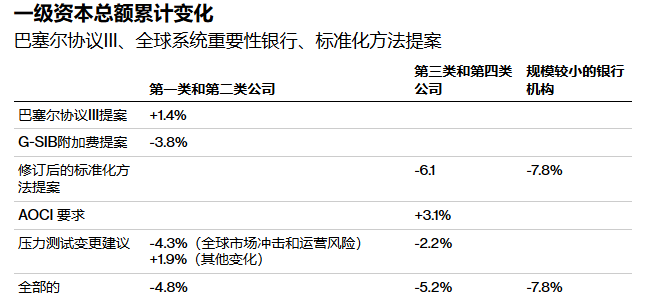
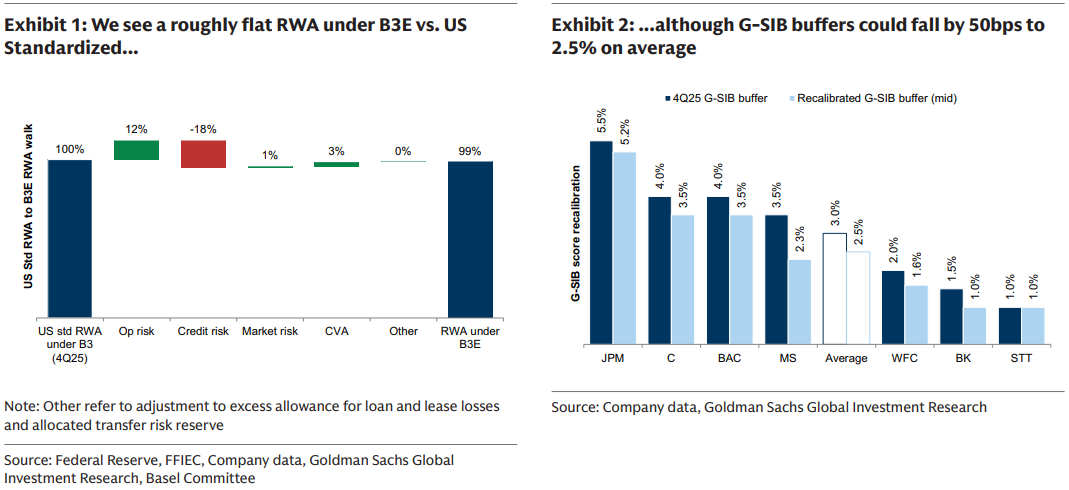
From a policy perspective, this round of reform will be the largest relaxation of capital rules since the 2008 financial crisis. In addition to directly modifying capital rules, regulatory focus is also simultaneously shifting towards liquidity requirements. Federal Reserve Vice Chair for Supervision Bowman and U.S. Treasury Secretary Besant have publicly advocated for adjustments to key liquidity rules (such as LCR and ILST), proposing to include banks’ capacity to obtain funding through channels such as the Federal Reserve discount window as part of high-quality liquid assets (HQLA), thereby reducing banks’ over-reliance on traditional liquidity buffers.
Loosening Regulation and Paving the Way for Balance Sheet Reduction
The direct effect of this policy round is to free up bank capital space and promote credit expansion. Wall Street banks will be able to release tens of billions of dollars in funds to expand lending, increase share buybacks, and boost shareholder dividends. In this process, traditional commercial banks and mega-regional banks will disproportionately become the main beneficiaries. The proposal significantly reduces the risk weights for residential mortgages and corporate loans; for example, the risk-weighted assets (RWA) of residential mortgages at small and medium-sized banks are expected to decrease by about 30% to 31%. Such structural tilting will markedly enhance the willingness and capacity of traditional lending institutions to expand their balance sheets.
Disclaimer: The content of this article solely reflects the author's opinion and does not represent the platform in any capacity. This article is not intended to serve as a reference for making investment decisions.
You may also like
"SaaS Apocalypse" Debunked? Autodesk (ADSK.US) and Intuit (INTU.US) Lead Growth Against the Trend as Wall Street Reprices the "AI Eating Software" Narrative
This week, Autodesk and Intuit are expected to record their strongest weekly gains in months, defying pressure on the overall technology sector. This strong performance signals a renewed optimism in the market regarding the growth prospects of the SaaS (Software as a Service) industry.
Starlink Targets the US Mobile Communication Market, SpaceX (SPCX.US) Opens New Growth Opportunities: Wall Street Focuses on the Reshaping of the Telecom Industry Landscape
Combining the existing satellite capacity, SpaceX is supplementing its capabilities to upgrade from “occasional emergency connectivity” to “daily mobile service.” The satellite network provides wide-area coverage and fills ground blind spots, while low-frequency terrestrial networks improve connectivity inside buildings and in environments with complex obstructions. The two form a complement to each other.

The Decisive Significance of Next Week's U.S. CPI: Will the Federal Reserve Hold Off on Raising Interest Rates in October?
Barclays and Morgan Stanley both expect the month-on-month increase in core CPI for September to slow from 0.29% in August to 0.24%, mainly due to a decline in the price increase of wireless communication services. Energy is driving overall inflation, but the marginal core pressure is easing, providing justification for the Federal Reserve to keep rates unchanged in October.

Crypto prices
More


