
Cango's 2025 revenue is $688.1 million, with the mining business contributing $675.5 million; net loss from continuing operations is $452 million, turning from profit to loss year-on-year.

On March 18, Cango released its full-year 2025 financial performance report for continued operations. According to the announcement, the company's total revenue in 2025 reached $688.1 million; a total of 6,594.6 bitcoins were mined; and the net loss from continuing operations for the year was $452 million. The comprehensive mining cost per bitcoin in 2025 reached as high as $97,272.
In terms of revenue, the company's total revenue in 2025 reached $688.1 million, with mining operations performing particularly well, contributing $675.5 million in revenue. By the end of 2025, a total of 6,594.6 relevant cryptocurrencies had been mined. In stark contrast, the international automobile trading business generated only $9.8 million in revenue, clearly demonstrating that mining operations dominate the company's revenue structure.
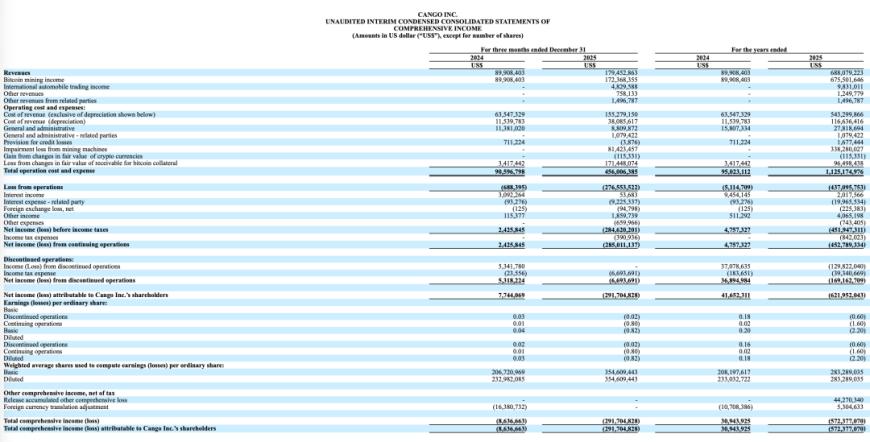
In 2025, the company's total operating costs and expenses amounted to a staggering $1.1 billion. Breaking this down, operating costs (excluding depreciation) were $543.3 million, operating costs (depreciation) were $116.6 million, and general and administrative expenses were $28.9 million (including $1.1 million in related party expenses). In addition, impairment losses on mining machines reached $338.3 million, while fair value losses on bitcoin-collateralized receivables amounted to $96.5 million; the company reported a total annual operating loss of $437.1 million.
Regarding net profit, the net loss from continuing operations in 2025 was $452.8 million, in sharp contrast with the $4.8 million net profit from continuing operations in 2024. However, the non-GAAP adjusted net profit was $24.5 million, an increase over $5.7 million in 2024.
As of December 31, 2025, the company held $41.2 million in cash and cash equivalents, $663 million in bitcoin-collateralized long-term receivables from related parties, mining machines with a net value of $248.7 million, and related party long-term debt of $557.6 million. To optimize its financial position, the company sold 4,451 relevant cryptocurrencies in February 2026 to repay part of the related party long-term debt, aiming to reduce overall financial leverage and strengthen the balance sheet.
Disclaimer: The content of this article solely reflects the author's opinion and does not represent the platform in any capacity. This article is not intended to serve as a reference for making investment decisions.
You may also like
JPMorgan analyzes Applied (APLD.US): AI computing power business advancing rapidly, facing real-world challenges with billion-dollar financing
JPMorgan's Credit Research team has released a report providing a comprehensive analysis of company operations, project progress, financing pressures, and risks.
Crypto: Pump.fun Earns $18.6M Despite Memecoin Slump
Societe Generale's chief bear: The AI boom is replicating the Asian financial crisis, with the deadly “debt time bomb”
Société Générale Chief Strategist Edwards warns that the true trigger for the AI boom is not inadequate productivity, but whether cheap money can continue to flow. Overseas long-term government bond yields continue to rise, while AI giants are issuing large amounts of debt, with hundreds of billions of dollars in new bonds needing to be absorbed by the same group of buyers. This is reminiscent of the 1990s, when Asia maintained prosperity through short-term dollar borrowing.
Crypto prices
More


