
Bitcoin Struggles Near $70,000 as “Quadruple Witching” and Global Tensions Weigh on Markets

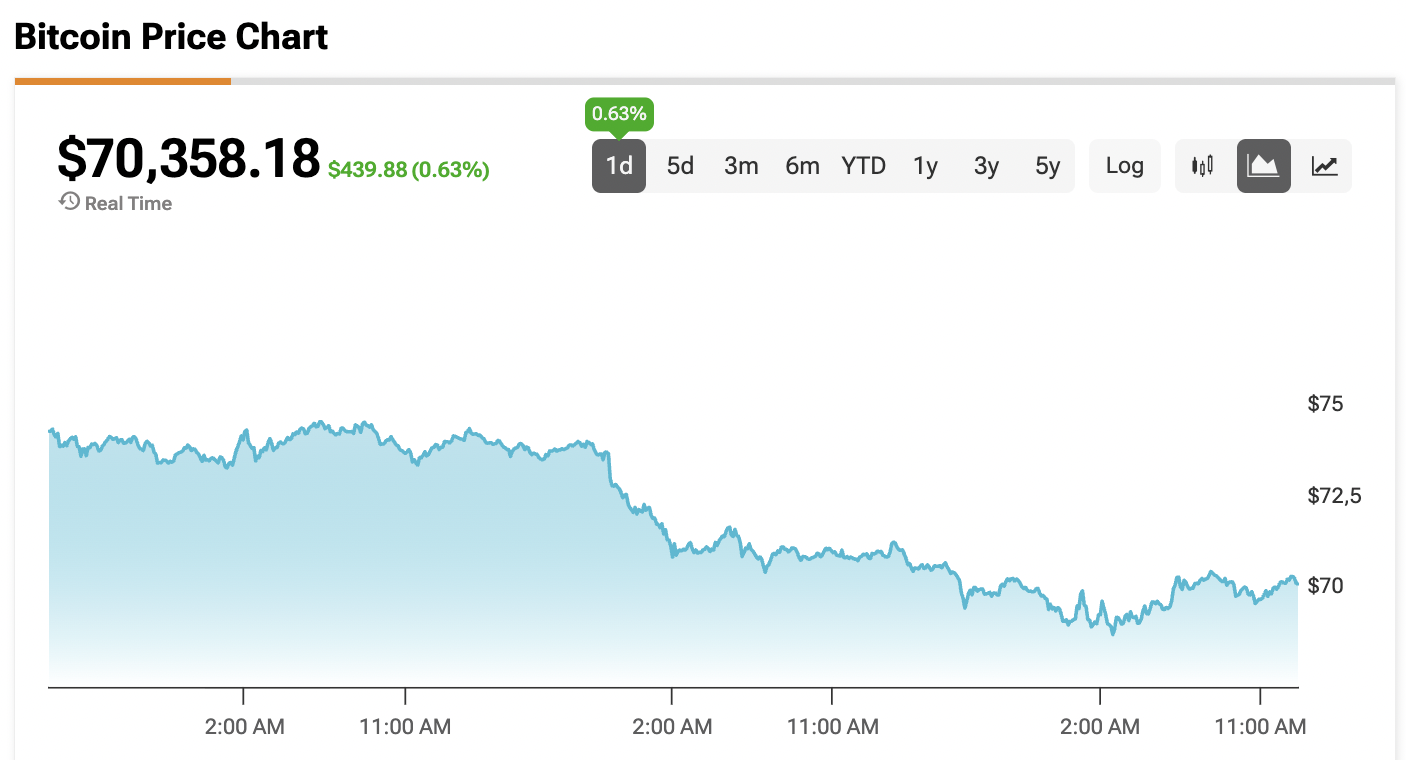
Bitcoin (BTC-USD) dipped below the $70,000 mark on Thursday, pulling back into a familiar trading range after briefly reaching highs above $76,000. This slide happens as investors face a mix of high oil prices, conflict in the Middle East, and a massive derivatives event in traditional finance known as “quadruple witching.” While the price action looks shaky, some analysts believe a specific chart pattern could still trigger a quick rebound.
Claim 70% Off TipRanks Premium
- Unlock hedge fund-level data and powerful investing tools for smarter, sharper decisions
- Stay ahead of the market with the latest news and analysis and maximize your portfolio's potential
Futures Selling and Stalling U.S. Demand Drive Prices Down
The recent drop aligns with a shift in how Bitcoin is being traded. Data shows that selling pressure is currently coming more from professional futures traders than from people buying the actual coins on exchanges. This is visible in the Coinbase premium gap, which turned negative, suggesting that demand from U.S. investors has cooled off.
Crypto analyst IT Tech pointed out a clear imbalance, noting that while spot selling fell by about $40 million, selling in the perpetual futures market dropped by a much larger $506.75 million. This indicates that traders using borrowed money (leverage) are the ones driving the current downward trend.
Historical Fractals Hint at Potential Rebound for BTC
Despite the drop, some traders see a bullish fractal forming. This is a pattern that looks like a previous market move. Specifically, Bitcoin is mimicking a correction from early March where the price fell to trap shorts before reversing higher.
If Bitcoin can quickly reclaim the $70,000 level, it may open a path back toward $76,000. However, the setup is time-sensitive. A drop below $68,300 could shift the focus toward lower support levels at $65,000 or even $62,000.
“Quadruple Witching” Adds to Market Stress
Adding to the uncertainty is a major event in traditional markets called “quadruple witching” on Friday. This happens four times a year when trillions of dollars in various stock and index derivatives expire at once. In 2025, Bitcoin often saw flat performance on these days followed by a week or two of price drops.
Cole Kennelly, CEO of Volmex Finance, warned that “quadruple witching could trigger a spike in cross-asset volatility as large derivatives positions expire.” This volatility often spills over from the stock market into crypto.
Outside of the charts, the war in Iran and rising energy costs are making investors nervous. With oil prices swinging toward $100 a barrel, there are fears that central banks will keep interest rates high. Wintermute trader Bryan Tan suggested that “being flat is a strong position” right now. He recommends that investors keep “dry powder” (cash) ready until the market shows a clearer direction.
At the time of writing, Bitcoin is sitting at $70,358.18.
Copyright © 2026, TipRanks. All rights reserved.
Disclaimer: The content of this article solely reflects the author's opinion and does not represent the platform in any capacity. This article is not intended to serve as a reference for making investment decisions.
You may also like
JPMorgan analyzes Applied (APLD.US): AI computing power business advancing rapidly, facing real-world challenges with billion-dollar financing
JPMorgan's Credit Research team has released a report providing a comprehensive analysis of company operations, project progress, financing pressures, and risks.

Crypto: Pump.fun Earns $18.6M Despite Memecoin Slump

Societe Generale's chief bear: The AI boom is replicating the Asian financial crisis, with the deadly “debt time bomb”
Société Générale Chief Strategist Edwards warns that the true trigger for the AI boom is not inadequate productivity, but whether cheap money can continue to flow. Overseas long-term government bond yields continue to rise, while AI giants are issuing large amounts of debt, with hundreds of billions of dollars in new bonds needing to be absorbed by the same group of buyers. This is reminiscent of the 1990s, when Asia maintained prosperity through short-term dollar borrowing.
Crypto prices
More


