
Bitcoin whales move millions as Iran war sends oil surging

Ancient Bitcoin holders moved tens of millions of dollars to exchanges as Bitcoin fell and energy prices jumped after attacks on Gulf oil and gas infrastructure deepened the conflict involving Iran, Israel and the United States.
Ancient whale “bc1ql” sent 1,000 Bitcoin (BTC), worth around $71 million at current prices, to Binance on Wednesday, according to blockchain data platform Arkham. The whale initially bought 5,000 BTC 13 years ago and still holds about 1,500 BTC worth about $106 million, according to blockchain analytics platform Onchain Lens.
The same day, one of the earliest Bitcoin holders, Owen Gunden, also transferred 650 BTC ($46 million) to crypto exchange Kraken, marking his first large sale in five months, when he sold a total of 11,000 BTC ($1.12 billion), according to analytics platform Lookonchain.
The transfers added to signs of profit-taking among some long-term holders as traders reacted to a broader risk-off move driven by the Middle East energy shock.
The whale movements follow reports of Israel striking Iran’s giant South Pars gasfield on Wednesday, after killing Iran’s intelligence minister, Esmail Khatib, the third senior Iranian figure assassinated over the past few days, the BBC reported. South Pars is part of the world’s largest natural gas field, with Qatar and Iran both operating facilities in the area.
After the strikes, Brent crude rose above $119 a barrel before easing to about $114.77, while WTI briefly touched $100 and later traded near $96.59, according to data from Trading Economics.
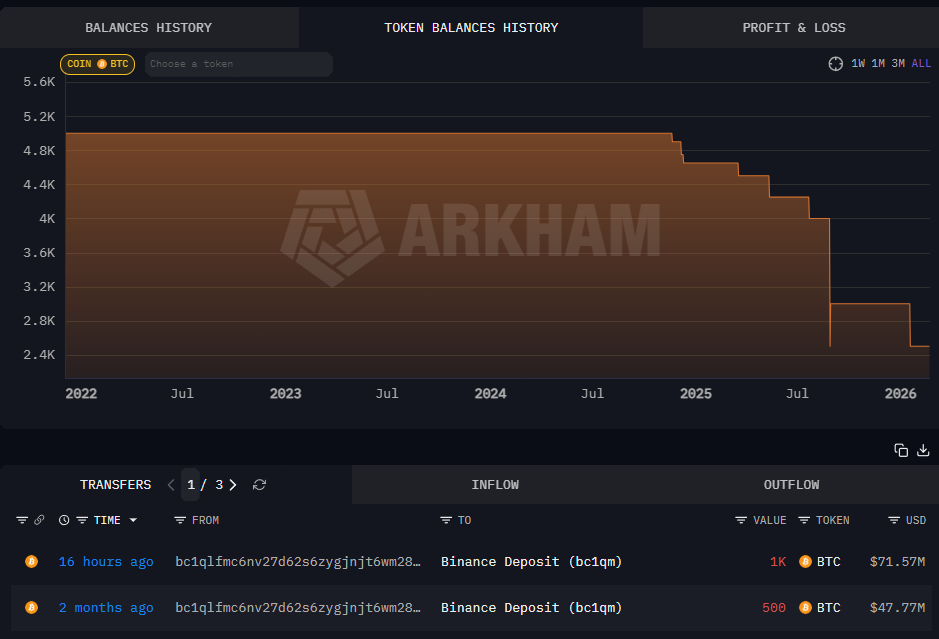 Ancient whale wallet “bc1ql,” token balance history, all-time chart. Source: Arkham
Wholesale gas prices in Europe and the UK also spiked after Iran attacked Qatar’s Ras Laffan natural gas complex on Wednesday and Thursday, reported news outlet Bloomberg.
Related: Binance says US midterms could boost Bitcoin and stocks
Bitcoin sell-off began after attack on Qatar gas complex
Bitcoin’s latest sell-off occurred shortly after Iran’s strike on Qatar’s energy infrastructure, according to Aurelie Barthere, principal research analyst at crypto intelligence platform Nansen.
“BTC began to sell off yesterday around noon CET, following the escalation of the war between Iran and Israel and the attack on gas infrastructure in Qatar, ” she told Cointelegraph, adding:
“If we fail to hold the $70K–$71K level, we could return to the previous range of approximately $60K–$71K.”
Bitcoin’s price fell 5% during the past 24 hours and was trading at $70,439 as of 10:15 a.m. in UTC, according to CoinMarketCap data.
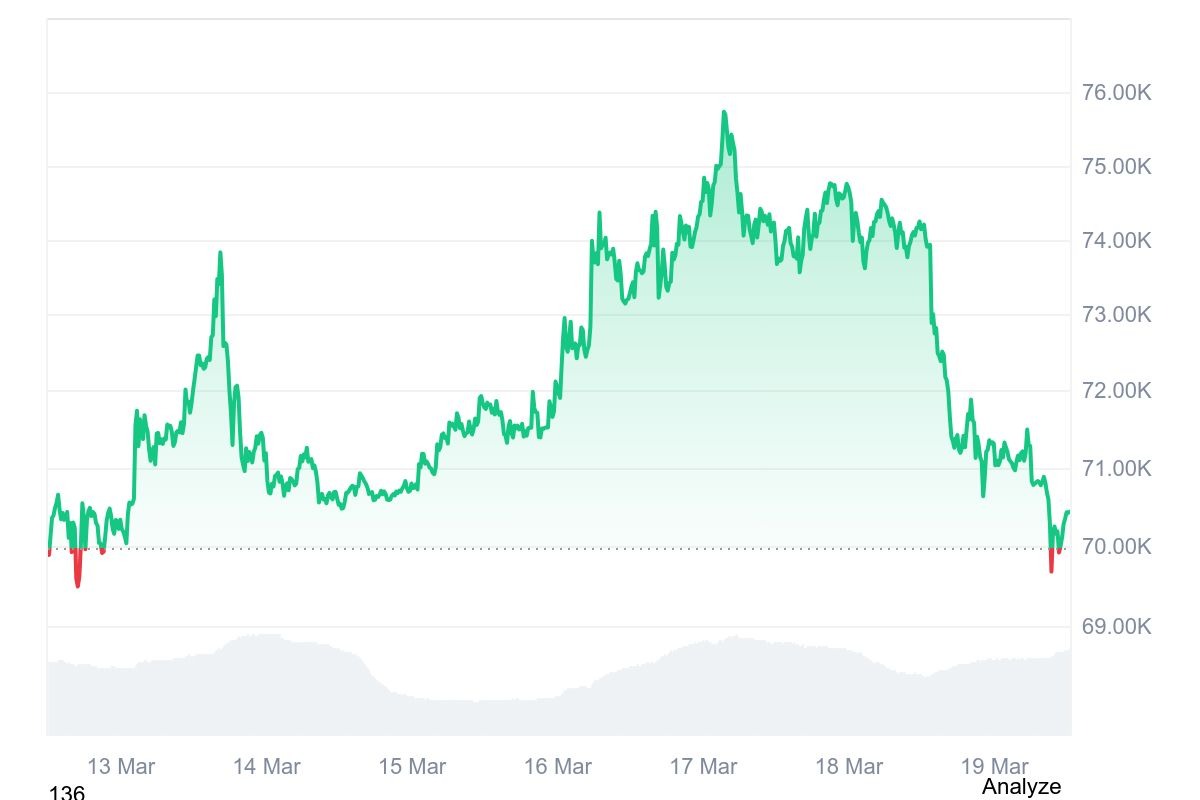 BTC/USD, 1-week chart. Source: CoinMarketCap
Bitcoin’s decline mirrored a 4.2% drop in gold prices over the past 24 hours, as the leading precious metal traded at $4,686 per oz on Thursday, according to goldprice data.
The simultaneous drop of the two assets suggests that investors are staging a “broader risk-off move” rather than a pivot to safe-haven assets, Alvin Kan, chief operating officer at Bitget Wallet, told Cointelegraph.
Magazine: Bitcoin’s ‘biggest bull catalyst’ would be Saylor’s liquidation — Santiment founder
Disclaimer: The content of this article solely reflects the author's opinion and does not represent the platform in any capacity. This article is not intended to serve as a reference for making investment decisions.
You may also like
VALERO ENERGY CORP <VLO.N>: JEFFERIES CUTS TARGET PRICE TO $394 FROM $401
VALERO ENERGY CORP : JEFFERIES CUTS TARGET PRICE TO $394 FROM $401
Gold prices rise Rs 1,500/10g; silver up Rs 3,100/kg ahead of US economic data, softer yields. Buy, sell or hold?
The Shopify Stock Rally Isn't Done: Chart of the Week -- Barrons.com
By Doug Busch Shopify is no longer a pandemic-era growth story that simply failed to slow down. It is compounding at a pace few software platforms its size still manage. In the second quarter of 2026, sales on its platform rose 32%. That was the fifth straight quarter of growth exceeding 30%. Merchants are also using more of Shopify's own tools, from payments to Shop Pay, and new channels like AI shopping agents are starting to increase demand. The simple bull case is that the stock already commands a huge share of independent online commerce, and that position should become more valuable as more buying moves through its checkout. A rule of market mechanics is that the vast majority of an individual security's gain is driven by its underlying sector. Within technology, software has staged a robust recovery, joining semiconductors to power the broader sector higher. The iShares Expanded Tech-Software Sector ETF has maintained an upward trajectory since its mid-April lows, though the advance from $74 to $112 has been choppy as bulls repeatedly stepped in to defend when necessary. Breadth across large-cap software has expanded significantly, with 24 constituents surging over 20% over the past three months. During that same three-month window, Shopify generated outstanding relative strength, advancing 36%, more than doubling the IGV's 17% gain over the same period. Expect the stock's outperformance to persist as software momentum broadens. Let's examine the daily and monthly charts to outline the technical drivers behind this thesis. Looking at the daily chart, the ratio chart against the IGV shows persistent outperformance extending back to mid-May. The stock is riding an eight-session winning streak, during which price action cleared a double-bottom-with-handle pivot at $151.39. Within this broader base, the stock recorded a bullish golden cross in late August and successfully filled its Sept. 10 price gap, tracing back to its Aug. 4 session, the day before a powerful earnings reaction sent the stock surging 17% hi
Crypto prices
More


