

Microsoft is threatening to sue two of the most valuable companies on the planet, Amazon and its own long standing partner Open, over a $50 billion cloud deal that may directly violate the exclusive AI hosting rights it spent $13 billion to secure. These are three of the largest tech companies with a combined market cap of $8 trillion in a standoff over who gets to run Artificial Intelligence at scale. The ramifications for the AI infra market are massive. However, there is an interesting thread running through it that the tech press have seemingly missed to capture.
The same week the dispute went public, BlackRock cemented itself as the world’s largest institutional holder of digital assets as they crossed $130 billion in crypto assets under management. The companies building AI and crypto infra do not function in separate worlds, they are the same companies, backed by the same institutional capital, sitting in the same allocation meetings. When you actually zoom out, the amount of capital flooding into AI and crypto tells a much more deeper story on where institutional allocation might be headed.
The $50 Billion Fight: Microsoft vs Amazon vs OpenAI
The dispute boils down to a contractual gray area. Under the partnership terms, Microsoft’s position is that their agreement requires OpenAI’s API products to run through Azure. OpenAI is pushing back, arguing that Frontier is a “non-API product” and therefore can be hosted elsewhere. Microsoft in return says this deal violates “the spirit, if not the letter” of what they agreed to.
Microsoft has invested over $13 billion into OpenAI since 2019, holds a 27% stake and signed $250 billion worth of Azure cloud contracts with. This alignment is beginning to crack. Microsoft CEO, Satya Nadella, has already indicated that the company is “doubling down” on their own models.
The broader picture makes this messier as well. Anthropic is quickly closing the gap with OpenAI, now sitting at an enterprise revenue of $19 billion versus OpenAI’s $25 billion. A gap that has termed “a wake-up call” for OpenAI. When three of the world’s largest tech companies are in a legal battle on who controls the AI’s infra layer, it sends a strong signal that centralized AI is moving toward a monopoly battleground.
BlackRock’s $130 Billion Crypto Empire: Built the Same Week
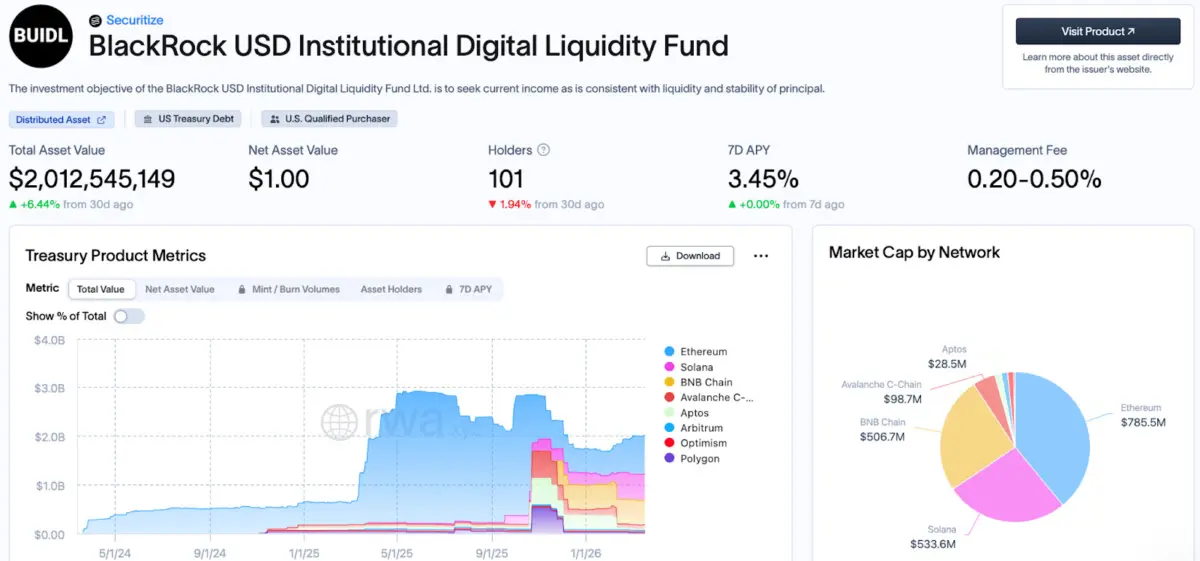
As the dispute over AI infrastructure takes place, at the very same time, BlackRock is building something just as consequential on the other side of the track. The largest asset manager in the world is now handling around $130 billion across crypto ETFs and on-chain financial infrastructure. The breakdown tells the story. The largest Bitcoin ETF, IBIT, holds 786,329 BTC with over $65 billion in AUM. Their Ethereum position sits at $6.8 billion. BUIDL, their tokenized U.S. Treasury fund, their tokenized U.S. treasury fund now sits at $2.01 Billion making it the largest on-chain Treasury product in existence.
On top of this, on March 12, BlackRock launched ETHB on Nasdaq, a staked Ethereum ETF that debuted with $107 million in seed assets, 80% of the ETH already staked on-chain earning a 3.1% annual yield paid out monthly, at a fee of 0.25% discounted to 0.12% on the first $2.5 billion. BlackRock’s global head of digital assets, Robert Mitchnick stated that ETHB provides investors “with an important new avenue to participate in the ecosystem’s evolution” while earning staking rewards.
The inflow data over the past week adds another layer. Between March 9 to 17, data from Farside Investors shows that BTC ETFs saw seven consecutive days of inflows that totalled to $1.168. Alongside this, we also saw the SEC and CFTC sign a joint memorandum establishing the first unified regulatory framework for digital assets in the U.S.
The takeaway therefore is very hard to look past. The regulatory backdrop in the U.S. is moving favourably and quickly all while crypto ETF adoption continues to accelerate. BlackRock isn’t allocating to crypto as a trade. It is actively building the financial infrastructure layer of it.
The Convergence: Same Capital, Same Committees, Same Thesis
The overlap is hard to ignore, even if it’s not perfectly traceable at the portfolio level. BlackRock is one of the largest institutional shareholders of both Microsoft and Amazon, the same firm in the middle of the AI infrastructure dispute is simultaneously building the world’s largest crypto stack. At the same time, the underlying rails are already intertwined. Microsoft runs Azure blockchain services, Amazon’s AWS already hosts Ethereum nodes, DeFi backends and exchange matching engines, and OpenAI’s agent platforms are increasingly interfacing with crypto-adjacent infrastructure. The institutional thesis running underneath all of this is that AI and crypto are not competing bets, they are complementary asymmetric plays sitting in the same portfolios.
The numbers that came out this week alone makes that hard to dismiss. Within the same seven day timeframe, NVIDIA projected $1 trillion in AI purchase orders and BlackRock crossed $130 billion in crypto AUM, both driven by the same global capital base.
The fracturing of centralized AI infrastructure also strengthens the crypto case in a way that does not get discussed enough. When three of the world’s largest tech companies cannot agree on who gets to control the AI infra layer, the permissionless nature of crypto starts to become a lot more attractive. No exclusive deals, no legal disputes on who gets to control what. Bitcoin at the low $70s post-FOMC is sitting at a level where the same institutions driving AI infrastructure demand are still accumulating BTC through ETFs at roughly $160 million per day. Whether that convergence is the primary driver is difficult to prove at the portfolio manager level, but directionally, the capital flows point in one direction.
What This Means for Bitcoin and What to Watch
Bitcoin is currently trading at the low $70K region, down approximately 2% since the FOMC yesterday. So far, the typical 48-hour window where BTC dips after the FOMC is playing out like clockwork. That dip window between March 19-20 is now active and historically this timeframe is where volatility has compressed before the directional move. If the recent demand in Bitcoin ETFs continues, this dip could very well be absorbed fast.
Beyond flows, there are two structural catalysts to watch. First, the Microsoft–OpenAI–Amazon dispute: if it resolves quietly, the AI narrative shifts back to execution; if it escalates into a prolonged legal battle, it reinforces a core crypto value proposition, no gatekeepers, no exclusivity, no dependency on a single platform. Second, the regulatory backdrop is quietly improving, with the recent SEC–CFTC coordination framework laying early groundwork for clearer rules around staking, tokenized securities, and DeFi, potentially unlocking the next wave of institutional products. Stepping back, the bigger question for Q2 2026 is no longer “AI or crypto?” but “how much of each?” The same institutions driving trillion-dollar AI capex cycles are still allocating aggressively into digital assets.


