
The "Gas Rush" intensifies: Europe and Asia bidding up TTF and JKM—why has natural gas become the king of energy price elasticity?

I. What Happened? Paralysis at the Strait of Hormuz and Drastic Fluctuations in Global Natural Gas Prices
1. Intense Price Volatility: The Surge in TTF and JKM
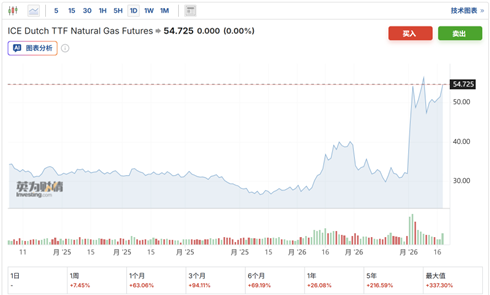
After the outbreak of conflict, global benchmark natural gas prices soared rapidly. The Dutch TTF (Title Transfer Facility), Europe’s benchmark natural gas futures contract, saw a significant spike in a short period. Data shows that TTF prices surged from about €30 per megawatt-hour (or $10.6/million Btu) before the conflict to nearly €60 per megawatt-hour at their peak (about $18.8–19.1/million Btu), an approximate increase of 90%. At the same time, Northeast Asia’s spot LNG delivered price (JKM) also skyrocketed from about $10.5–12/million Btu to $18–26.1/million Btu, a surge of 69% to 148%.
2. The Underlying Cause of the Price Surge: Physical Disruption of Core Supply Chains
The main driving force behind this round of natural gas price hikes is the expected physical disruption of the global LNG supply chain. The Strait of Hormuz is an absolute hub for global LNG trade, handling about 20% of all seaborne LNG volume worldwide.
Even more critical is that for Qatar, one of the world’s largest LNG exporters, over 70% of its LNG exports must pass through this strait, with no alternative maritime route available. In 2025, Qatar’s LNG exports are expected to reach about 82 million tons (roughly 106 billion cubic meters), accounting for nearly 20% of global LNG trade volume.
……
Disclaimer: The content of this article solely reflects the author's opinion and does not represent the platform in any capacity. This article is not intended to serve as a reference for making investment decisions.
You may also like
Tokenized Commodity Adoption Accelerates as Holders Climb Past 450K
AI wants money, and Western governments want money too! The global "capital battle" has begun, and the bond storm has "just started"
AI infrastructure development and government fiscal deficits are both competing for the world's limited capital. The five largest AI data center operators in the US have issued about $220 billion in bonds so far this year, while the US fiscal deficit has surpassed $1.99 trillion. The combined massive financing demand from these two sectors is driving a systemic rise in global capital costs. The financing costs for lower-rated borrowers are approaching double digits, and the credit market is beginning to stratify in terms of allocation. European bank stocks have plummeted, and French assets are also being repriced. This "great capital tightening" may first impact capital markets, and subsequently deal a severe blow to the real economy.
The chill persists in US aerospace and defense stocks! JPMorgan warns: Defense budget outlook dims, aviation demand cools, strong Q3 results may not reverse the downward trend.
JPMorgan believes that aerospace and defense companies are about to face a challenging third-quarter earnings season.
Crypto prices
More


