
Bitcoin inflows to exchanges spike as BTC hits resistance at $75K

Centralized crypto exchanges recorded a spike in Bitcoin hourly inflows on Monday as the crypto market rallied, with one analyst warning it could signal selling pressure.
Hourly Bitcoin flows into exchanges spiked to 6,100 BTC on March 16, the highest since Feb. 20, reported head of research at CryptoQuant, Julio Moreno, on Tuesday.
He added that the share of large inflows reached 63% of total inflows, which is the highest since mid-October 2025.
It comes as Bitcoin has rallied around 12% so far this month, hitting a six-week high of around $76,000 on March 17.
Traders often send Bitcoin (BTC) to exchanges in preparation to sell or exchange for stablecoins.
“Historically, spikes in large deposits to exchanges have been associated with increased selling pressure,” the analyst noted.
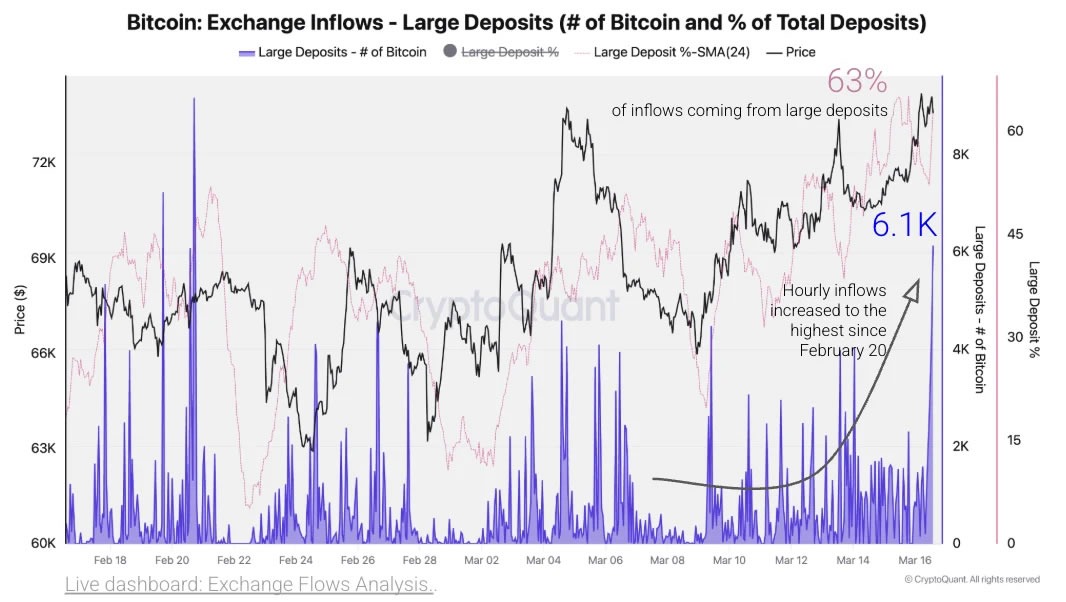 Bitcoin exchange flows have spiked this week. Source:
CryptoQuant
Bitcoin exchange flows have spiked this week. Source:
CryptoQuant
Fed may signal no rate cuts this year
The spike in exchange inflows comes just days before the Federal Reserve’s meeting and rate decision on Wednesday, which can have an impact on crypto sentiment.
However, markets have priced in no changes to the US interest rate this month, with CME futures predicting a 98.9% probability of them remaining the same and only a 1.1% chance that they will be increased.
The Fed could even signal no interest rate cuts at all this year in the wake of the US-Iran war and increasing inflation concerns, reported the Associated Press on Wednesday.
Bitcoin realized price resistance at $75,000
Moreno also noted that if Bitcoin continues to rally, it could first find resistance at $75,000.
“These levels represent the lower band of the traders’ onchain Realized Price, which historically acts as price resistance in bear markets,” he said.
The asset came just shy of $75,000 three times on Coinbase over the past 24 hours and hit resistance each time, according to TradingView.
The actual Realized Price, or the average break-even price for active traders, which acted as resistance in October and January, is currently around $84,700.
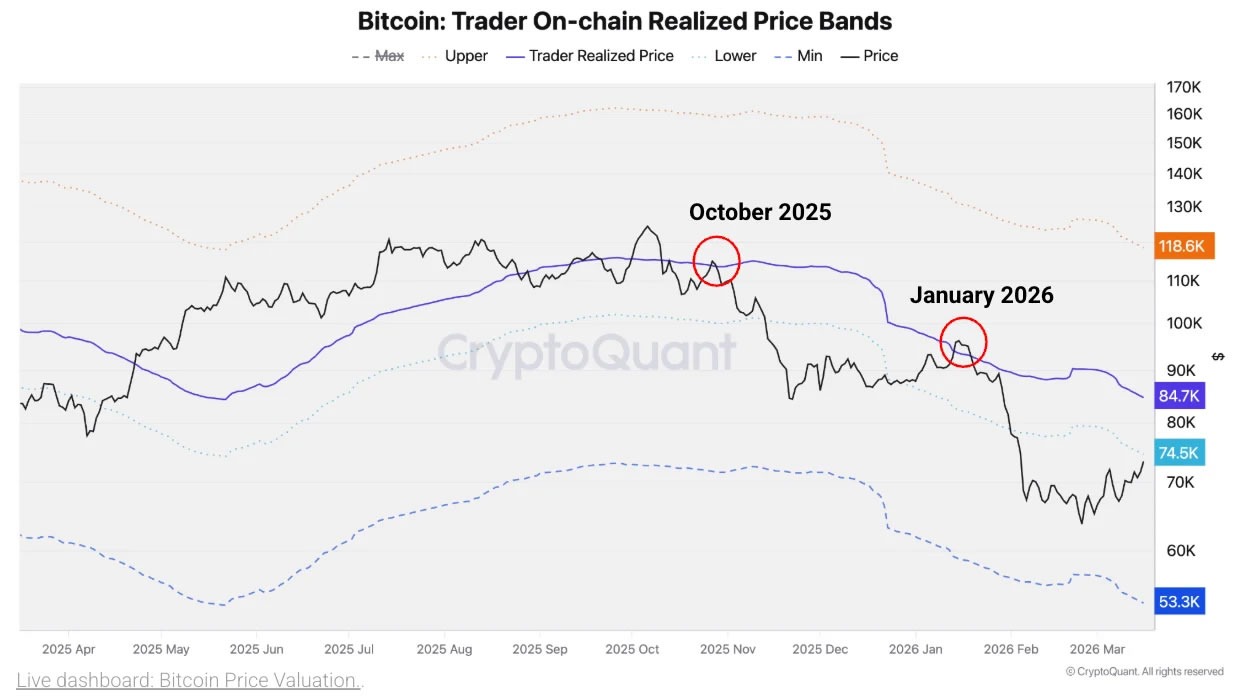 Bitcoin is facing resistance at the lower band of the onchain RP. Source:
CryptoQuant
Bitcoin is facing resistance at the lower band of the onchain RP. Source:
CryptoQuant
Disclaimer: The content of this article solely reflects the author's opinion and does not represent the platform in any capacity. This article is not intended to serve as a reference for making investment decisions.
You may also like
U.S. budget deficit soars to nearly $2 trillion, exceeding 6% of GDP; high interest rates and tax cuts further worsen the deficit
The US budget deficit for fiscal year 2026 has risen to $1.993 trillion, a year-on-year increase of 12%, marking the highest level since 2021 and projected to account for over 6% of GDP. High interest rates have pushed net interest payments to over $1.1 trillion, accounting for more than half of the deficit increase; lower-than-expected tax and tariff revenues have further worsened the financial shortfall. With just weeks left before the midterm elections, neither party intends to implement substantial fiscal consolidation, and the deficit outlook is highly dependent on the election results.
To deliver computing power, Oracle uses trucks to transport natural gas to power its data centers
To address pipeline delays in AI data center construction, Oracle has adopted an unconventional energy supply method by transporting compressed natural gas via trucks, which has already been implemented in Utah and Texas, and is also being considered for the "Project Jupiter" in New Mexico. However, this solution costs four times as much as pipeline natural gas and is limited in scale, covering only a small fraction of the project's total capacity.
Aptos insider vesting ends, cutting APT unlocks by 60%
US Treasury yields soar to a 24-year high; US Treasury advisors expect future declines as AI investments and energy shocks drive up borrowing costs
David Zervos, senior advisor to U.S. Treasury Secretary Yellen and a veteran Wall Street professional, stated on Thursday that despite the recent surge in U.S. Treasury yields to their highest levels in decades, the current real yields are significantly elevated compared to historical levels, suggesting room for a decline in the future.
Crypto prices
More


