
The stock market plunge is not pricing in stagflation! HSBC in-depth analysis: the market is pricing in recession risks, but currently there are structural misalignments and overselling.

According to Zhihui Finance, since the US and Israel launched strikes against Iran, global stock markets have fallen by 5%. Analysts at HSBC believe that from a macroeconomic driver perspective, this decline is “basically justified.” However, the bank pointed out in a research report that “there are significant structural dislocations beneath the surface of the market,” and that many national stock markets have been oversold relative to their fundamentals.
HSBC's model indicates that the recent market rotation “reflects more of the market pricing in recession risk, rather than stagflation risk.” Currently, the probability of an economic recession has climbed sharply to 35%, up from 10% two weeks ago.
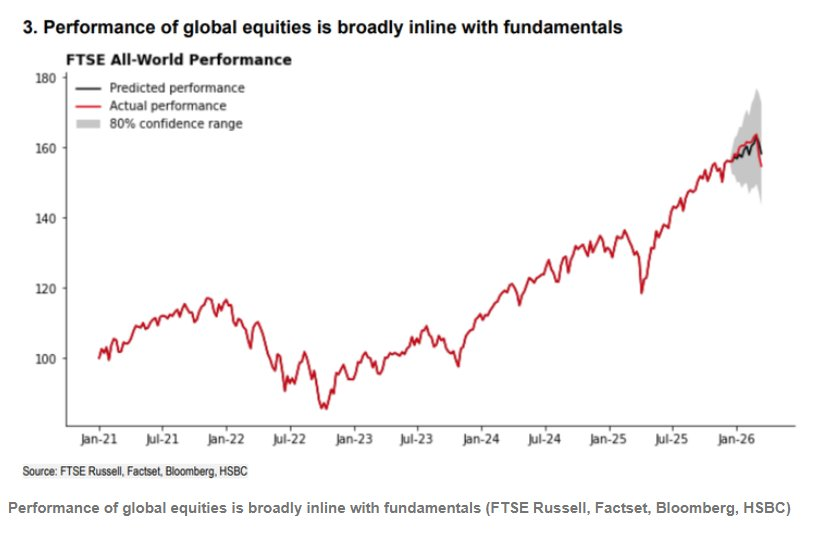
Alastair Pinder, Head of Emerging Markets and Global Equity Strategy at HSBC Global Research, stated that the market-implied probability of stagflation has barely changed, remaining at just 8%. Data from the bank shows that this shift is highly consistent with the 9% underperformance of cyclical sectors relative to defensive sectors since mid-February.
Pinder added that the “largest physical supply disruption in the history of the oil market” caused by a substantive shutdown of the Strait of Hormuz, has become a major pressure point for stock markets.
According to sensitivity analysis of stock market returns to oil price shocks, if supply bottlenecks continue to push oil prices higher, European markets such as Germany, the Netherlands, Belgium, and France may underperform, while markets with higher energy weightings such as Norway, Saudi Arabia, the UK, Canada, and Brazil are expected to show greater resilience.
HSBC’s research also found that some emerging markets have suffered “unjustified” sell-offs during this round of volatility: South Korea, South Africa, and Indonesia have been oversold by 5-10%.
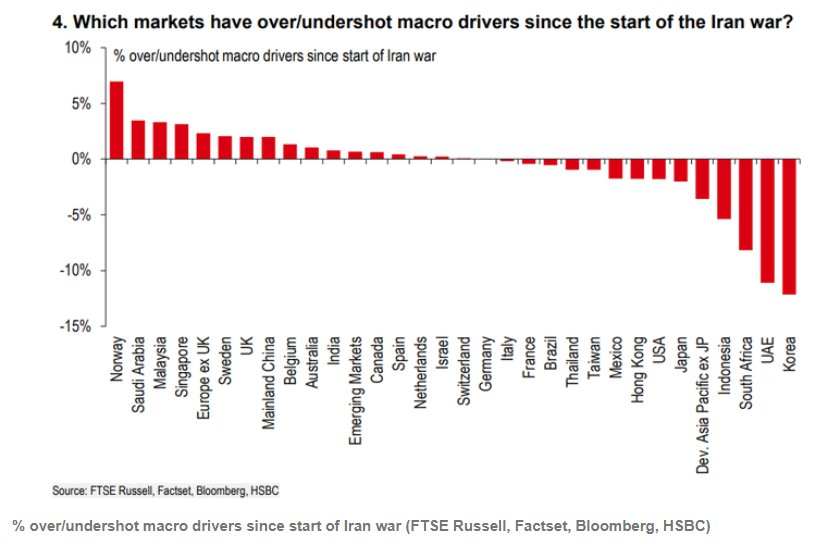
Strategists pointed out that valuations in these markets are showing “increasingly significant attractiveness,” especially since analysis shows these countries have relatively limited exposure to rising oil prices.
The research team also noted that of the UAE market's 23% decline, about 10% cannot be explained by fundamentals—though this gap may reflect the current geopolitical risk premium embedded in the market.
For investors seeking to adjust their holdings, HSBC recommends focusing on materials, industrials, and financials, believing that these areas have advantages in the current environment.
The bank suggests that investors should “give priority to cyclical sectors that can remain resilient in a stagflationary environment,” and based on its stagflation defense ratings, highlights metals & mining, industrials, and banks as key subsectors.
Disclaimer: The content of this article solely reflects the author's opinion and does not represent the platform in any capacity. This article is not intended to serve as a reference for making investment decisions.
You may also like
Natural gas pipeline delays threaten the progress of AI data center projects! Oracle (ORCL.US) resorts to the "trucking gas" strategy to ensure power supply
Oracle (ORCL.US) is adopting a novel power supply strategy—transporting natural gas directly to server campuses by truck—to ensure that multiple data center projects progress as planned.
U.S. budget deficit soars to nearly $2 trillion, exceeding 6% of GDP; high interest rates and tax cuts further worsen the deficit
The US budget deficit for fiscal year 2026 has risen to $1.993 trillion, a year-on-year increase of 12%, marking the highest level since 2021 and projected to account for over 6% of GDP. High interest rates have pushed net interest payments to over $1.1 trillion, accounting for more than half of the deficit increase; lower-than-expected tax and tariff revenues have further worsened the financial shortfall. With just weeks left before the midterm elections, neither party intends to implement substantial fiscal consolidation, and the deficit outlook is highly dependent on the election results.
To deliver computing power, Oracle uses trucks to transport natural gas to power its data centers
To address pipeline delays in AI data center construction, Oracle has adopted an unconventional energy supply method by transporting compressed natural gas via trucks, which has already been implemented in Utah and Texas, and is also being considered for the "Project Jupiter" in New Mexico. However, this solution costs four times as much as pipeline natural gas and is limited in scale, covering only a small fraction of the project's total capacity.
Aptos insider vesting ends, cutting APT unlocks by 60%
Crypto prices
More


