
It would take an internet apocalypse to stop Bitcoin

Imagine a world where Internet connections collapse one after another. In this chaos, a study by the Cambridge Centre for Alternative Finance shows that Bitcoin would stand firm even if 72% of submarine cables were to break. How is this possible?
In brief
- Bitcoin would withstand a failure of 72% of submarine cables, proving exceptional resilience to internet disruptions.
- Thanks to its decentralization, 64% of Bitcoin nodes are invisible and protected, limiting the impact of targeted attacks or massive failures.
- Cable failures neither affect the stability nor the price of bitcoin, with a near-zero correlation, strengthening its credibility.
72% of submarine cables down? No reason to worry about Bitcoin
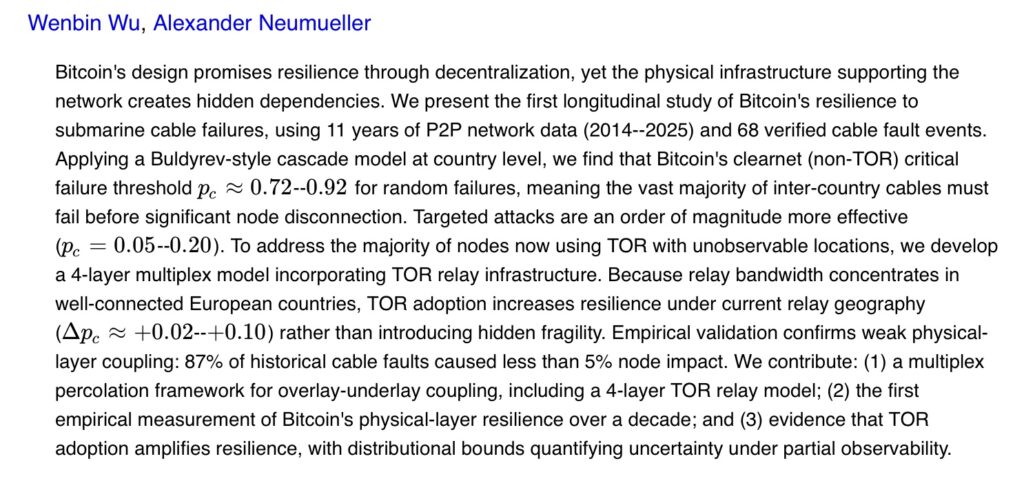
Researchers Wenbin Wu and Alexander Neumueller analyzed 68 historical submarine cable outage events. Their conclusion is clear: 72% to 92% of these infrastructures would need to fail to significantly disrupt the Bitcoin network. A threshold well beyond usual catastrophic scenarios.
 Wu and Neumueller analyze Bitcoin disruption levels.
This resilience is explained by the network’s decentralization. Unlike traditional banking systems, Bitcoin doesn’t depend on a central point. Indeed, each network node acts as an independent guardian, able to maintain transactions even during major disruptions.
An architecture that reassures investors seeking stability and the data speaks for itself. 87% of past outages had an impact of less than 5% on Bitcoin nodes. Further proof that the crypto queen is designed to withstand digital storms.
Why internet outages do not affect the price of bitcoin
Contrary to expectations, submarine cable outages have almost no impact on BTC’s price. The researchers calculated a correlation coefficient of -0.02, proving there is no link between these events and bitcoin fluctuations. An independence explained by the decentralized nature of the blockchain.
Moreover, compensation mechanisms built into the network automatically redirect transactions to operational nodes. Thus, even in the event of a major disruption, the market remains stable. A feature that reassures and strengthens bitcoin’s credibility as a safe haven asset.
However, despite its robustness, Bitcoin is not completely immune. Indeed, targeted attacks on “chokepoints” (submarine cable concentration points) could theoretically threaten the network. Researchers estimate a critical failure threshold of 0.05 to 0.20 would be enough to cause localized disruptions.
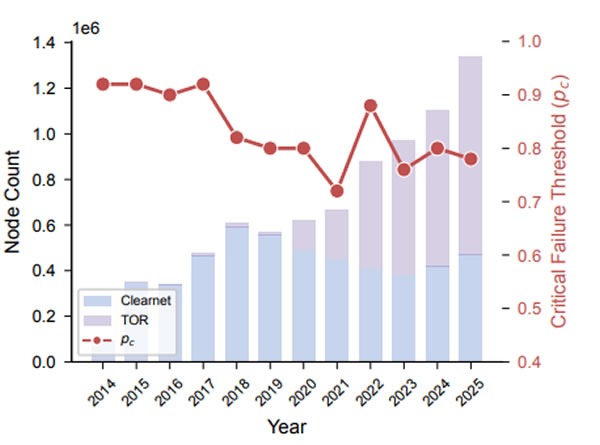 Critical level for Bitcoin.
Bitcoin proves once again that it is much more than just a crypto: it is an infrastructure designed to withstand the worst crises. With 72% of submarine cables needing to fail to impact it, BTC positions itself as a must-have asset for investors seeking stability.
Maximize your Cointribune experience with our "Read to Earn" program! For every article you read, earn points and access exclusive rewards. Sign up now and start earning benefits.
Disclaimer: The content of this article solely reflects the author's opinion and does not represent the platform in any capacity. This article is not intended to serve as a reference for making investment decisions.
You may also like
NASDAQ TRADE HALT <RIBBU.O> VOLATILITY TRADING PAUSE AT 12:14 PM
NASDAQ TRADE HALT VOLATILITY TRADING PAUSE AT 12:14 PM
Siebert CIO Says Micron Stock Is a Buy, Just Not Forever
Magna International Inc. Price Target Cut to $77.00/Share From $80.00 by TD
Ratings actions from Baystreet: http://www.baystreet.ca (END) Dow Jones Newswires October 08, 2026 11:09 ET (15:09 GMT)
Dow Jones Top Financial Services Headlines at 11 AM ET: Q&A: Bitcoin Funds Are Expanding. HANetf's Co-CEO Explains Why | Global ...
Q&A: Bitcoin Funds Are Expanding. HANetf's Co-CEO Explains Why Last week, London-based HANetf, an exchange-traded fund provider, launched the world's first euro-hedged bitcoin ETC-noting a shift in demand among its European client base. ---- Global Bond Turmoil Reveals the Surprising Resilience of Emerging Markets "It's very clear that EM is behaving differently than in the past, and EM is holding up better than expected." ---- U.K. Regulators Ready Green Light for $4 Billion ATM Tie-Up Between Brink's, NCR Atleos Authorities said the offer to sell off some parts of Brink's business should address concerns over the ATM operator's planned acquisition of its rival. ---- Choosing the Right Bond Strategy for Today's High-Yield World Before chasing higher rates, bond buyers have to figure out what type of investor they actually are. ---- Fed's Waller Sees Multiple Rate Increases Ahead to Cool Inflation In prepared remarks at the Istanbul Economic Forum, Christopher Waller said the economic data underscoring the need for interest-rate increases hasn't shifted much. ---- Financial Services Roundup: Market Talk Find insight on ABN Amro Bank, Standard Life and more in the latest Market Talks covering financial services. ---- Wells Fargo Faces Regulator Probe Over Efforts to Boost Black Homeownership Trump's Housing and Urban Development is seeking to crack down on race-based lending, calling it a potential violation of the Fair Housing Act. ---- Ripple, Crypto's Payments Giant, Breaks Into Wall Street The crypto firm is emerging as a serious player in financing leveraged ETFs, a lucrative business long dominated by big banks. ---- Venture Firm Behind Chip Startup Groq Targets $10 Billion Megafund Winning bets on hot AI startups are vaulting a little-known Dallas firm into a small group of firms raising gigantic funds. ---- How one trend-following fund outperformed rivals by bringing humans back into the decision-making process One trend-following fund has outperformed rivals this year by deciding to take profits. ---- Wal
Crypto prices
More


